Overview
Green sits in the middle of the rainbow, between yellow and blue. The word shares its roots with grass and grow.
Screen green and CSS green are not the same. Full-strength green light, #00FF00, is what CSS calls lime. The CSS keyword green is the darker #008000.
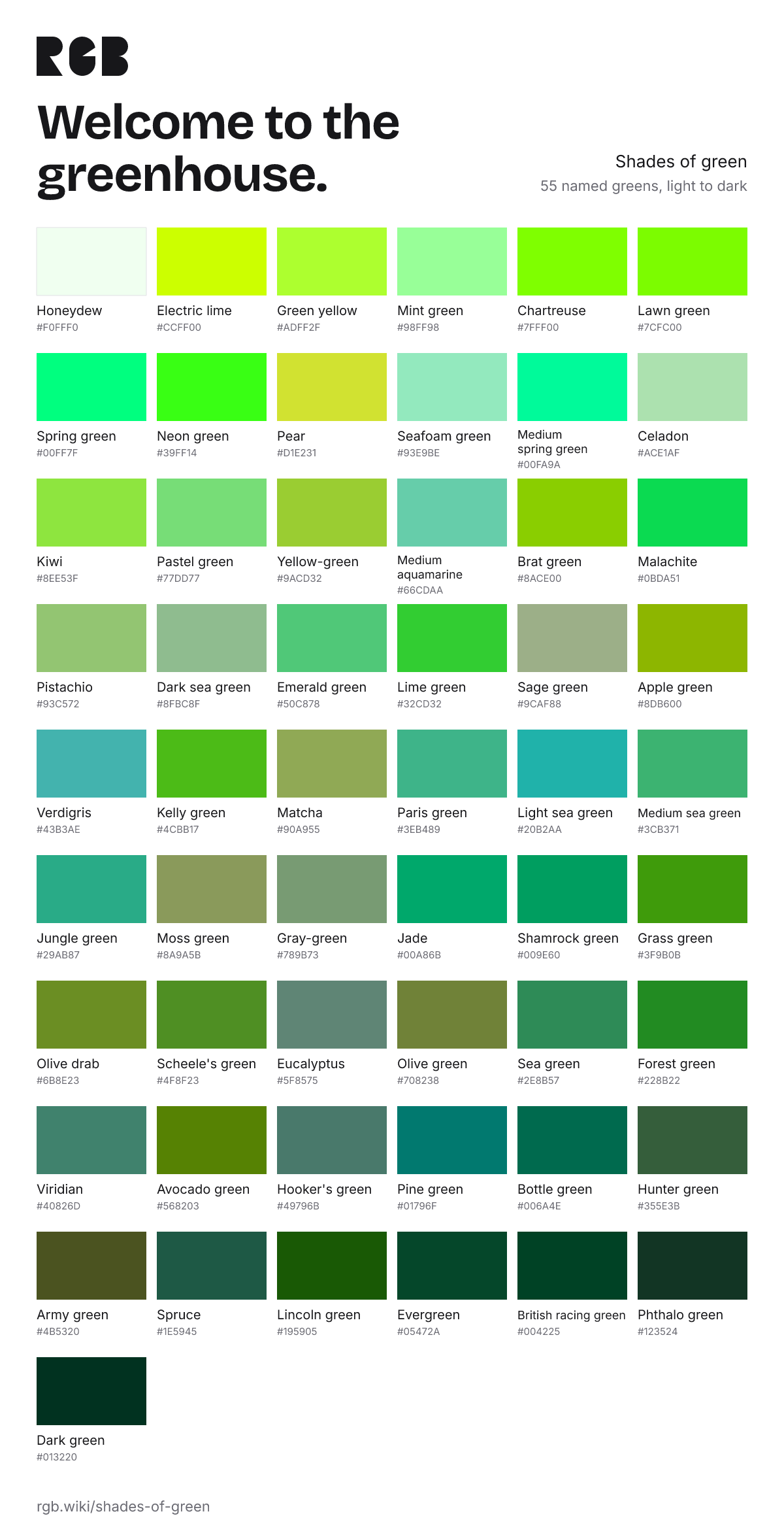
Named greens lean one way or the other: toward yellow, like chartreuse and lime green, or toward blue, like jade and seafoam green. Muted greens such as sage green and olive green are softened with gray or brown.
| HEX | #008000 | |
|---|---|---|
| RGB | rgb(0, 128, 0) | |
| HSL | hsl(120, 100%, 25%) | |
| HSV | 120°, 100%, 50% | |
| CMYK | 100, 0, 100, 50 | |
| OKLCH | oklch(52.0% 0.177 142.5) |
Types of green
Light and pastel greens
Green with plenty of white: honeydew, mint green, celadon, seafoam green and pastel green.
Bright and yellow-greens
Vivid greens, many leaning toward yellow: chartreuse, neon green, lime green, Kelly green and apple green.
Muted greens
Greens softened with gray or brown: sage green, matcha, moss green, eucalyptus and olive green.
Blue-greens
Greens that lean toward blue: verdigris, emerald green, jade, viridian and pine green.
Dark greens
The deepest greens: forest green, hunter green, British racing green, evergreen and dark green.
Greens from pigments
Scheele’s green and Paris green, arsenic greens once used in wallpaper, and phthalo green, a modern synthetic pigment.
Light, dark and other greens
Plain names like these have no single official code. Each card shows a typical value; click it to copy.
All 55 greens, light to dark