Blues are the best-liked colors
Tested on blue onlyIn lab studies, people’s color preferences peak at blue. One explanation is that blues remind us of things we like, such as clear skies and clean water. Indigo was not tested by name.1
A deep blue-violet named after one of the oldest dyes in the world.
Indigo is a deep color between blue and violet. Its standard code online is #4B0082, the CSS color named indigo: a little red, no green and about half-strength blue, which makes it look more purple than blue.
The name comes from indigo dye, which colored the oldest known blue cloth and still colors blue jeans. The word goes back to the Greek for “Indian”, because the dye reached Europe from India. Cloth dyed with real indigo is a dark navy blue, nothing like the web code.
That gap has a simple cause. When programmers drew up a list of color names for computer screens in the 1980s, they gave “indigo” to a dark purple. Web browsers inherited the list, so #4B0082 became the indigo most people meet online.
Indigo is also the odd one out in the rainbow. Isaac Newton counted it as one of seven colors in the spectrum, between blue and violet, but later writers have argued that his indigo was simply what we now call blue.
| HEX | #4B0082 | |
|---|---|---|
| RGB | rgb(75, 0, 130) | |
| HSL | hsl(275, 100%, 25%) | |
| HSV | 275°, 100%, 51% | |
| CMYK | 42, 100, 0, 49 | |
| OKLCH | oklch(33.9% 0.179 301.7) |
People’s average “indigo” in the xkcd survey (#380282) is close to the web code, only bluer. Cloth dyed with real indigo is far darker and bluer, beyond the left edge of this view. The outline is an approximate range, not a measured one.
Tints with white
Shades with black
Tones with gray
Pairings that work in rooms, outfits and interfaces.
Rich and regal. Works for invitations, packaging and night themes.
The web’s indigo next to the blues the dye really makes.
Warm against cool, with high contrast. Let saffron be the accent.
Soft contrast. Good for beauty and wellness brands.
Cool and modern. Strong for tech and apps.
Quiet and polished. Works for finance and evening wear.
Pick a palette to see where its colors sit on the color wheel. The caret marks indigo. Tap a band to copy its code.
Lined up by hue around indigo. Hover a color to see how similar it is.The bar under each name shows how similar it is. Similarity comes from the distance between the two colors in OKLab, a model of how we see color.
Indigo carries two sets of associations. As a dye, it means denim, work clothes and hand-dyed cloth from West Africa to Japan, and it has a dark history as a plantation crop. As a screen color, it reads as deep, nocturnal and a little mystical, the space between blue and purple. Studies of color and emotion test basic words like “blue” and “purple”, not indigo itself, so most of what is said about indigo’s mood is convention.
In lab studies, people’s color preferences peak at blue. One explanation is that blues remind us of things we like, such as clear skies and clean water. Indigo was not tested by name.1
In a 1994 study with color chips, darker colors were rated as more dominant and less pleasant than lighter ones. That fits indigo’s serious, nighttime feel, but the study used basic color samples, not indigo.2
In colonial South Carolina, indigo was grown for export from 1747 to 1800, second only to rice in value, and it was tended by enslaved people. In British India, tenant farmers were forced to grow it as a condition of their tenancy.3, 4
Indigo was a dye for thousands of years before it was a color name. Its story runs from ancient Peru to a Nobel Prize, a farmers’ revolt and the jeans in your closet.
Cotton cloth from Huaca Prieta in Peru is dyed with indigo, the oldest known use of the dye anywhere.1
Indigo appears in Egypt, its earliest known use in the Old World.1
First known use of the word “indigo” in English, for the dye.2
Isaac Newton’s Opticks lists the colors of the spectrum as “red, orange, yellow, green, blue, indigo, deep violet”.3
Tailor Jacob Davis and Levi Strauss & Co. patent riveted pockets for work pants, the start of blue jeans.4
Adolf von Baeyer first makes indigo in the lab. He later wins the 1905 Nobel Prize in Chemistry for his work on dyes.5, 6
The German firm BASF puts synthetic indigo on the market, and plant indigo begins its decline.5
Gandhi’s first campaign of civil resistance in India, in Champaran, backs farmers forced to grow indigo for almost no pay.7
A list of color names for computer screens gives “indigo” to a dark purple, #4B0082. Web browsers later adopt it.8
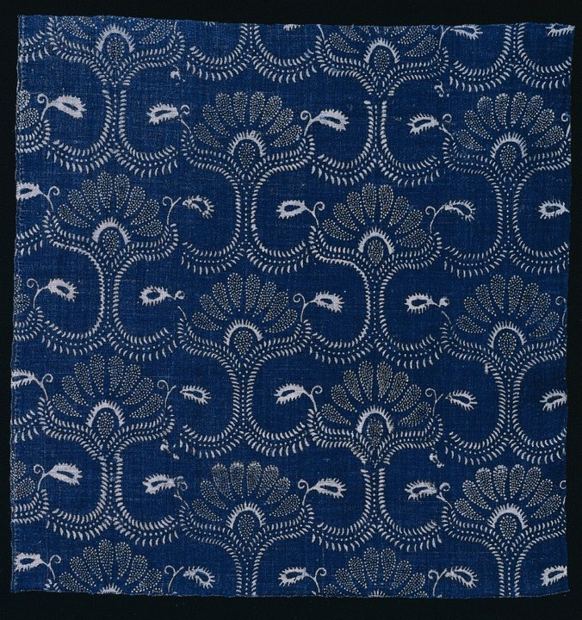
A length of French cotton printed with a resist and dyed in indigo, now at the Cleveland Museum of Art. This is what indigo looks like on cloth: a deep navy, far from the purple web code.
Sampled from the Cleveland Museum of Art’s photograph (1935.113), released as CC0 (public domain). Colors in a photo shift with the lighting, so read the codes as close, not exact.
FedEx purple, #4D148C, is a little lighter and a touch bluer than this page’s code. It colors the “Fed” of the logo.
Codes from the tokens “color-fedex-purple” and “color-fedex-orange” in the style sheet of the FedEx newsroom, read on November 18, 2026.

stc’s purple, #4F008C, is a shade lighter than this page’s code. The Saudi telecom company sets its lowercase wordmark in it.
The purple is the fill in the logo served inline on stc.com.sa. The logo shown is that file.
Taco Bell’s purple, #501098, is lighter than this page’s code and leans a little bluer. It is the color the chain uses most across its website.
The purple is the most used color in the stylesheets of Taco Bell’s website, read on November 18, 2026.

Cadbury’s purple, #4B0983, is nearly identical to this page’s code, a shade bluer in the mix.
The purple is the “purple” color in the CSS of Cadbury’s UK website, read on November 18, 2026. The logo shown is the site’s header logo file, unaltered.
Logos belong to their owners and are shown unaltered, only to show where each palette comes from. Palettes are sampled in-house.
A deep color between blue and violet. The usual web code is #4B0082 (RGB 75, 0, 130), which looks purple. Cloth dyed with real indigo is a dark navy blue.
It depends on which indigo you mean. The dye and denim are blue. The web color #4B0082 is purple, because of a 1980s list of computer color names. Dictionaries define indigo as a deep reddish blue.
Isaac Newton named seven colors in the spectrum and linked them to the seven notes of a musical scale, with indigo between blue and violet. Some modern color scientists divide the spectrum without a separate indigo band.
Gold and saffron for warmth and contrast, blush and mint for a softer modern look, and silver or denim blue for something calm.
Leaves of indigo plants are soaked and fermented to release the dye. Dyed cloth comes out of the vat greenish and turns blue in the air, and repeated dips make it darker. Most indigo today is made synthetically.
Navy blue (#000080) is a pure dark blue. Web indigo (#4B0082) adds red, so it leans purple. Real indigo-dyed cloth is much closer to navy.
