Khaki

The dusty brown of colonial uniforms, named after the Hindi word for dust.

Overview

Khaki is a light, dusty brown with a hint of gray. Its usual code is #C3B091: red, green and blue close together, with red slightly ahead, so it reads as a soft yellowish brown.

The word comes from Hindi and Urdu khākī, “dust-colored”, from khāk, dust, a word of Persian origin. British Indian Army units gave the name to their uniform cloth in the mid-1800s, and it was in English by 1856.

Khaki was a camouflage color first. Dull brown hid dirt, but it also hid soldiers, and by 1900 British and American troops were wearing it. In 1902 the British Army switched to a darker, greener khaki, and in British English khaki can still mean an olive green. People’s average khaki in the xkcd color survey leans green too.

Khaki is a soft neutral for clothing, interiors and outdoor brands. Use dark text on it, since white text is hard to read. It pairs well with navy, olive, white and brick red.

Names differ between color lists. In CSS and HTML, the keyword khaki is #F0E68C. This page covers khaki as #C3B091.
HEX#C3B091
RGBrgb(195, 176, 145)
HSLhsl(37, 29%, 67%)
HSV37°, 26%, 76%
CMYK0, 10, 26, 24
OKLCHoklch(76.5% 0.048 80.0)
Every code converts from the HEX value #C3B091. #C3B091 matches the khaki of Maerz and Paul’s A Dictionary of Color (1930), plate 13, sample J7, according to Wikipedia; the 1955 ISCC-NBS dictionary files that khaki as a light to moderate yellowish brown, while the web’s two khaki keywords, taken from the X11 color list, are a pale yellow and a greener olive tan. CMYK is a screen-based estimate; print results vary.
Khaki color card, hex #C3B091: “Dust in time”

Khaki on the color map

People’s average khaki in the xkcd survey is a greener olive tan, just past the edge of the outline on the yellow-green side. The CSS keyword khaki is much lighter and yellower, above the outline on the same side. The outline is an approximate range, not a measured one.

Shades and tints

Tints with white

Shades with black

Tones with gray

Khaki sits in the middle. Tints add white, shades add black and tones add gray, in 10% steps out from it. Tap any swatch to copy its code.

Light and dark khaki

#F0E68C
CSS khakiThe CSS keyword khaki, from the X11 color list. A pale yellow, nothing like uniform cloth.
#DBD0BD
Pale khakiMixed 40% with white. A light stone color.
#C3B091
KhakiThe reference color.
#BDB76B
Dark khakiThe CSS keyword darkkhaki. Despite the name, about as light as khaki, but greener.
#728639
Khaki greenWhat people called khaki green, on average, in the xkcd survey. An olive green.

Colors that go with khaki

Pairings that work in rooms, outfits and interfaces.

Khaki and navy

Crisp and classic, like a summer uniform.

Khaki and olive

Field colors. Outdoorsy and practical.

Khaki and white

Light and relaxed. Good for summer clothing and interiors.

Khaki and brick

Warm and earthy, with a strong red-brown accent.

Khaki and black

Plain and utilitarian. Strong contrast without being harsh.

Khaki and sky blue

Sand and sky. Calm and fresh.

Color-wheel palettes

Pick a palette to see where its colors sit on the color wheel. The caret marks khaki. Tap a band to copy its code.

Similar colors

Desert82%Tan87%Sandstone88%Greige87%KhakiPutty87%Ecru88%

Lined up by hue around khaki. Hover a color to see how similar it is.The bar under each name shows how similar it is. Similarity comes from the distance between the two colors in OKLab, a model of how we see color.

Khaki vs tan

Khaki#C3B091 · hue 37°
  • Grayer and duller
  • Leans toward olive
  • From the Hindi word for dust
Tan#D2B48C · hue 34°
  • Lighter and warmer
  • Leans toward orange
  • The CSS keyword tan

Meaning

  • Uniforms
  • British India
  • Camouflage
  • Summer wear

Khaki is the color of the soldier in the field. It was picked in British India to blend in with the dust, spread to armies around the world, and then moved into everyday clothing. Today, Merriam-Webster notes, it suggests casual summer wear more than uniforms. Mood research tests broad words such as brown, not khaki itself, so this section sticks to documented uses and one survey.

Chosen to blend in

Documented use

Units of the British Indian Army gave the Hindi word for dust-colored to their uniform cloth in the mid-1800s. Dull brown hid dirt, but Merriam-Webster says the main reason all colonial units of the British Army eventually adopted it was that it made excellent camouflage.1, 2

Brown or green

Dictionaries

Merriam-Webster defines khaki as a light yellowish brown; the Cambridge Dictionary allows a yellowish brown or a greenish brown. Both were worn. In 1902 the British Army chose a darker, greener khaki for its service dress, and the US Army called a similar shade olive drab.1, 3, 2

People picture it greener

One survey

In the xkcd color survey, people’s average khaki was #AAA662, an olive tan much greener than the dictionary color. Participants named colors on their own screens, so treat it as a rough guide.4

Sources (4)
  1. Merriam-Webster, “khaki”, definition, etymology and “Did you know?”.
  2. Wikipedia, “Khaki”, history.
  3. Cambridge Dictionary, “khaki”.
  4. Munroe, R. (2010). “Color survey results”. xkcd blog. The survey’s color averages are released as CC0 data.

History

Khaki went from a Hindi word for dust to a uniform color within a few years, and to armies around the world within fifty.

  1. 1848

    The Corps of Guides, raised in 1846 on the North-West Frontier of British India, adopts a khaki uniform. It is the first unit in the Indian or British armies to wear it.1, 2

  2. 1856

    First known use of khaki in English, as an adjective for the color. The noun, for the cloth, follows in 1857.3

  3. 1868

    British troops wear khaki officially for the first time, on the expedition to Abyssinia.1

  4. 1898

    The US Army adopts khaki in the Spanish–American War, replacing its blue field uniforms.1

  5. 1900

    Britain’s general election, held in the middle of the Boer War, becomes known as the khaki election, after the army’s new uniform.4

  6. 1902

    Britain adopts a darker, greener khaki for its service dress. The US Army takes a similar shade and calls it olive drab.1

  7. 2001

    SVG 1.0 lists khaki as a pale yellow, red 240, green 230, blue 140, from the X11 color list. CSS still uses it.5

Sources (5)
  1. Wikipedia, “Khaki”, history.
  2. Wikipedia, “Corps of Guides (India)”, uniforms.
  3. Merriam-Webster, “khaki”, etymology and first known use.
  4. Wikipedia, “Khaki election”.
  5. W3C (2001). Scalable Vector Graphics (SVG) 1.0 Specification, recognized color keyword names.

Khaki in use

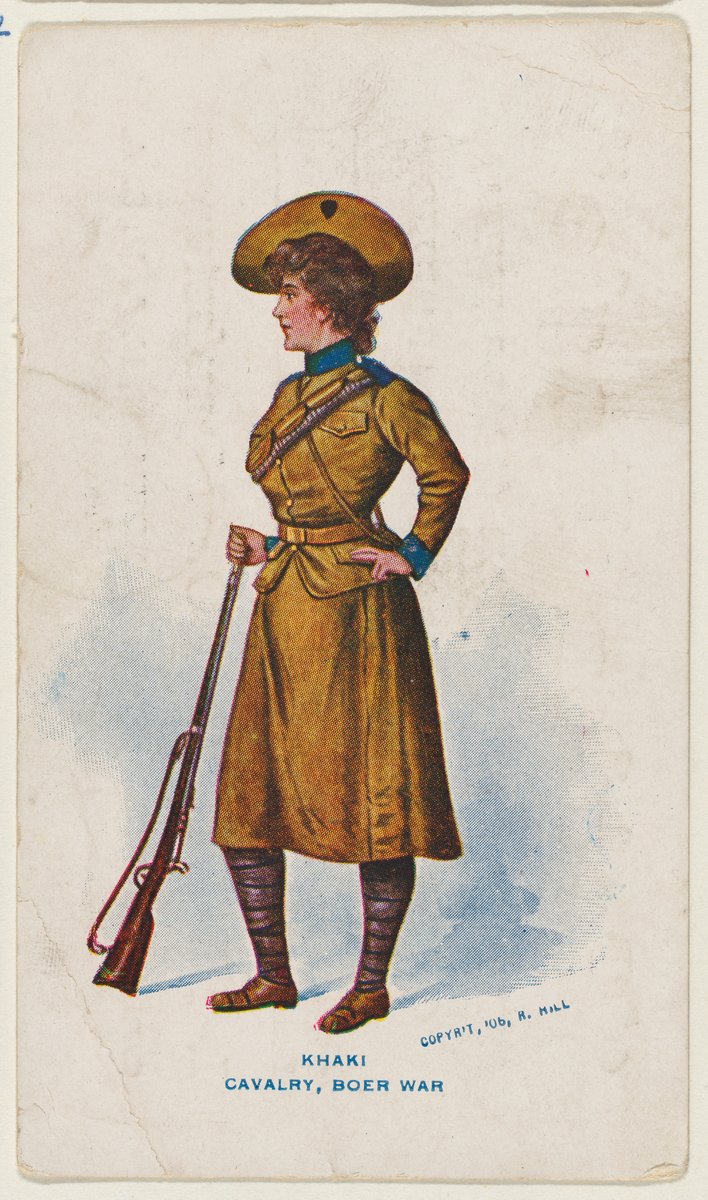
A small printed card of a woman in a brown cavalry uniform with a broad hat, high boots and a rifle, captioned “Khaki, Cavalry, Boer War”
#AD7B43#885930#4C3C2F#DCD3C9
Trade cardKhaki, Cavalry, Boer War (1903)

A cigar card from a 1903 American series of costumes, now at the Metropolitan Museum of Art, showing a woman in khaki cavalry dress. Its khaki is printed as a warm, golden brown, darker and stronger than the dictionary color, with blue at the collar and cuffs.

#AD7B43#885930#4C3C2F#DCD3C9
Source: The Met

Palettes are sampled in-house.

Questions

What color is khaki?

A light, dusty yellowish brown. The usual code is #C3B091 (RGB 195, 176, 145), from Maerz and Paul’s 1930 color dictionary.

Why is the CSS color khaki yellow?

CSS took its color names from the X11 list, where khaki is a pale yellow, #F0E68C. Its darkkhaki, #BDB76B, is about as light as the dictionary khaki but greener.

Is khaki green or brown?

Both, depending on where you are. American dictionaries define khaki as a light yellowish brown. In British English it can also mean a greenish brown, like the darker khaki the British Army adopted in 1902.

What is the difference between khaki and tan?

They are close. Khaki (#C3B091) is grayer and leans toward olive. Tan (#D2B48C) is lighter and warmer.

What does the word khaki mean?

Dust-colored. It comes from Hindi and Urdu khākī, from khāk, dust, a word of Persian origin.

What colors go with khaki?

Navy and white for a classic look, olive for an outdoor feel, and brick red or black for contrast.