A soft, cool near-black named after volcanic glass.
Overview
Obsidian is a near-black with a faint cool, blue-green tint. The code most color lists use is #0B1215: very little red and only a little more green and blue. No color standard defines obsidian, so this code is a convention, not a measurement of the stone.
Obsidian is natural volcanic glass. It forms when lava cools so fast that crystals barely have time to grow. Iron and other elements make it dark brown to black, and most black obsidian holds tiny grains of magnetite, an iron oxide. Gas bubbles can give it a golden sheen, and nanoparticles of magnetite or other minerals can give it a rainbow shimmer.
Real obsidian is seldom the cool blue-black of the code. Museum pieces photograph as warm, brownish or neutral blacks, and polished surfaces throw back gray highlights, which made the stone a good mirror. Because it is glass, it also breaks to an edge sharper than steel.
On screens, #0B1215 is a softer alternative to pure black for dark themes, text and large backgrounds. White and pale colors read clearly on it.
HEX
#0B1215
RGB
rgb(11, 18, 21)
HSL
hsl(198, 31%, 6%)
HSV
198°, 48%, 8%
CMYK
48, 14, 0, 92
OKLCH
oklch(17.6% 0.012 226.1)
Every code converts from the HEX value #0B1215. #0B1215 is the obsidian that color lists commonly use, but no color standard or dictionary defines it, and Maerz and Paul’s color dictionary has no obsidian. The real stone is usually black, sometimes brown or green, and museum pieces photograph as warmer blacks; see the range below. CMYK is a screen-based estimate; print results vary.
Obsidian on the color map
LighterDarker
Near black, colors have almost no hue, so this map of hue and lightness can show only the outline around the reference. The museum samples are warmer or more neutral than the code’s faint blue tint and fall outside this close view: the mirror is a brownish black, the Aztec head a neutral dark gray, and the Egyptian beaker almost exactly as dark as the code but without its blue. The outline is an approximate range, not a measured one.
Shades and tints
Tintswith white
Shadeswith black
Toneswith gray
Obsidian sits in the middle. Tints add white, shades add black and tones add gray, in 10% steps out from it. Tap any swatch to copy its code.
Light and dark obsidian
#B6B8B9
Obsidian smokeMixed 70% with white. A cool, light gray.
#85888A
Light obsidianMixed 50% with white. A mid gray with a faint blue tint.
#54595B
Obsidian slateMixed 30% with white. A dark slate gray.
#303638
OnyxMixed 15% with white, which lands close to onyx. See onyx
#0B1215
ObsidianThe reference color.
Colors that go with obsidian
Pairings that work in rooms, outfits and interfaces.
Obsidian and gold
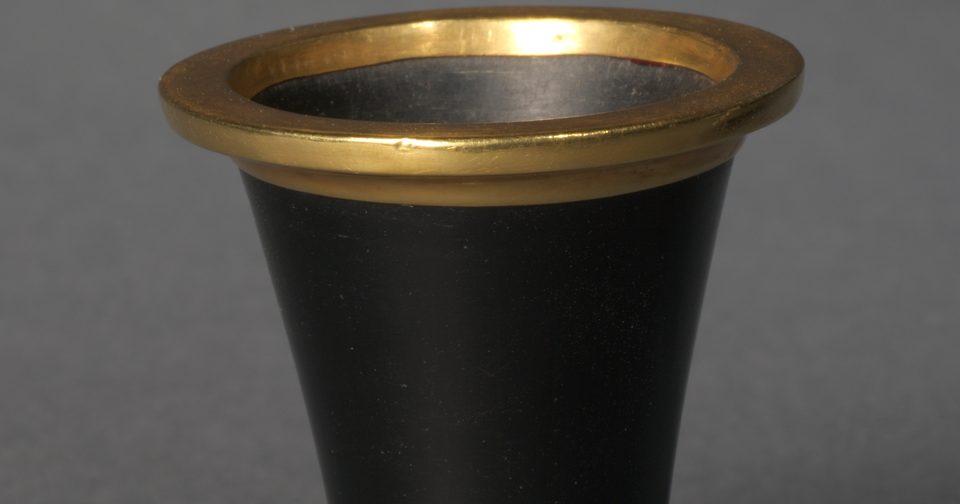
From the Egyptian beaker: black glass with a gold rim. Rich and formal.
Obsidian and white
Maximum contrast. Clean, modern and easy to read.
Obsidian and ember
Volcanic: black glass and the glow of lava.
Obsidian and slate
Cool grays around a black anchor. Calm and technical.
Obsidian and stone
Warm neutrals with a black accent. Quiet and natural.
Rainbow obsidian
Soft violet and green accents, after the stone’s rainbow sheen.
Color-wheel palettes
Pick a palette to see where its colors sit on the color wheel. The caret marks obsidian. Tap a band to copy its code.
Dark green41%ObsidianVantablack83%Lamp black68%Oxford blue49%Eigengrau85%Midnight purple39%
Lined up by hue around obsidian. Hover a color to see how similar it is.The bar under each name shows how similar it is. Similarity comes from the distance between the two colors in OKLab, a model of how we see color.
Obsidian vs onyx
Obsidian#0B1215 · hue 198°
Much darker, nearly black
A faint cool, blue-green tint
Named after volcanic glass
Onyx#353839 · almost no hue
Lighter, a charcoal gray
Almost perfectly neutral
Named after a different stone
Meaning
Volcanic glass
Sharp blades
Mirrors and visions
Aztec art
Dark themes
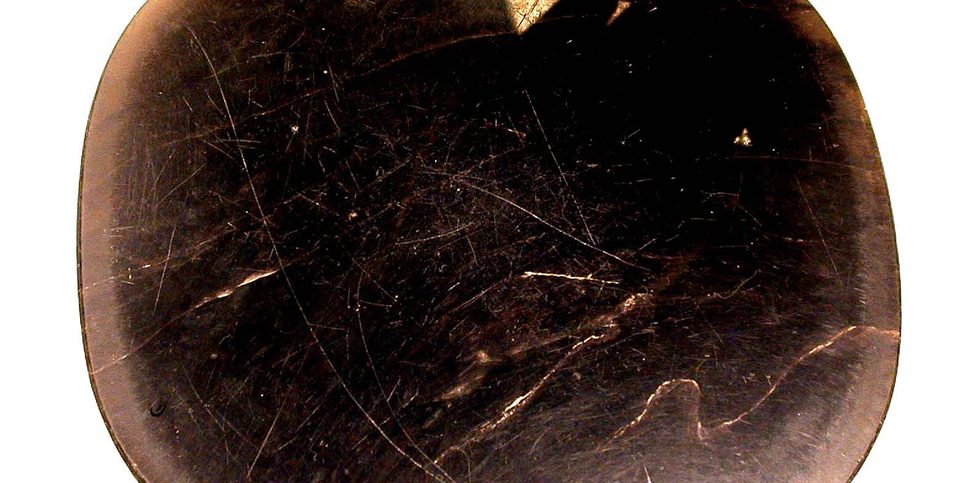
Obsidian’s meanings come from what people made of it: blades, mirrors and sacred objects. In Aztec Mexico it was tied to Tezcatlipoca, whose name means “smoking mirror”. In Europe, one Aztec mirror became the magic “black stone” of an Elizabethan scholar. As with most named colors, research on color and emotion tests broad hues, not obsidian itself.
Sharper than steel, not proven to heal better
One animal study
A well-made obsidian blade can have an edge only about three nanometers thick, many times sharper than a steel scalpel. Some surgeons use obsidian blades, though the US Food and Drug Administration has not approved them for use on people. In one study in rats, obsidian cuts showed less inflammation after seven days, but the difference was gone after 21 days.1
The smoking mirror
Historical record
In Aztec belief, obsidian was linked with several gods, above all Tezcatlipoca, “smoking mirror”, who is shown with round obsidian mirrors on his head, chest or back, or in place of a missing foot. His mirror stood for revelation, premonition and power, and mirrors were thought to ward off evil spirits and capture a person’s image and soul.2
John Dee’s black stone came from Mexico
Lab analysis
The obsidian mirror linked to John Dee (1527–1608/9), the Elizabethan scholar who tried to speak with angels, is in the British Museum. In 2021, chemical analysis matched its glass to the Pachuca source in central Mexico, showing it was an Aztec mirror brought to Europe soon after the Spanish conquest.2
Sources (2)
Wikipedia, “Obsidian”, properties, prehistoric and historical use, and medical use, citing Buck (1982), “Ancient technology in contemporary surgery”, Western Journal of Medicine, 136, 265–269.
People have shaped obsidian for hundreds of thousands of years. Its name is Roman, and its English name came in the 1700s.
700,000 BC
The first known use of obsidian, at Kariandusi in Kenya and other Acheulian sites.1
5th millennium BC
In the Ubaid period, people make blades from obsidian quarried in what is now Turkey.1
Before 2100 BC
Obsidian scalpels are left at a Bronze Age settlement in Turkey.1
1859–1814 BC
In Egypt, under Amenemhat III, a craftsman makes a small cosmetics beaker of obsidian with a gold rim.2
Ancient Rome
Pliny the Elder writes of a volcanic glass found in Ethiopia by a traveler named Obsius. Through a misspelling of his name in manuscripts, the stone became obsidian.1, 3
1400s–early 1500s
Mexica (Aztec) sculptors carve and polish figures and mirrors of obsidian, such as a head of the god Xochipilli-Macuilxochitl.4, 5
1500s
An Aztec obsidian mirror reaches Europe soon after the Spanish conquest and comes to belong to John Dee.5
About 1770
Horace Walpole owns the mirror and labels it “The Black Stone into which Dr Dee used to call his Spirits”.5
1794
First known use of “obsidian” as a noun in English.3
Ground and polished flat, obsidian made the mirrors of ancient Mexico. Under the lamp this one reads as a warm, brownish black, about #070303, with coppery reflections near #3F2A24, nothing like the cool tint of the screen code.
#070303#20110F#3F2A24
Source: The Met
Source
Sampled from the Metropolitan Museum of Art’s photograph (1994.35.562), released as CC0 (public domain). The picture shown is a detail. Colors in a photo shift with the lighting, so read the codes as close, not exact.
#212121#5A5B59#1E1E1C
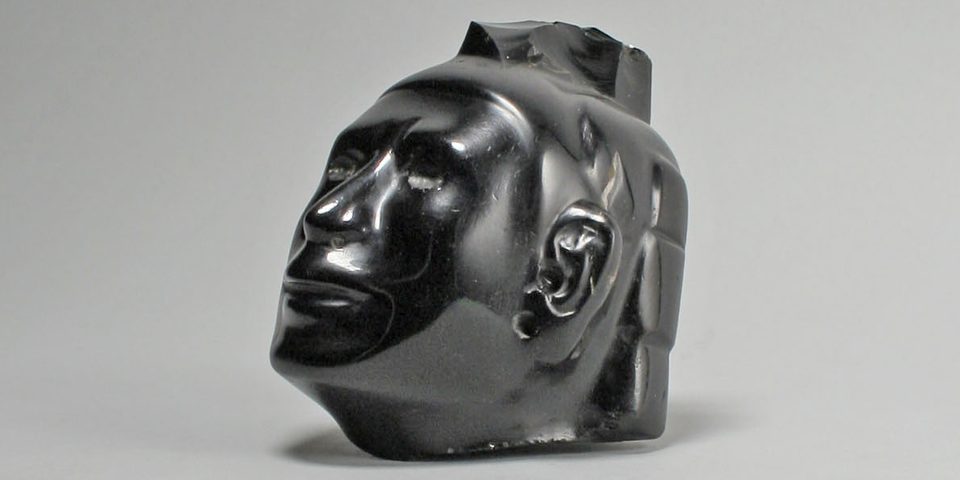
SculptureHead of Xochipilli-Macuilxochitl, Mexica (Aztec, 1400s–early 1500s)
Carved from obsidian and polished to a high gloss. The stone is a neutral black, about #212121, and its highlights turn a soft gray, #5A5B59.
#212121#5A5B59#1E1E1C
Source: The Met
Source
Sampled from the Metropolitan Museum of Art’s photograph (2012.517.2), released as CC0 (public domain). The picture shown is a detail. Colors in a photo shift with the lighting, so read the codes as close, not exact.
#0F0F0E#1E1E1C#C3A564
VesselCosmetic beaker of obsidian and gold, Egypt (about 1859–1814 BCE)
Ancient Egyptians paid dearly for cosmetics, and the vessels that held them got lavish treatment. This small beaker pairs black volcanic glass with a gold rim. The obsidian is a near-neutral black, about #0F0F0E.
#0F0F0E#1E1E1C#C3A564
Source: Cleveland Museum of Art
Source
Sampled from the Cleveland Museum of Art’s photograph (1985.107), released as CC0 (public domain). The picture shown is a detail. Colors in a photo shift with the lighting, so read the codes as close, not exact.
Palettes are sampled in-house.
Questions
What color is obsidian?
A near-black. The code most color lists use is #0B1215 (RGB 11, 18, 21), a black with a faint blue-green tint. Real obsidian is usually black, sometimes brown or green, and rarely yellow, orange, red or blue.
Is obsidian a stone or glass?
Glass. Obsidian is natural volcanic glass that forms when lava cools too quickly for crystals to grow, which is why it breaks with very sharp edges.
Why is obsidian black?
Iron and other elements darken it, and most black obsidian contains tiny grains of magnetite, an iron oxide. Nearly colorless obsidian is very rare.
What is the difference between obsidian and onyx?
As screen colors, obsidian (#0B1215) is almost black, while onyx (#353839) is a lighter charcoal gray. As stones, obsidian is volcanic glass and onyx is a different stone altogether.
Is obsidian sharper than a scalpel?
Yes. A well-made obsidian edge can be about three nanometers thick, many times sharper than a steel scalpel. Some surgeons use obsidian blades, but the US FDA has not approved them for use on people.
What colors go with obsidian?
Gold and warm stone for a rich look, white for crisp contrast, and ember orange or soft violet as bright accents.