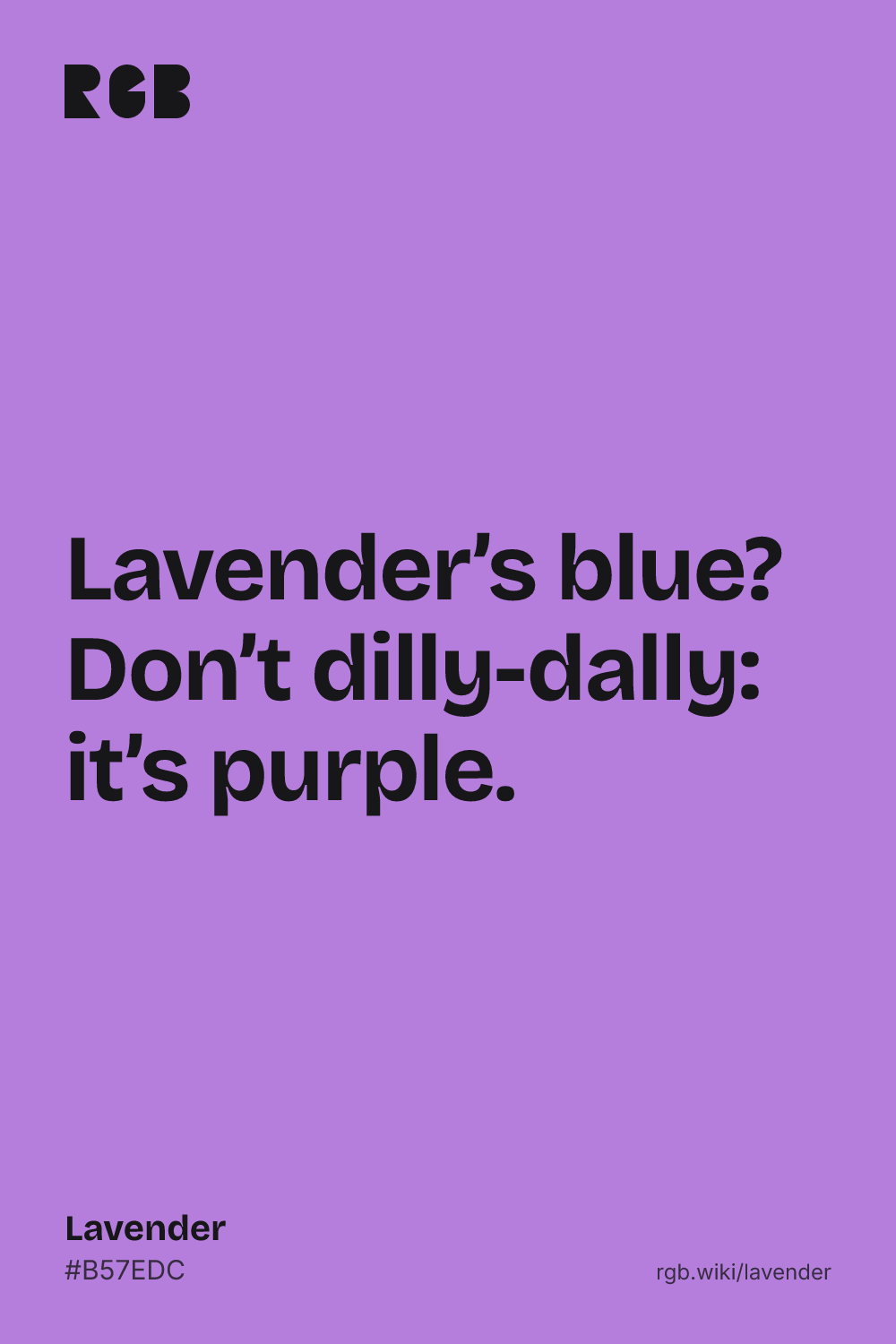
Lavender is a light purple, the color of lavender flowers. Its classic code is #B57EDC: a medium violet with more blue than red, matching the lavender sample in a standard 1930 color dictionary.
Web designers know a much paler lavender. The CSS keyword of the same name is almost white with a faint blue-violet tint, like the palest part of the flower, not its usual color.
The plant’s name goes back to medieval Latin lavandula. As a color word, lavender has been used in English since at least 1705, and in the 20th century it became linked with gay and lesbian identity.
Lavender suits soft, airy designs. It pairs well with sage, cream and gray, and deeper purples give it weight.
Names differ between color lists. In CSS and HTML, the keyword lavender is #E6E6FA. This page covers lavender as #B57EDC.
HEX
#B57EDC
RGB
rgb(181, 126, 220)
HSL
hsl(275, 57%, 68%)
HSV
275°, 43%, 86%
CMYK
18, 43, 0, 14
OKLCH
oklch(68.4% 0.145 310.0)
Every code converts from the HEX value #B57EDC. #B57EDC matches the lavender sample in Maerz and Paul’s A Dictionary of Color (1930), shown as “floral lavender” on Wikipedia. CMYK is a screen-based estimate; print results vary.
Lavender on the color map
LighterDarker
People’s average lavender in the xkcd survey is a little lighter than the dictionary sample. CSS lavender (#E6E6FA) sits far above both, in the top-left corner of this view, with only a trace of color. The outline is an approximate range, not a measured one.
Shades and tints
Tintswith white
Shadeswith black
Toneswith gray
Lavender sits in the middle. Tints add white, shades add black and tones add gray, in 10% steps out from it. Tap any swatch to copy its code.
Light and dark lavender
#DDC6EF
Pale lavenderVery light and soft. A gentle background color.
#D4ACF2
Light lavenderLighter and a little brighter than lavender.
#B57EDC
LavenderThe reference color.
#8978E4
Lavender blueA bluer, deeper lavender. Maerz and Paul (1930) gave the name to the pale color now called periwinkle, so “lavender blue” leads there on this site. See periwinkle
Colors that go with lavender
Pairings that work in rooms, outfits and interfaces.
Lavender and sage
Soft and natural, like a herb garden. Popular for weddings.
Lavender and charcoal
Modern and quiet. Good for beauty and tech.
Lavender and lemon
Near-opposites, both light. Fresh and springlike.
Lavender and cream
Light and romantic. Suits stationery and soft branding.
Lavender and deep purple
Tonal and rich. Lavender softens a dark purple.
Lavender and peach
Warm meets cool, both soft. Friendly and modern.
Color-wheel palettes
Pick a palette to see where its colors sit on the color wheel. The caret marks lavender. Tap a band to copy its code.
Medium purple66%Amethyst61%LavenderWisteria53%Heliotrope55%Medium orchid57%Orchid67%
Lined up by hue around lavender. Hover a color to see how similar it is.The bar under each name shows how similar it is. Similarity comes from the distance between the two colors in OKLab, a model of how we see color.
Lavender vs lilac
Lavender#B57EDC · hue 275°
Bluer and more saturated
Named after the lavender plant
Much paler on the web
Lilac#C8A2C8 · hue 300°
Grayer, with equal red and blue
Named after the lilac shrub
Softer and more muted
Meaning
Flowers
Scent
Calm
Softness
Pride
Lavender feels soft, fresh and gentle, and it brings the plant to mind: sachets, soap and fields of flowers. Much of its calm reputation comes from the scent, not the color. It also has a political history: in the mid-20th century, “lavender” was used as a slur for gay people, and then taken back as a sign of pride. As with most named colors, color research tests broad hues, not lavender itself.
A symbol of gay and lesbian pride
Historical record
In the 1950s, the US government’s purge of gay employees came to be called the Lavender Scare, after a senator’s jibe about “lavender lads”. In 1970, lesbian feminists turned an insult into a protest as the “Lavender Menace”, and the color has stood for pride since.1, 2
Calming? That’s the scent
Tested on the scent
A 2019 review found that breathing in lavender oil lowered anxiety scores, though most trials were of low quality. None of this tested the color, and there is no good evidence that looking at lavender calms you.3
A color word of its own
Two studies
When 51 American English speakers named 330 color chips in their own words, lavender was one of four high-agreement names beyond the basic eleven. A later study found that Japanese has no common word for it.4, 5
Sources (5)
Wikipedia, “Lavender scare”, citing David K. Johnson’s The Lavender Scare (2004).
Donelli, D., Antonelli, M., Bellinazzi, C., Gensini, G. F. & Firenzuoli, F. (2019). Effects of lavender on anxiety: A systematic review and meta-analysis. Phytomedicine, 65, 153099. doi:10.1016/j.phymed.2019.153099
Lindsey, D. T. & Brown, A. M. (2014). The color lexicon of American English. Journal of Vision, 14(2), 17. doi:10.1167/14.2.17
Kuriki, I. et al. (2017). The modern Japanese color lexicon. Journal of Vision, 17(3), 1. doi:10.1167/17.3.1
History
Lavender was a plant and a perfume for centuries before it was a color. In the 20th century the color word picked up a second, political meaning.
1200s
The plant’s name appears in Middle English as “lavendre”, from medieval Latin lavandula.1
1705
First recorded use of “lavender” as a color name in English.2
1930
Maerz and Paul’s A Dictionary of Color lists three main lavenders: lavender, lavender gray and lavender blue.2
1953
Executive Order 10450 lets the US government fire employees for “sexual perversion”. The purge becomes known as the Lavender Scare.3, 4
1970
Lesbian activists in lavender “Lavender Menace” T-shirts take over the opening of the Second Congress to Unite Women in New York.5
2001
The SVG standard adds “lavender” to the web’s color names, as the pale #E6E6FA.6
Sources (6)
Merriam-Webster, “lavender”, etymology and first known use.
Wikipedia, “Lavender (color)”, citing Maerz and Paul’s A Dictionary of Color (1930).
A light purple, the color of lavender flowers. The classic code is #B57EDC (RGB 181, 126, 220). The CSS keyword lavender is a much paler #E6E6FA.
Why is web lavender so pale?
The CSS name comes from an old list of color names for computer screens, which gave lavender to an almost white blue-gray. It matches the palest part of the flower, not its usual color.
What is the difference between lavender and lilac?
Lavender (#B57EDC) is bluer and more saturated. Lilac (#C8A2C8) is grayer, with equal parts red and blue, and looks softer and pinker.
What colors go with lavender?
Sage green, cream and charcoal are the safest. Lemon yellow makes a fresh contrast, and deep purple a rich tonal pair.
Does the color lavender help you relax?
There is no good evidence that seeing lavender calms you. The research on lavender and anxiety is about the scent of lavender oil, and even those trials are mostly of low quality.
What does lavender symbolize?
Softness, freshness and calm, mostly from the plant. Since the mid-20th century it has also stood for gay and lesbian identity and pride.