Lawn green

A screen-bright yellow-green, much lighter than any lawn a groundskeeper would be proud of.

Overview

Lawn green is a vivid, light yellow-green. Its code is #7CFC00, the CSS keyword lawngreen: green almost at full strength, red at about half and no blue. It is practically the same color as chartreuse, #7FFF00. The two codes differ by three steps of red and green, far too little to see.

The name is older than the code. In the first decade of the 1900s, “lawn green” was the name of an American ready-mixed paint, and a standard 1930 color dictionary matched it to a soft, grassy sample, the same one it proposed as the true grass green. A later dictionary filed that sample as moderate yellow green, #8A9A5B. The bright web value came from a Unix color list, which the web adopted in 2001.

Real lawns look nothing like the code. Turf researchers rate lawn color on a scale of 1 to 9, where 1 is light green or straw brown and 9 is dark green, and a darker green usually means more chlorophyll and more nitrogen in the leaves. A pale, yellowish lawn is often a hungry one. When people named colors themselves in an online survey, their average lawn green was #4DA409, a much darker, grassier green.

On screen, lawn green is a loud accent. Black text on it reaches 15.8:1 contrast; white text only 1.3:1, which is unreadable. It glows on black, navy and charcoal. For a lawn that looks real, use one of the darker shades below.
HEX#7CFC00
RGBrgb(124, 252, 0)
HSLhsl(90, 100%, 49%)
HSV90°, 100%, 99%
CMYK51, 0, 100, 1
OKLCHoklch(88.2% 0.263 136.2)
Every code converts from the HEX value #7CFC00. #7CFC00 is the CSS keyword lawngreen, defined in the CSS Color Module Level 4 and first listed among the web’s color names in SVG 1.0 (2001). It comes from the X11 color list, which already gave “lawn green” as 124 252 0. Maerz and Paul’s 1930 A Dictionary of Color places lawn green at a much softer sample, filed by the ISCC-NBS as moderate yellow green, #8A9A5B. CMYK is a screen-based estimate; print results vary.
Lawn green color card, hex #7CFC00: “Lawn and order”

Lawn green on the color map

CSS chartreuse sits right on top of the reference. People’s average lawn green in the xkcd survey sits well below the outline, much darker, and a little to the right, greener. Maerz and Paul’s 1930 lawn green sits below and to the left: darker, grayer and yellower. The outline is an approximate range, not a measured one.

Shades and tints

Tints with white

Shades with black

Tones with gray

Lawn green sits in the middle. Tints add white, shades add black and tones add gray, in 10% steps out from it. Tap any swatch to copy its code.

Light and dark lawn green

#B0FD66
Light lawn greenMixed 40% with white.
#7CFC00
Lawn greenThe reference color.
#7FFF00
ChartreuseThe CSS keyword chartreuse. Three steps brighter in red and green, so the two look the same. See chartreuse
#57B000
Dark lawn greenMixed 30% with black.
#4DA409
Lawn green as people picture itPeople’s average lawn green in the xkcd color survey (CC0 data).
#3E7E00
Deep lawn greenMixed 50% with black.
#8A9A5B
1930 lawn greenModerate yellow green, where the ISCC-NBS files Maerz and Paul’s 1930 lawn green. Shared with moss green. See moss green

Colors that go with lawn green

Pairings that work in rooms, outfits and interfaces.

Lawn green and navy

Sporty and sharp. Navy calms the glare, and lawn green text stays readable on it.

Dark mode accent

A near-black screen with lawn green kept for buttons, links and highlights. Use a soft gray for body text.

Garden party

Fresh and cheerful, for summer invitations. Dark green carries the text, lawn green and pink do the decorating.

Straw to dark green

An illustrative run from straw brown to dark green, the two ends of the turf color scale. Not official rating colors; lawn green itself would sit off the light end.

Croquet Scene

Sampled from Winslow Homer’s 1866 painting: the lawn, a blue dress and a red one. Proof that a painted lawn reads as olive, not lawn green.

Lawn green and charcoal

Bold and modern. Charcoal text on a lawn green panel is very easy to read.

Color-wheel palettes

Pick a palette to see where its colors sit on the color wheel. The caret marks lawn green. Tap a band to copy its code.

Similar colors

Electric lime59%Green yellow75%Kiwi65%Chartreuse96%Lawn greenNeon green82%Spring green65%

Lined up by hue around lawn green. Hover a color to see how similar it is.The bar under each name shows how similar it is. Similarity comes from the distance between the two colors in OKLab, a model of how we see color.

Lawn green vs chartreuse

Lawn green#7CFC00 · hue 90°
  • Red 124, green 252, no blue
  • Named after a mown lawn
  • An American paint name by the 1900s
Chartreuse#7FFF00 · hue 90°
  • Red 127, green 255, no blue
  • Named after a French liqueur
  • Side by side, the two look the same

Meaning

  • Named after lawns
  • Turf rated 1 to 9
  • CSS keyword
  • Brighter than grass

Lawn green is named after something people measure. Turf researchers score lawn color by eye and by camera, and on their scales the best lawns are dark. The web’s lawn green would sit at the pale end. Color psychology studies test broad words such as green, never lawn green, so the claims below are about real grass and about the name.

Lawns are judged by how dark they are

Rating standard

The National Turfgrass Evaluation Program, which tests grass varieties across the United States, rates color on a 1 to 9 scale. For genetic color, 1 is light green and 9 is dark green; for seasonal and winter color, 1 is straw brown. Raters score genetic color while the turf is growing actively and not under stress.1

Dark green tracks chlorophyll and nitrogen

Study

In an Oklahoma State University study of bermudagrass and creeping bentgrass fertilized at different nitrogen rates, visual color ratings rose with the chlorophyll in the clippings (r² = 0.64). Extension guides describe the other side: a plant short of nitrogen turns pale green to yellow, older leaves first. A lawn the color of lawngreen would look underfed.2, 3

Green because chlorophyll passes it by

Plant science

Chlorophyll absorbs light most strongly in the blue and red parts of the spectrum and absorbs green less, so green light scattered back by the leaf’s structures, such as cell walls, is what we see.4

A turf index would score it low

Our calculation

Researchers at the University of Arkansas built a dark green color index (DGCI) from the hue, saturation and brightness of turf photos, scoring darker, bluer and less saturated greens higher. By our calculation from the published formula, #7CFC00 scores about 0.17, against about 0.32 for people’s average lawn green in the xkcd survey and 0.41 for the 1930 dictionary’s sample. The index was made for photographs of turf, not single screen colors, so read this as an illustration.5, 6

People picture it darker

Survey

In the xkcd color survey, where thousands of people named colors on their own screens, the average lawn green was #4DA409, a mid green with about two thirds of the brightness of the web code. The word lawn pulls people toward real grass, not toward the glowing keyword.7

Sources (7)
  1. Morris, K. N. “A Guide to NTEP Turfgrass Ratings”, National Turfgrass Evaluation Program.
  2. Bell, G. E., Howell, B. M., Johnson, G. V., Raun, W. R., Solie, J. B. & Stone, M. L. (2004). Optical sensing of turfgrass chlorophyll content and tissue nitrogen. HortScience, 39(5), 1130–1132. doi:10.21273/HORTSCI.39.5.1130 (abstract).
  3. Iowa State University Extension and Outreach, Yard and Garden, “Identifying Plant Nutrient Deficiencies: Nitrogen”.
  4. Wikipedia, “Chlorophyll”, citing Virtanen, O., Constantinidou, E. & Tyystjärvi, E. (2022). Chlorophyll does not reflect green light: how to correct a misconception. Journal of Biological Education, 56(5), 552–559. doi:10.1080/00219266.2020.1858930.
  5. Karcher, D. E. & Richardson, M. D. (2003). Quantifying turfgrass color using digital image analysis. Crop Science, 43(3), 943–951. doi:10.2135/cropsci2003.0943. Formula as reproduced in the pliman index list: DGCI = [(H − 60)/60 + (1 − S) + (1 − B)]/3.
  6. Our calculation: HSB values of #7CFC00 (90°, 100%, 99%), #4DA409 (94°, 95%, 64%) and #8A9A5B (75°, 41%, 60%) put through the formula in reference 5.
  7. Munroe, R. (2010). “Color Survey Results”, xkcd, with the list of averages (CC0).

History

The lawn is older than the color name, and the color name is older than the code. The story runs from mown meadows and the first lawn mower to a paint name, a color dictionary and the camera-based scores turf researchers use today.

  1. 1548

    First known use of “lawn” in English, for an open space between woods. It comes from Middle English launde.1

  2. 1700s

    “Lawn” comes to mean a mown stretch of grass, and large mown spaces become fashionable in European and American gardens.2

  3. 1830

    Edwin Budding of Stroud, England, patents the first lawn mower, made to cut sports grounds and large gardens as a better tool than the scythe.3

  4. 1866

    Winslow Homer paints Croquet Scene, one of five pictures of a lawn game recently brought to the United States from the British Isles.4

  5. 1900s

    “Lawn green” is in use as the name of an American ready-mixed paint, according to the date Maerz and Paul later record for it.5

  6. 1930

    Maerz and Paul’s A Dictionary of Color puts lawn green at plate 21 L 5, the sample it also proposes as the one true grass green. The 1955 ISCC-NBS dictionary files it as moderate yellow green.5, 6

  7. 2001

    SVG 1.0 takes lawngreen, rgb(124, 252, 0), from the X11 color list into the web’s color names, and CSS later adopts the same list.7

  8. 2003

    Douglas Karcher and Michael Richardson publish a dark green color index for turf photos, which agrees closely with visual ratings and varies less than the scores of several human raters.8

  9. 2004

    An Oklahoma State University study finds that visual color ratings of fertilized turf follow the chlorophyll in its clippings.9

  10. 2010

    In the xkcd color survey, people’s average lawn green is #4DA409, far darker than the web code.10

Sources (10)
  1. Merriam-Webster, “lawn”, etymology and first known use.
  2. Wikipedia, “Lawn”, history section, citing Shelley Mitchell, “Plants in the Classroom: The Story of Oklahoma Turfgrass”, Oklahoma State University Extension (2020).
  3. Wikipedia, “Lawn mower”, citing The Old Lawnmower Club’s “Mower History” and the British patent of 31 August 1830.
  4. Art Institute of Chicago, Winslow Homer, Croquet Scene, 1866 (1942.35), catalog entry.
  5. Maerz, A. & Paul, M. R. (1930). A Dictionary of Color. New York: McGraw-Hill. Index p. 197, “190– Lawn GreenM … 21 L 5”; the key to superior letters (M: the name of an American ready-mixed paint) and to dates given only by decade; and the note on grass green, p. 161. Scan at the Internet Archive.
  6. Kelly, K. L. & Judd, D. B. (1955). The ISCC-NBS Method of Designating Colors and a Dictionary of Color Names. National Bureau of Standards Circular 553. Tabulated in Aubrey Jaffer’s “Maerz and Paul color names”: lawn green, category 120, moderate yellow green.
  7. W3C (2001). Scalable Vector Graphics (SVG) 1.0, recognized color keyword names; and the X11 list, rgb.txt, at MIT CSAIL.
  8. Karcher, D. E. & Richardson, M. D. (2003). Quantifying turfgrass color using digital image analysis. Crop Science, 43(3), 943–951. doi:10.2135/cropsci2003.0943.
  9. Bell, G. E. et al. (2004). Optical sensing of turfgrass chlorophyll content and tissue nitrogen. HortScience, 39(5), 1130–1132. doi:10.21273/HORTSCI.39.5.1130.
  10. Munroe, R. (2010). “Color Survey Results”, xkcd, with the list of averages (CC0).

Lawn green in use

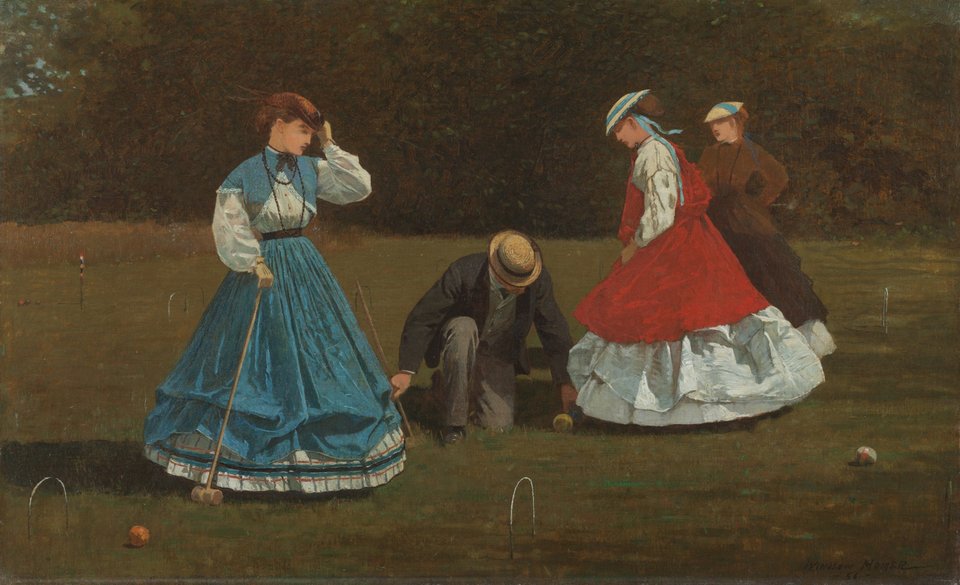
Four people playing croquet on a mown lawn in front of a dark hedge: a woman in a blue dress holding a mallet and shading her eyes, a crouching man in a straw hat placing a ball, a woman in a red and white dress and another in brown behind her, with white wire hoops in the grass
#5D4C2C#4B4024#3E6367#8D3727
PaintingCroquet Scene, Winslow Homer (1866)

Homer painted a summer lawn in full afternoon sun, and in the photo it samples as an olive brown, about #5D4C2C in the light and #4B4024 in shadow, under a blue dress (#3E6367) and a red one (#8D3727). A painted lawn, like a real one, is far darker and duller than the web’s lawn green.

#5D4C2C#4B4024#3E6367#8D3727
Source: Art Institute of Chicago

Palettes are sampled in-house.

Questions

What color is lawn green?

A vivid, light yellow-green. Its code is #7CFC00 (RGB 124, 252, 0), the CSS keyword lawngreen: green almost at full strength, red at about half and no blue.

Is lawn green the same as chartreuse?

Almost. Chartreuse is #7FFF00, just three steps higher in red and green than lawn green’s #7CFC00. Both have a hue of 90°, and side by side you cannot tell them apart. They are separate names with separate histories: lawn green after mown grass, chartreuse after a French liqueur.

Does lawn green look like a real lawn?

No. Real lawns are much darker and less saturated. In the xkcd color survey, people’s average lawn green was #4DA409, and a 1930 color dictionary put lawn green at a soft, grassy sample filed as moderate yellow green (#8A9A5B). The web code is a screen-bright version of the name.

Why is healthy grass dark green?

Chlorophyll absorbs mostly blue and red light, so leaves look green. In turf studies, grass with more chlorophyll gets darker color ratings, and nitrogen feeding raises both. Grass short of nitrogen turns pale green to yellow, older leaves first.

How do turf experts rate lawn color?

By eye, on a scale of 1 to 9. In the National Turfgrass Evaluation Program, 1 is light green (or straw brown for seasonal color) and 9 is dark green. Researchers also score color from photos with a dark green color index, which rewards darker, less saturated greens.

Where does the lawngreen code come from?

From the X11 color list for Unix computers, which SVG 1.0 brought to the web in 2001 and CSS still uses. The name itself is older: it was an American paint name by the first decade of the 1900s.

What colors go with lawn green?

Navy, charcoal and near-black make it glow; white and hot pink make it playful. Put black or charcoal text on it, never white. For a natural, garden look, use darker greens such as #4DA409 or #2E5E1E with it.