Forest green

A leafy green named after the woods, and darker in most people’s minds than on screen.

Overview

Forest green is a strong, leafy green. Its web code is #228B22: plenty of green with only a little red and blue, at a bit more than half brightness.

The name means the green of the woods and has been a color word in English since 1810. The web code is much younger. It comes from the color list of the X Window System, tuned in the 1980s to look right on the computer screens of the day, and became a CSS keyword in 2001.

Most people picture something darker. Dictionaries call forest green a dark yellowish or moderate olive green, and people’s average forest green in the xkcd color survey is a deep, nearly black green. The Minnesota Wild’s official Forest Green is close to that, and so are the greens of old forest paintings.

Forest green makes a deep, natural base color. It pairs well with cream, gold, burgundy and warm wood tones. Use the web code for a fresh, leafy look, or a darker version for the classic one.

HEX#228B22
RGBrgb(34, 139, 34)
HSLhsl(120, 61%, 34%)
HSV120°, 76%, 55%
CMYK76, 0, 76, 45
OKLCHoklch(55.8% 0.169 142.9)
Every code converts from the HEX value #228B22. #228B22 is the CSS keyword forestgreen, defined in the CSS Color Module Level 4 and first listed among the web’s color names in SVG 1.0 (2001). It comes from the X Window System’s color list, where forest green was 35, 142, 35 in the 1980s and was retuned to 34, 139, 34 in 1989. CMYK is a screen-based estimate; print results vary.
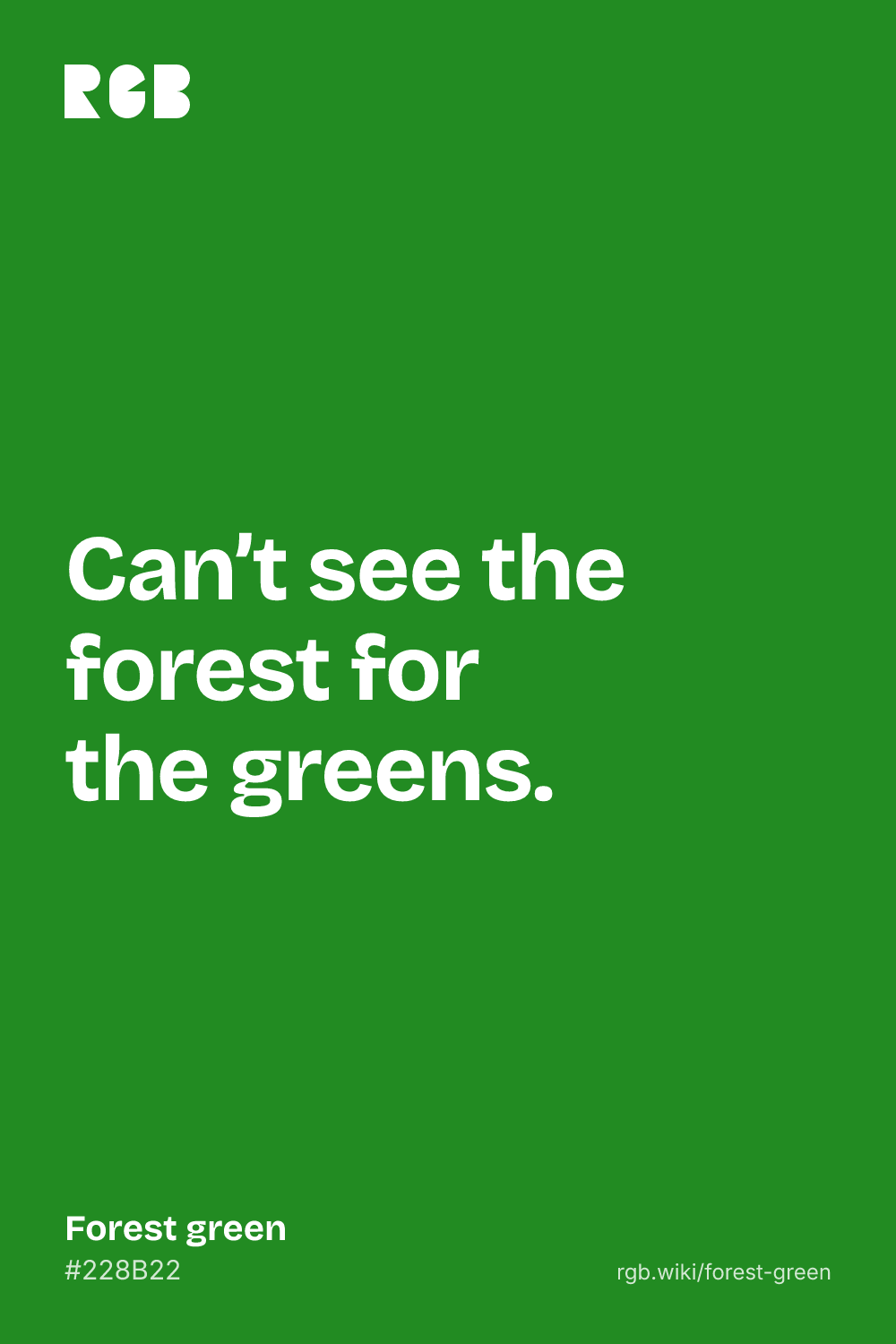
Forest green color card, hex #228B22: “Can’t see the forest for the greens”

Forest green on the color map

People’s average forest green in the xkcd survey is far darker, near the bottom of this view and almost straight below the web code. The dictionary’s forest green sits down and to the left, outside the outline: darker and more olive. The outline is an approximate range, not a measured one.

Shades and tints

Tints with white

Shades with black

Tones with gray

Forest green sits in the middle. Tints add white, shades add black and tones add gray, in 10% steps out from it. Tap any swatch to copy its code.

Light and dark forest green

#7AB97A
Light forest greenMixed 40% with white. A soft, leafy green.
#6B8E23
Olive drabEarly X11 color lists also called this exact code medium forest green. CSS knows it as olivedrab. See olive drab
#228B22
Forest greenThe reference color.
#355E3B
Hunter greenDarker and grayer, named after 19th-century hunting clothes. See hunter green
#145314
Dark forest greenMixed 40% with black. Deeper, and closer to the forest green most people picture.

Colors that go with forest green

Pairings that work in rooms, outfits and interfaces.

Forest green and cream

Calm and classic. Good for heritage brands and packaging.

Forest green and gold

Rich and traditional. A favorite for school and club colors.

Forest green and burgundy

Heritage and outdoorsy. Think tweed, leather and wood.

Forest green and terracotta

Earthy and warm, like a garden in late summer.

Forest green and navy

Deep and preppy. Suits outdoor gear and menswear.

Forest green and pale pink

Fresh and soft. Suits weddings and florals.

Color-wheel palettes

Pick a palette to see where its colors sit on the color wheel. The caret marks forest green. Tap a band to copy its code.

Similar colors

Olive drab66%Avocado green78%Scheele's green81%Grass green72%Forest greenSea green70%Shamrock green63%

Lined up by hue around forest green. Hover a color to see how similar it is.The bar under each name shows how similar it is. Similarity comes from the distance between the two colors in OKLab, a model of how we see color.

Forest green vs hunter green

Forest green#228B22 · hue 120°
  • Brighter: a leafy mid green on screen
  • Named after the woods
  • A CSS keyword, forestgreen
Hunter green#355E3B · hue 129°
  • Darker and grayer
  • Named after 19th-century hunting clothes
  • No CSS keyword

Meaning

  • Woods
  • School colors
  • Hockey
  • Old screens

Forest green reads as woods, the outdoors and tradition. It is a school and club color, and in hockey it is the green of the Minnesota Wild, whose logo hides a row of pine trees. The web’s version, inherited from the computer screens of the 1980s, is brighter and leafier than the forest green most people picture. As with most named colors, research on color and emotion tests broad hues such as green, not forest green itself.

An official school color

Official document

The University of the Philippines names forest green as one of its institutional colors, the complement to its primary maroon. Its 2017 visual identity guide bases both colors on the university’s 2005 code.1
Forest Green on the ice

Documented use

The NHL’s Minnesota Wild count Forest Green among their four official colors, with Iron Range Red, Harvest Gold and Minnesota Wheat. Since 2017, Forest Green has been the main color of the team’s home jersey.2, 3

Darker in everyday speech

Online survey

In the xkcd color survey, where people named over five million colors online, the average forest green came out #06470C, a deep, nearly black green. Dictionaries also make it darker than the web code: Merriam-Webster calls it a dark yellowish or moderate olive green.4, 5

Sources (5)
  1. University of the Philippines, “UP Visual Identity Guidebook 2017 now available online”, and the guidebook’s “Institutional colors”, pp. 20–21.
  2. Brown, H. (2022). “How did Minnesota sports teams get their colors?” WCCO, CBS News Minnesota.
  3. Minnesota Wild (2017). “New Wild jerseys unveiled”. NHL.com.
  4. Munroe, R. (2010). “Color survey results”. xkcd blog. The survey’s color averages are released as CC0 data.
  5. Merriam-Webster, “forest green”, definition and first known use.

History

Forest green is an old color name with a young web code. The name dates from the early 1800s; the code was tuned for computer screens in the 1980s.

  1. 1810

    First known use of “forest green” as a color name in English.1

  2. 1912

    Robert Ridgway’s Color Standards and Color Nomenclature, a color atlas for naturalists, includes a forest green.2

  3. 1930

    Maerz and Paul’s A Dictionary of Color prints a forest green sample. The 1955 ISCC-NBS dictionary files it as a moderate olive green.2, 3

  4. 1986

    Forest green is in the first color list of the X Window System, at 35, 142, 35, a list tuned for Digital’s VT240 terminals.4, 5

  5. 1989

    A revised X11 color list, tuned on a different monitor, sets forest green to 34, 139, 34: the code the web uses today.4, 5

  6. 2001

    SVG 1.0 adds “forestgreen” to the web’s color names, as #228B22.6

  7. 2005

    The University of the Philippines’ revised code becomes the basis for its colors: maroon, with forest green as its complement.7

  8. 2017

    Forest Green becomes the main color of the Minnesota Wild’s new home jersey.8

Sources (8)
  1. Merriam-Webster, “forest green”, definition and first known use.
  2. Kelly, K. L. & Judd, D. B. (1955). The ISCC-NBS Method of Designating Colors and a Dictionary of Color Names. National Bureau of Standards Circular 553. PDF at NIST. Entries for Ridgway’s and Maerz and Paul’s forest green, as tabulated in Jaffer’s color-name dictionaries.
  3. Wikipedia, “Forest green”, citing Maerz and Paul’s A Dictionary of Color (1930), p. 195 and plate 23.
  4. Wikipedia, “X11 color names”, history of the list (X10R3 in 1986, X11R4 in 1989).
  5. Jaffer, A. “Color-Name Dictionaries”, with the early X11 lists old-rgb.txt (“tuned” for the VT240) and raveling.txt (tuned for an HP monitor).
  6. W3C (2001). Scalable Vector Graphics (SVG) 1.0, recognized color keyword names.
  7. University of the Philippines, “UP Visual Identity Guidebook 2017 now available online”, and the guidebook’s “Institutional colors”, p. 20.
  8. Minnesota Wild (2017). “New Wild jerseys unveiled”. NHL.com.

Forest green in use

All brand colors
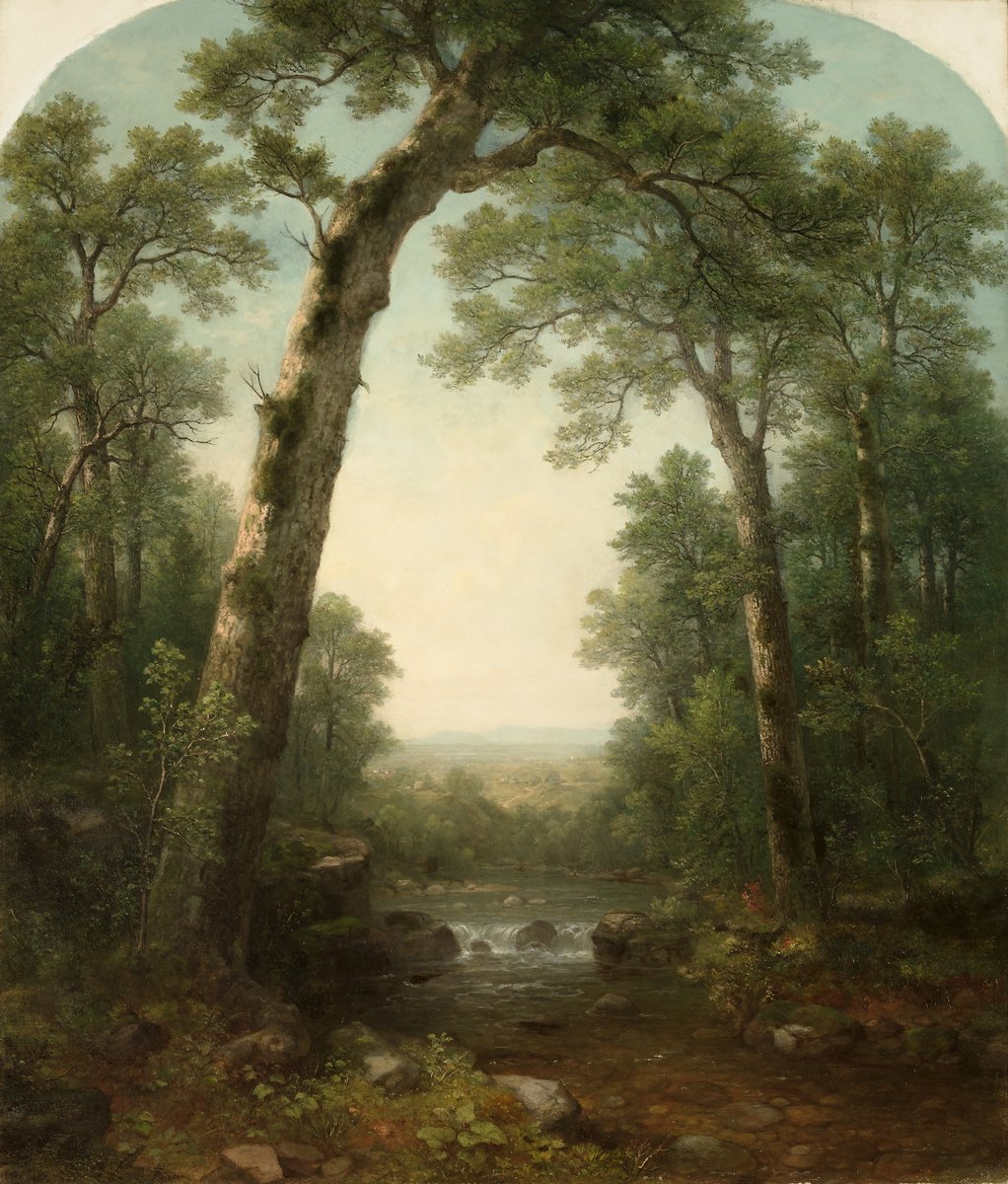
A painted forest of tall trees framing a stream that runs over rocks toward a hazy, open valley under a pale sky
#342D17#534F2C#797850#ABAF8E
PaintingForest Stream with Vista (1872)

A forest scene by the American landscape painter Asher B. Durand, at the Cleveland Museum of Art. Its greens are olive and brown, far from the web’s bright forest green and close to the dictionary’s moderate olive green.

#342D17#534F2C#797850#ABAF8E
Source: Cleveland Museum of Art

Logos belong to their owners and are shown unaltered, only to show where each palette comes from. Palettes are sampled in-house.

Questions

What color is forest green?

A strong, leafy green. The web code is #228B22 (RGB 34, 139, 34). In everyday speech, forest green usually means something darker, closer to #06470C.

What is the difference between forest green and hunter green?

On screen, forest green (#228B22) is brighter and leafier. Hunter green (#355E3B) is darker and grayer, and is named after the clothes hunters wore in the 1800s. Dictionaries describe both as dark yellowish greens, so in speech they overlap.

Is forest green a dark green?

The web code is a mid green, at about half brightness. Most people mean something darker: the average forest green in the xkcd survey is almost black-green, and dictionaries call it a dark yellowish or moderate olive green. For a darker forest green, try #145314.

What colors go with forest green?

Cream and gold for a classic look, burgundy and navy for something deep and traditional, and terracotta or pale pink to warm it up.

Why is it called forest green?

After the green of the woods. It has been a color name in English since 1810.

Where does the code #228B22 come from?

From the color list of the X Window System. Forest green was in it in the 1980s at RGB 35, 142, 35, was retuned to 34, 139, 34 in 1989, and became the CSS keyword forestgreen with SVG 1.0 in 2001.