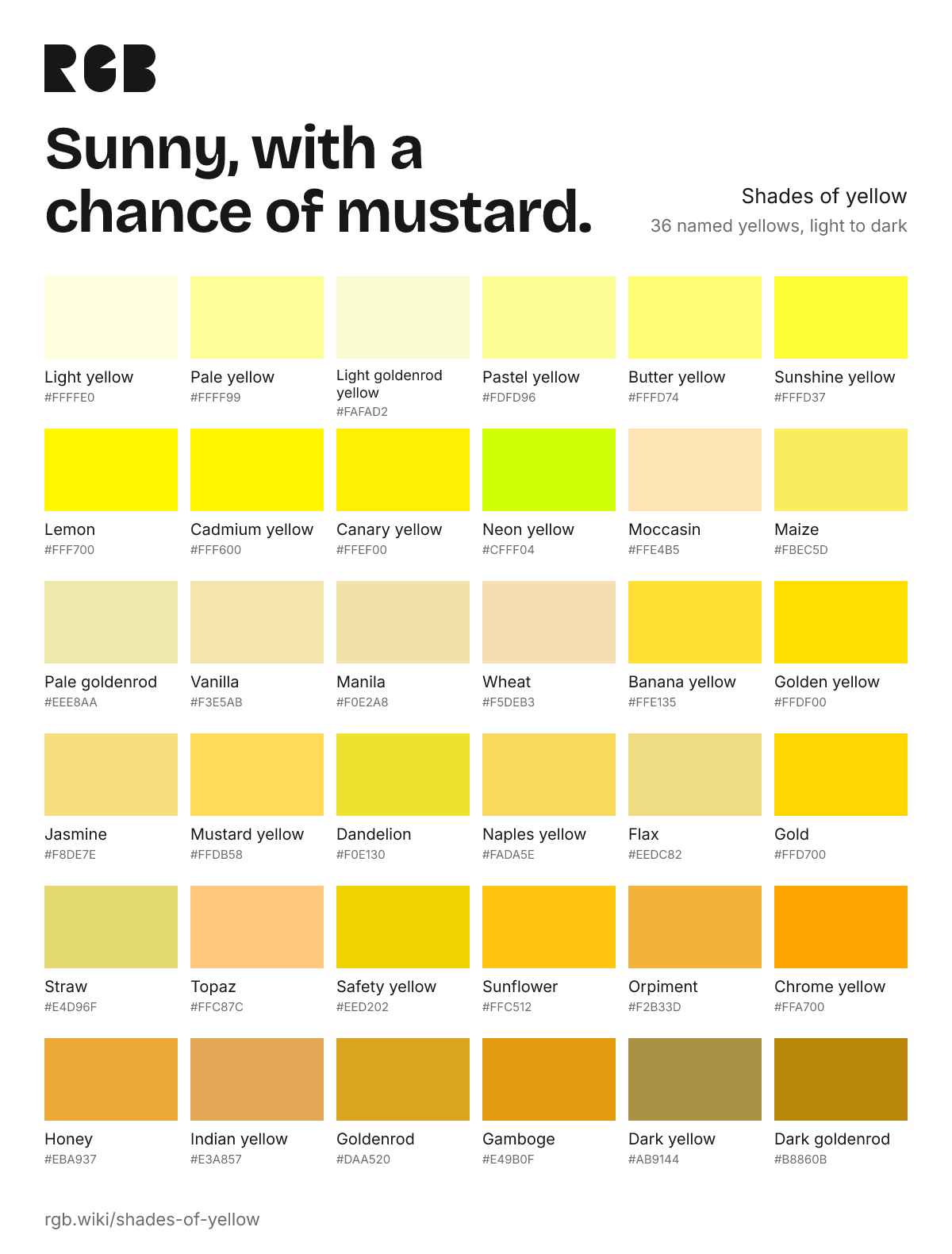
Overview
Yellow sits between green and orange in the rainbow. It is the lightest of the strong colors: a full-strength yellow is far lighter than a full-strength red or blue, which is why yellow text on white is hard to read.
On screens, yellow is red and green light at full strength with no blue: #FFFF00, the CSS keyword yellow.
Add a little red and yellow warms toward gold, mustard yellow and amber. Add a little green and it turns sharp, like neon yellow. Add white and you get the pale, buttery yellows.
| HEX | #FFFF00 | |
|---|---|---|
| RGB | rgb(255, 255, 0) | |
| HSL | hsl(60, 100%, 50%) | |
| HSV | 60°, 100%, 100% | |
| CMYK | 0, 0, 100, 0 | |
| OKLCH | oklch(96.8% 0.211 109.8) |
Types of yellow
Pale yellows
Yellow with plenty of white: light yellow, pale yellow, pastel yellow, butter yellow and vanilla.
Bright yellows
Close to pure yellow: lemon, canary yellow, sunshine yellow, banana yellow and neon yellow.
Golden yellows
Yellows that lean warm, toward orange: gold, golden yellow, sunflower, mustard yellow and honey.
Soft, natural yellows
Muted yellows named after crops and paper: wheat, straw, flax, maize and manila.
Yellows from pigments
Names from paints, old and new: Naples yellow, chrome yellow, cadmium yellow, the bright yellow that replaced it, gamboge, made from tree resin, and orpiment, a poisonous arsenic mineral.
All 36 yellows, light to dark