A deep crimson red named after an insect dye that once rivaled silver as a trade good.
Overview
Cochineal is a deep crimson red, named after one of the most valuable dyes in history. Its usual code, #9B1B30, is a strong red with a slight lean toward pink. No standard defines it, and color lists disagree on the shade.
The dye comes from the cochineal, a tiny scale insect (Dactylopius coccus) that feeds on prickly pear cactus and is native to Mexico and South America. About a fifth of its dried body is carminic acid, a red substance that keeps predators away. Treated with aluminum or calcium salts, it becomes carmine, the pigment and food color E120. It takes about 70,000 insects to make one pound of dried cochineal.
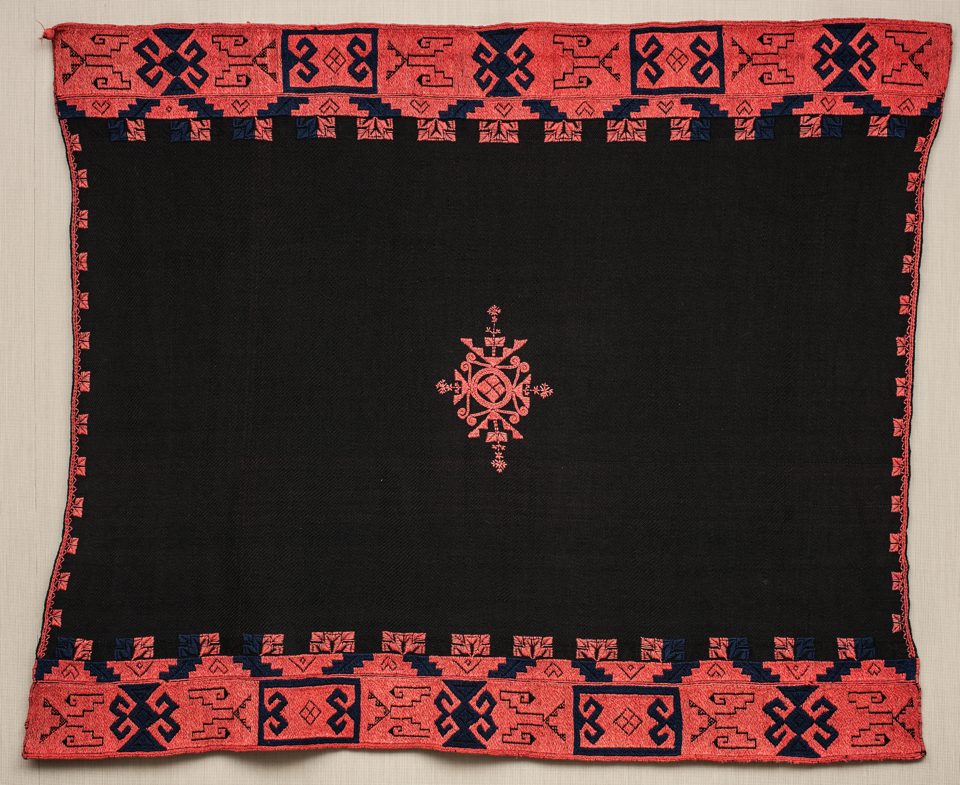
Real cochineal is not one color. How the insects are killed, and what the dye is fixed with, changes the result, and carmine can give shades from crimson to scarlet. On the wool of the Acoma cape below, it reads as a warm coral red. The 1955 ISCC-NBS dictionary files the cochineal of Maerz and Paul’s 1930 color dictionary among the vivid reds, brighter than the code.
Use cochineal as a rich, slightly cool red for headings, labels and packaging. It carries white text well and pairs with indigo, gold, cream and cactus green.
HEX
#9B1B30
RGB
rgb(155, 27, 48)
HSL
hsl(350, 70%, 36%)
HSV
350°, 83%, 61%
CMYK
0, 83, 69, 39
OKLCH
oklch(45.1% 0.162 18.7)
Every code converts from the HEX value #9B1B30. #9B1B30 is the cochineal most references use, but no standard defines it, and color lists disagree. The 1955 ISCC-NBS dictionary files the cochineal of Maerz and Paul’s A Dictionary of Color (1930) as a vivid red, much brighter; see the range below. CMYK is a screen-based estimate; print results vary.
Cochineal on the color map
LighterDarker
People’s average carmine sits just right of the code: a little warmer and more saturated. Maerz and Paul’s cochineal sits above it, lighter and much more vivid. The dyed wool sits above and to the right, lighter and warmer, and its brightest red falls outside the outline. Real cochineal ranges from crimson to scarlet, so no single dot is the true one. The outline is an approximate range, not a measured one.
Shades and tints
Tintswith white
Shadeswith black
Toneswith gray
Cochineal sits in the middle. Tints add white, shades add black and tones add gray, in 10% steps out from it. Tap any swatch to copy its code.
Light and dark cochineal
#C37683
Light cochinealMixed 40% with white. A dusty rose.
#DC143C
CrimsonLighter and brighter: the CSS keyword crimson. See crimson
#9B1B30
CochinealThe reference color.
#960018
CarmineThe pigment made from cochineal, a shade darker and more saturated. See carmine
#5D101D
Dark cochinealMixed 40% with black. A deep wine red.
Colors that go with cochineal
Pairings that work in rooms, outfits and interfaces.
Cochineal and indigo
Old dye partners: the red and blue of the Acoma cape.
Cochineal and cactus green
The bug and its host plant. Fresh and natural.
Cochineal and gold
Rich and ceremonial, like braid on a scarlet coat. Use red as the background.
Cochineal and cream
Warm and readable. Good for long text and labels.
Cochineal and slate
Modern and calm. The red stays the only accent.
Cochineal and blush
Soft and tonal. Light and dark from the same red.
Color-wheel palettes
Pick a palette to see where its colors sit on the color wheel. The caret marks cochineal. Tap a band to copy its code.
Lined up by hue around cochineal. Hover a color to see how similar it is.The bar under each name shows how similar it is. Similarity comes from the distance between the two colors in OKLab, a model of how we see color.
Cochineal vs carmine
Cochineal#9B1B30 · hue 350°
Named after the insect and its dye
A touch lighter and softer
No standard defines the code
Carmine#960018 · hue 350°
Named after the pigment made from the insect
A touch darker and more saturated
Also the food color E120
Meaning
Insect dye
Prickly pear
Trade
Redcoats
Food color
Cochineal’s meanings come from what it cost. For three centuries it was a red of wealth and rank: Aztec tribute, Spanish trade, the scarlet of British officers. Today it is the hidden red in yogurts, sweets and lipsticks. Research on color and emotion has never tested cochineal itself, so its story is historical.
Second only to silver
Historical record
After the Spanish conquest, Spaniards shipped dried cochineal to Europe by the ton. It became the region’s second most valuable export after silver, and its price was quoted on the Amsterdam and London commodity exchanges.1, 2
Scarlet for officers, madder for privates
Historical record
British officers’ coats were dyed true scarlet with cochineal, while privates wore cheaper madder red and sergeants a “lesser scarlet” of madder and cochineal. Scarlet reached all ranks only in 1873. After World War I, mainly because cochineal-dyed cloth was expensive, scarlet came back only for the guards, bands and officers’ formal dress.3
A rare allergy put it on labels
US regulation
A small number of people react to cochineal, in rare cases with anaphylaxis. Some studies put such reactions at levels no higher than for other common allergens. Since 2011, US rules require cochineal extract and carmine to be named on the labels of foods and cosmetics.4, 2
Sources (4)
Wikipedia, “Cochineal”, citing Behan, “The bug that changed history”.
For about 300 years, cochineal was one of Europe’s most prized dyes. Its story runs from Mesoamerican dyers through Spanish trade and British uniforms to today’s food labels and labs.
2nd century BC
Cochineal dye is already in use in the Americas. Later the Mixtec, Zapotec, Aztec and Otomi peoples color cloth and paper with it.1
1400s
Conquered by the Aztec Empire, eleven towns in Coixtlahuaca, Oaxaca, each pay a yearly tribute that includes 40 bags of cochineal dye.1
1500s
After the conquest, Spaniards record the harvest and ship dried insects to Europe by the ton. Cochineal becomes the region’s second most valuable export after silver.1, 2
1589
The Amsterdam commodity exchange begins to record the price of cochineal.1
1768
A British warrant has sergeants’ coats dyed a “lesser scarlet” of madder and cochineal. Officers buy coats dyed true scarlet with cochineal.3
1777
French botanist Nicolas-Joseph Thiéry de Menonville smuggles cochineal insects and cactus pads to Saint-Domingue. The colony dies out, and the Mexican monopoly holds.1
Mid-1800s
Synthetic dyes such as alizarin crimson arrive, and demand for cochineal falls sharply.1, 2
2009
The US Food and Drug Administration requires cochineal extract and carmine to be named on food and cosmetic labels from 2011, after reports of severe allergic reactions.4
2018
Researchers report the first proof of concept for making carminic acid in a microbe, the fungus Aspergillus nidulans, instead of in insects.5
Frandsen, R. J. N. et al. (2018). Heterologous production of the widely used natural food colorant carminic acid in Aspergillus nidulans. Scientific Reports, 8, 12853. doi:10.1038/s41598-018-30816-9
An Acoma woman’s wool cape or dress from New Mexico, now at the Met. The museum describes its red borders as cochineal-dyed raveled bayeta, set against indigo-dyed blue and undyed dark Churro wool. On cloth, cochineal reads as a warm rose red, lighter than the code.
#D35650#A7403D#6B3031#1C191F
Source: The Met
Source
Sampled from the Metropolitan Museum of Art’s photograph (2023.646.2), released as CC0 (public domain). Colors in a photo shift with the lighting, so read the codes as close, not exact.
#A50034#6B6B6B
BrandingLG Group
LG Red, #A50034, is a little brighter and pinker than this page’s code. LG’s CI page lists it as Pantone 207C and uses it for the face symbol.
#A50034#6B6B6B
Source: LG CI page
Source
Codes from the CI elements page of LG’s corporate site (R165 G0 B52 and R107 G107 B107), read on November 18, 2026. The logo shown is the image from the same page, unaltered.
Logos belong to their owners and are shown unaltered, only to show where each palette comes from. Palettes are sampled in-house.
Questions
What color is cochineal?
A deep crimson red. Its usual code is #9B1B30 (RGB 155, 27, 48), though no standard defines it. The real dye ranges from crimson to scarlet.
What is cochineal made from?
From cochineal insects, tiny scale insects that live on prickly pear cactus. Their dried bodies contain carminic acid, which is processed into the dye and into carmine.
Is cochineal the same as carmine?
Closely related. Carmine is the pigment made by treating cochineal’s carminic acid with aluminum or calcium salts. As a food color, it is listed as E120.
Is cochineal vegan?
No. It is made from insects, so many vegetarians and vegans avoid it. In 2012 Starbucks said it would replace cochineal in its strawberry drinks with a tomato extract after vegetarians objected.
Why were British redcoats dyed with cochineal?
Cochineal gave a true scarlet but was expensive, so at first it was used mainly for officers’ coats. Most soldiers wore cheaper madder red until scarlet was issued to all ranks in 1873.
What colors go with cochineal?
Indigo and navy, gold, cream, slate gray and cactus green. White text reads well on it.