The name means “early ripening”
Dictionary recordApricot comes, through French, Spanish, Arabic and Greek, from Latin praecocia, “early ripening”: the Latin name meant an early-ripening peach. The word reached English in the 1500s.1, 2
A soft, warm orange named after the early-ripening stone fruit.
Apricot is a pale, warm orange, close to peach. Its usual web code is #FBCEB1: strong red with a little less green and blue, which makes a soft pastel.
The name comes from the fruit. The word reached English in the 1500s as abrecock, through French and Spanish from Arabic al-barqūq and, at the root, Latin praecocia, “early ripening”. It has been used as a color name since 1851.
The fruit itself is much deeper: an orange-yellow, often flushed with red, colored mainly by beta-carotene. Merriam-Webster defines the color apricot as a moderate orange, and people in the xkcd color survey picked a stronger orange, #FFB16D, for the name.
Use #FBCEB1 as a soft, warm background or a gentle accent. It pairs well with deep teal, navy, sage and warm browns. For text, pair it with a dark color: apricot text on white is unreadable.
| HEX | #FBCEB1 | |
|---|---|---|
| RGB | rgb(251, 206, 177) | |
| HSL | hsl(24, 90%, 84%) | |
| HSV | 24°, 29%, 98% | |
| CMYK | 0, 18, 29, 2 | |
| OKLCH | oklch(88.3% 0.064 54.5) |
People’s average apricot in the xkcd survey is a stronger, deeper orange, inside the outline near its lower edge. The dictionary’s apricot sits below the outline: the same hue, but much darker. Both are closer to the real fruit than the pale web code. The outline is an approximate range, not a measured one.
Tints with white
Shades with black
Tones with gray
Pairings that work in rooms, outfits and interfaces.
Warm and cool opposites. Fresh and calm at once.
A soft accent on deep blue. Polished, good for weddings.
Orchard colors: fruit and leaf. Gentle and natural.
Warm tones together. Cozy, like a bakery.
Neighbors on the color wheel. Bright and summery.
Warmth against cool gray. Quiet and modern.
Pick a palette to see where its colors sit on the color wheel. The caret marks apricot. Tap a band to copy its code.
Lined up by hue around apricot. Hover a color to see how similar it is.The bar under each name shows how similar it is. Similarity comes from the distance between the two colors in OKLab, a model of how we see color.
Apricot feels soft, warm and sunny. Its meanings come straight from the fruit, a stone fruit grown since ancient times whose name means “early ripening”. Mood research tests broad color words such as orange, not apricot itself, so the claims here are about the name and the fruit.
Apricot comes, through French, Spanish, Arabic and Greek, from Latin praecocia, “early ripening”: the Latin name meant an early-ripening peach. The word reached English in the 1500s.1, 2
A study of 37 apricot varieties found beta-carotene was the main pigment, with total carotenoids ranging more than tenfold between varieties. The fruit’s measured hue tracked its carotenoid content closely, so deeper orange apricots carry more of it.3
Merriam-Webster defines the color apricot as a moderate orange, and the ISCC-NBS dictionary files Maerz and Paul’s apricot in the same group. People in the xkcd survey chose a strong light orange. All three are deeper than #FBCEB1.1, 4, 5
The apricot traveled west from Asia over thousands of years, and its name traveled with it through half a dozen languages. As a color name, it is a Victorian newcomer.
People domesticate the apricot in Central Asia and China, as genetic studies confirm. It grows in Armenia so early that botanists later name it Prunus armeniaca.1
The word reaches English as abrecock, from French abricot, Spanish, Arabic al-barqūq and Latin praecocia, “early ripening”.1, 2
First known use of apricot for the fruit, according to Merriam-Webster.2
First recorded use of apricot as a color name in English.3
Maerz and Paul print an apricot sample on plate 10 of A Dictionary of Color. Today’s web code is a screen match for it.3
The ISCC-NBS dictionary files Maerz and Paul’s apricot under moderate orange.4
A study of 37 varieties finds beta-carotene is the apricot’s main pigment, and that the fruit’s hue tracks its carotenoid content.5
In the xkcd color survey, people’s average apricot is a strong light orange, #FFB16D.6
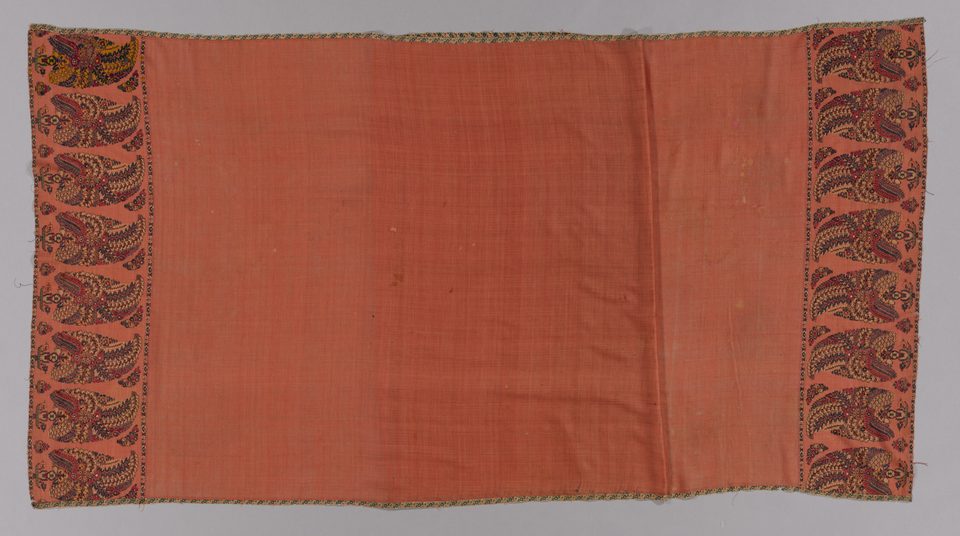
A Kashmir shawl of fine goat-hair wool, at the Cleveland Museum of Art, which titles it for its apricot field. Its ends carry rows of paisley-like cones. In the photo the plain field reads as a dusty orange-red, far deeper than the pale web code.
Sampled from the field and end borders in the Cleveland Museum of Art’s photograph (2008.215), released as CC0 (public domain). Colors in a photo shift with the lighting, so read the codes as close, not exact.
Palettes are sampled in-house.
A pale, warm orange, close to peach. The usual web code is #FBCEB1 (RGB 251, 206, 177).
It is Wikipedia’s screen match for the apricot sample in Maerz and Paul’s A Dictionary of Color (1930). No source is given for the conversion, so treat it as close, not exact.
Peach (#FFE5B4) is lighter and more yellow. Apricot is pinker and a little deeper. Both are named after stone fruits.
The fruit is an orange-yellow, often flushed with red, colored mainly by beta-carotene. Dictionaries call the color apricot a moderate orange, which is deeper than #FBCEB1.
From Latin praecocia, “early ripening”, by way of Greek, Arabic al-barqūq, Spanish and French. It first appeared in English in the 1500s.
Deep teal, navy, sage green, warm browns and coral. Use a dark color for text, since apricot is too light to read on white.