Neon green

A glowing yellowish green named after neon signs, though neon itself glows red.

Overview

Neon green is an intensely bright green with a touch of yellow. Its usual web code is #39FF14: green at full strength, with only a little red and blue. That puts it at the very edge of what a screen can show, close to pure screen green.

The name borrows the glow of neon signs, but neon gas itself glows reddish orange, and only red signs hold pure neon. The green people mean is the glow of fluorescent dyes and pigments, which turn ultraviolet and blue light into visible light. Brothers Robert and Joseph Switzer made the first fluorescent paint in Berkeley, California, in 1934.

That is why every neon green code is an approximation. A fluorescent vest gives off more green light than an ordinary surface could ever reflect, so it seems to glow even in daylight. A screen only mixes red, green and blue light up to its own white, and every color it shows could be matched by ordinary paint.

Neon green is a color for accents: a button, a line of type, a highlight on black. It is far too light to carry white text, but black or charcoal text on it reads very clearly.

HEX#39FF14
RGBrgb(57, 255, 20)
HSLhsl(111, 100%, 54%)
HSV111°, 92%, 100%
CMYK78, 0, 92, 0
OKLCHoklch(87.1% 0.286 141.5)
Every code converts from the HEX value #39FF14. #39FF14 is the neon green most color lists use, but no standard defines it: Wikipedia traces it only to a defunct website of page layouts. Real fluorescent green cannot be matched on screen, so treat any neon green code as typical, not official. CMYK is a screen-based estimate; print results vary.
Neon green color card, hex #39FF14: “Glow for it”

Neon green on the color map

People’s average neon green in the xkcd survey sits almost on top of this code, a hair greener, and so do their “fluorescent green” (#08FF08) and “highlighter green”. All of them crowd against CSS lime, the purest green a screen can make: neon greens live at the very edge of a screen’s range. The outline is an approximate range, not a measured one.

Shades and tints

Tints with white

Shades with black

Tones with gray

Neon green sits in the middle. Tints add white, shades add black and tones add gray, in 10% steps out from it. Tap any swatch to copy its code.

Light and dark neon green

#88FF72
Light neon greenMixed 40% with white. A fresh, minty green.
#39FF14
Neon greenThe reference color.
#32FB02
Fluorescent greenAlmost the same as neon green, a shade darker. Both names describe the glow of fluorescent dyes.
#7FFF00
ChartreuseYellower and a little softer, a CSS keyword with a page of its own. See chartreuse
#22990C
Dark neon greenMixed 40% with black. A strong grass green.

Colors that go with neon green

Pairings that work in rooms, outfits and interfaces.

Neon green on black

The classic glow look. Keep neon green for lines, type and buttons.

Neon green and hot pink

Two glows at once. Loud and playful, for posters and party flyers.

Neon green and charcoal

Sporty and technical. Good for apps and sportswear.

Neon green and purple

Near-opposites with punch. Suits gaming and music.

Neon green and white

Clean and bright. Use dark text on white, never green text.

Neon green and steel gray

The look of safety gear. Practical and hard to miss.

Color-wheel palettes

Pick a palette to see where its colors sit on the color wheel. The caret marks neon green. Tap a band to copy its code.

Similar colors

Green yellow58%Kiwi55%Chartreuse81%Lawn green82%Neon greenSpring green67%Medium spring green49%

Lined up by hue around neon green. Hover a color to see how similar it is.The bar under each name shows how similar it is. Similarity comes from the distance between the two colors in OKLab, a model of how we see color.

Neon green vs lime green

Neon green#39FF14 · hue 111°
  • Far brighter, at the edge of what screens show
  • Named after the glow of neon signs
  • Too light for white text
Lime green#32CD32 · hue 120°
  • Darker and calmer
  • A CSS keyword, limegreen
  • Named after the fruit

Meaning

  • Glow
  • Safety gear
  • Highlighters
  • Fluorescence
  • Screens

Neon green reads as electric, artificial and impossible to miss. That is the point: it is the look of fluorescent dyes, which were made to catch the eye, and it now marks safety vests, highlighters and sportswear. Its name points to neon signs, though neon gas glows red. Research on color and emotion tests basic words like “green”, not neon green, so claims about its mood are guesswork.

Not the color of neon

Well established

Neon gas glows reddish orange in a discharge tube, and only red signs hold pure neon. Green signs use other tricks: blue-glowing mercury vapor inside yellow uranium glass, or, since the 1920s, fluorescent coatings inside the tube.1, 2
Brighter than any ordinary surface

Color science

No ordinary surface can reflect more light of a color than falls on it. Fluorescent dyes break that limit by turning ultraviolet and blue light into longer wavelengths, and colors look fluorescent once they pass it. Every color on a standard sRGB screen can be matched by an ordinary surface, so no hex code reaches that glow.3, 4

People picture pure screen green

Online survey

In the xkcd color survey, where people named millions of colors online, the average neon green (#0CFF0C), fluorescent green (#08FF08) and highlighter green (#1BFC06) all came out almost identical: nearly the brightest, purest green a screen can show.5

Sources (5)
  1. Royal Society of Chemistry, “Neon”, Periodic Table, history and uses.
  2. Wikipedia, “Neon lighting”, citing Stephen van Dulken’s Inventing the 20th Century (2002).
  3. Jung, A., Wilkie, A., Hanika, J., Jakob, W. & Dachsbacher, C. (2019). Wide gamut spectral upsampling with fluorescence. Computer Graphics Forum, 38(4), 87–96. doi:10.1111/cgf.13773
  4. Schieber, F. (2001). Modeling the appearance of fluorescent colors. Proceedings of the Human Factors and Ergonomics Society Annual Meeting, 45(18), 1324–1327. doi:10.1177/154193120104501802
  5. Munroe, R. (2010). “Color survey results”. xkcd blog. The survey’s color averages are released as CC0 data.

History

Neon green is a 20th-century color: it took its name from neon signs and its look from fluorescent paint. The glowing green itself is older, in glass colored with uranium.

  1. 1852

    Physicist George Gabriel Stokes coins the word “fluorescence”, after the mineral fluorspar, for substances such as uranium glass that turn invisible ultraviolet light into visible light.1

  2. About 1880

    James Powell and Sons of London, one of the first firms to sell glowing uranium glass, makes a vase with a uranium glass knop. It is now at the Metropolitan Museum of Art.2, 3

  3. 1898

    William Ramsay and Morris Travers discover neon in London. Its name comes from the Greek neos, new, and in their spectrometer it glows brilliant red.4

  4. 1910

    Georges Claude shows neon tube lighting at the Paris Motor Show. His patents also foresee other gases, such as argon and mercury vapor, for colors neon cannot make.5

  5. 1934

    Brothers Robert and Joseph Switzer mix fluorescent compounds with shellac in Berkeley, California, and make the first fluorescent paint, shown that year at a magicians’ convention in Oakland.6, 7

  6. 1940s

    The Switzers develop daylight fluorescent pigments, which glow even in sunlight, and Allied troops use bright fluorescent fabrics as signals in World War II. Their company becomes Day-Glo Color Corp. in 1969.6, 8

  7. 1999

    The first US standard for high-visibility safety apparel, ANSI/ISEA 107, is published. Federal rules now require road workers’ apparel to be fluorescent yellow-green, fluorescent orange-red or both.9, 10

  8. 2010

    In the xkcd color survey, people’s average neon green is #0CFF0C, almost pure screen green.11

Sources (11)
  1. Wikipedia, “Fluorescence”, History, quoting G. G. Stokes, “On the change of refrangibility of light”, Philosophical Transactions of the Royal Society (1852).
  2. Wikipedia, “Uranium glass”.
  3. The Metropolitan Museum of Art, “Vase with knopped stem”, attributed to Harry Powell, James Powell and Sons (Whitefriars), London, about 1880 (2015.244).
  4. Royal Society of Chemistry, “Neon”, Periodic Table, history and uses.
  5. Wikipedia, “Neon lighting”, citing Stephen van Dulken’s Inventing the 20th Century (2002).
  6. Encyclopedia of Cleveland History, “Switzer, Robert C.”, Case Western Reserve University.
  7. Johnston, D. C. (1997, August 29). “Robert Switzer, Co-Inventor of Day-Glo Paint, Dies at 83”. The New York Times.
  8. Wikipedia, “Day-Glo Color Corp.”, citing the American Chemical Society’s National Historic Chemical Landmark history.
  9. Wikipedia, “High-visibility clothing”, ANSI/ISEA.
  10. USDA Forest Service, “High-Visibility Safety Apparel”, Incident Sign Installation Guide.
  11. Munroe, R. (2010). “Color survey results”. xkcd blog. The survey’s color averages are released as CC0 data.

Neon green in use

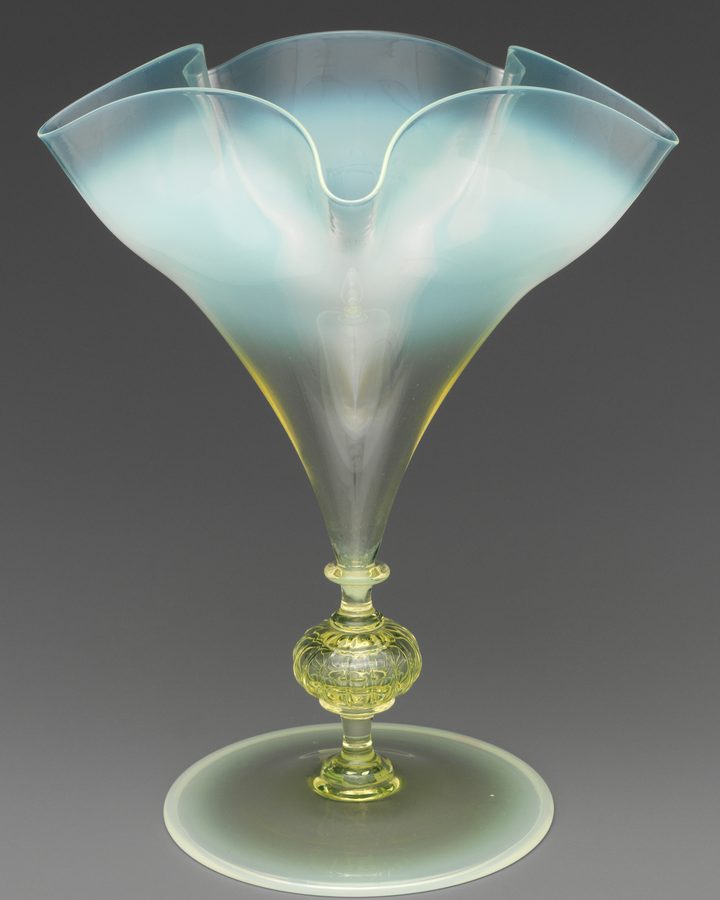
A glass vase with a wide, wavy, fan-shaped bowl in pale blue-white opal glass, on a slender stem with a ribbed yellow-green glass knob and a round foot
#DEDAA2#B6B782#ADAB57#868A54
GlassVase with uranium glass knop (about 1880)

A vase attributed to Harry Powell of James Powell and Sons, London, at the Metropolitan Museum of Art. Its knop, the swelling in the stem, is uranium glass: a pale greenish yellow in daylight, as here, it glows bright green under ultraviolet light. It is a fluorescent green from decades before neon signs.

#DEDAA2#B6B782#ADAB57#868A54
Source: The Met

Palettes are sampled in-house.

Questions

What color is neon green?

An intensely bright green with a slight yellow cast. The usual web code is #39FF14 (RGB 57, 255, 20).

Is neon green the color of neon?

No. Neon gas glows reddish orange. Green signs use mercury vapor, colored glass or fluorescent coatings, and neon green paints and inks get their glow from fluorescent pigments.

Why can’t my screen show true neon green?

Fluorescent colors turn ultraviolet and blue light into extra visible light, so they look brighter than any ordinary surface could. A screen only mixes red, green and blue light, so it can show a vivid green but not that glow.

What is the difference between neon green and lime green?

Neon green (#39FF14) is much brighter, close to the most intense green a screen can show. Lime green (#32CD32) is darker and calmer, and it is a standard CSS color.

Is fluorescent green the same as neon green?

Nearly. Both names describe the glowing green of fluorescent dyes. The fluorescent green on this page, #32FB02, is a shade darker than #39FF14, a difference most people cannot see.

What colors go with neon green?

Black, charcoal and dark purple make it glow. Hot pink makes a loud, playful pair, and steel gray gives a sporty, technical look. Use dark text on it.