Overview
At its simplest, pink is a pale red: red mixed with white. That is why it has no band of its own in the rainbow. The name comes from the garden flowers called pinks.
The CSS keyword pink is #FFC0CB, a soft, light pink. Brighter pinks such as hot pink and neon pink have less white in them and lean further toward purple. At full strength the family runs into magenta and fuchsia.
Between those ends, pinks lean warm or cool. Warm pinks such as salmon and watermelon edge toward orange, and coral crosses over into the oranges. Cool pinks such as rose and pink-purple edge toward purple.
| HEX | #FFC0CB | |
|---|---|---|
| RGB | rgb(255, 192, 203) | |
| HSL | hsl(350, 100%, 88%) | |
| HSV | 350°, 25%, 100% | |
| CMYK | 0, 25, 20, 0 | |
| OKLCH | oklch(86.8% 0.074 7.1) |
Types of pink
Pale and pastel pinks
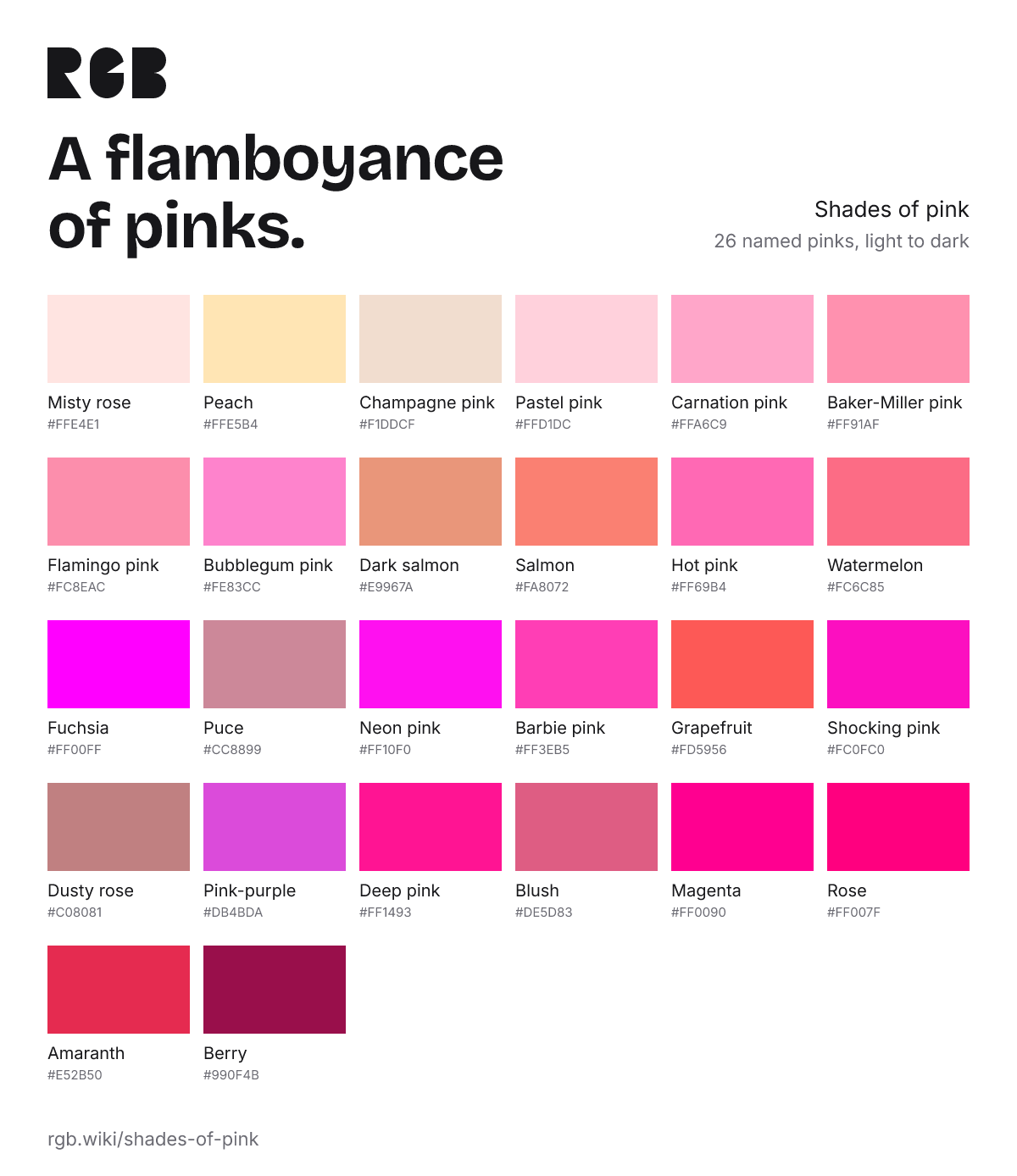
Pink with plenty of white: pastel pink, misty rose, champagne pink and carnation pink.
Hot and neon pinks
Bright, saturated pinks: hot pink, bubblegum pink, shocking pink and neon pink.
Salmon and peach pinks
Pinks that lean toward orange: peach, salmon, watermelon and grapefruit. Their neighbor coral is filed with the oranges.
Purple-pinks
Pinks that lean toward purple: pink-purple, fuchsia and magenta.
Dusty and deep pinks
Pinks grayed down or darkened: dusty rose, puce, blush and berry.
Light, dark and other pinks
Plain names like these have no single official code. Each card shows a typical value; click it to copy.
All 26 pinks, light to dark