Overview
White is what we see when light of every color reaches the eye together. Isaac Newton showed this with prisms: split sunlight and you get the rainbow, bring the rainbow back together and you get white again.
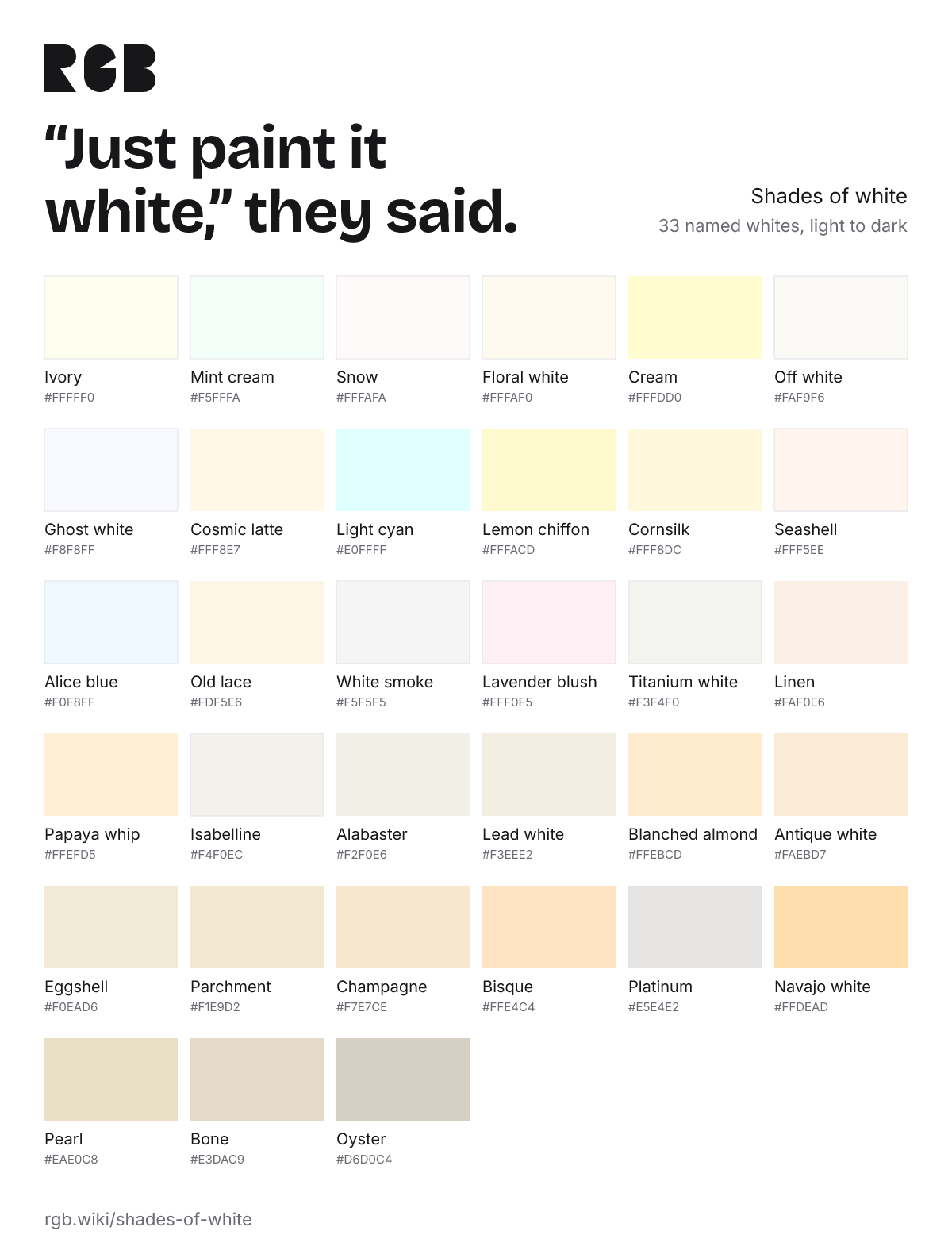
On screens, white is every channel at full strength: #FFFFFF, the CSS keyword white. The named whites are all slightly off. A touch of yellow makes them warm, like ivory and cream. A touch of blue makes them cool, like ghost white and Alice blue.
In painting, lead white was the main white for centuries, even though it is poisonous. Titanium white largely replaced it in the 20th century.
| HEX | #FFFFFF | |
|---|---|---|
| RGB | rgb(255, 255, 255) | |
| HSL | hsl(0, 0%, 100%) | |
| HSV | 0°, 0%, 100% | |
| CMYK | 0, 0, 0, 0 | |
| OKLCH | oklch(100.0% 0.000 89.9) |
Types of white
Warm whites
Whites with a touch of yellow: ivory, cream, eggshell, linen and antique white.
Cool whites
Neutral or slightly blue whites: ghost white, Alice blue, mint cream and white smoke.
Pink and peach whites
Whites with a pink or peach tint: snow, seashell, lavender blush and bisque.
Off-whites
Whites dulled with a little gray or beige: off white, alabaster, parchment, bone and oyster.
Unusual whites
Cosmic latte is the name astronomers chose for the average color of light from the galaxies around us. Champagne and pearl are named after a drink and a gem.
All 33 whites, light to dark