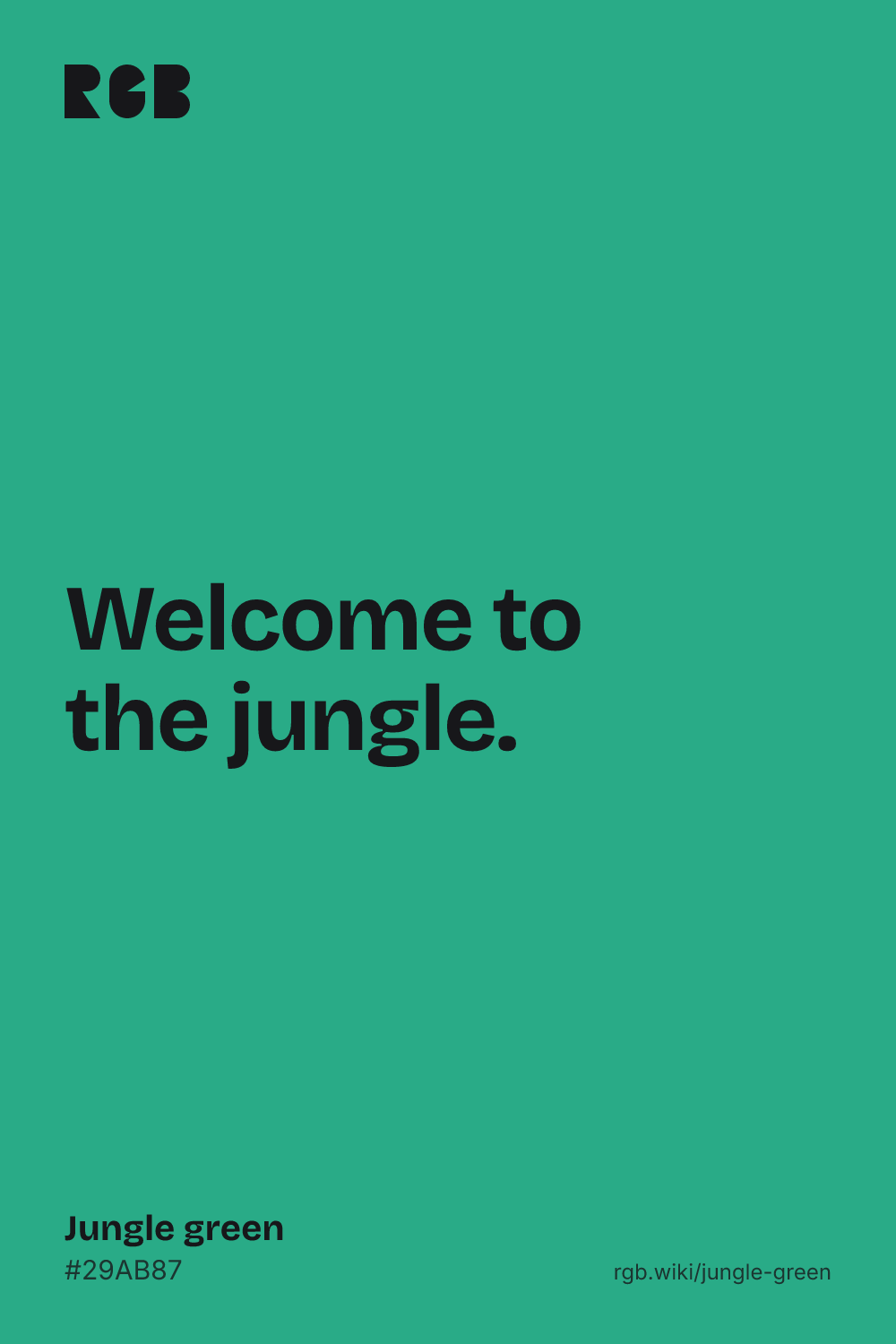
Jungle green is a medium green with a cool, bluish lean. Its usual code is #29AB87: green at 67%, blue at 53% and only a little red. That puts it between jade, which is a touch deeper and more vivid, and the bluer CSS keyword light sea green.
That bright code traces to a crayon color introduced in 1990, not to a color dictionary. The dictionaries describe something far darker. Merriam-Webster defines jungle green as “a very dark green”, and the 1955 ISCC-NBS dictionary files the jungle green sample in Maerz and Paul’s A Dictionary of Color (1930) as very dark green, centered on #1C352D, and blackish green. Oddly, the two share almost the same hue: the dictionary color is the crayon’s green with most of the light and strength taken out. People in the xkcd color survey landed in between, on a medium green.
The dark jungle green is the one soldiers knew. In Burma in the Second World War, British and Indian troops found their tan khaki drill the wrong color for the jungle. Clothing was dyed green as a stop-gap, and a jungle green uniform, “JG” for short, was in wide use by early 1944. Australians in the Pacific called theirs “jungle greens”. Gurkha battalions wore jungle green in Malaya in the 1950s, and Australians still wore jungle greens in Vietnam.
On screens, #29AB87 is light enough for black text, which reaches 7.3:1, but white text only manages 2.9:1. Use a deeper shade such as #196751 behind white text. Jungle green looks fresh with white and sand, lively against coral, and glows on near-black.