A word people agree on
One studyWhen 51 American English speakers named 330 color chips in their own words, peach was one of four high-agreement names beyond the basic eleven, with teal, lavender and maroon. Women used more color names than men.1
A soft, creamy orange named after the fruit, though dictionaries make it pinker.
Peach is a pale, creamy orange. Its usual web code is #FFE5B4: red at full strength, green a little lower and blue lower again, which tints white toward orange.
The name comes from the fruit, through French from the Latin for “Persian fruit”, although the peach was first grown in China. Peach has been a color name in English since 1588, and the web code matches the peach sample in a 1930 color dictionary.
Peach is one of the color words Americans agree on most, but they do not all mean this shade. The average peach in the xkcd color survey was a deeper orange, #FFB07C, and dictionaries define peach as a yellowish pink, closer to the blush on the fruit’s skin.
Peach needs dark text. It pairs well with mint, teal and navy, and makes a soft, warm step next to coral.
| HEX | #FFE5B4 | |
|---|---|---|
| RGB | rgb(255, 229, 180) | |
| HSL | hsl(39, 100%, 85%) | |
| HSV | 39°, 29%, 100% | |
| CMYK | 0, 10, 29, 0 | |
| OKLCH | oklch(93.1% 0.069 83.2) |
People’s average peach in the xkcd survey is deeper and more orange, below and to the left of the outline. The survey’s “pale peach” (#FFE5AD) is almost exactly the web code. The dictionary’s yellowish pink is so much pinker that it falls off the left edge of this view. The outline is an approximate range, not a measured one.
Tints with white
Shades with black
Tones with gray
Pairings that work in rooms, outfits and interfaces.
Soft and sweet. Suits nurseries, stationery and bakeries.
Warm against cool. Fresh and grown-up.
Crisp and classic. Navy text reads well on peach.
Tonal and warm, from pale peach to bright coral.
Earthy and gentle. Good for weddings and home goods.
Quiet and modern. Peach warms up a dark layout.
Pick a palette to see where its colors sit on the color wheel. The caret marks peach. Tap a band to copy its code.
Lined up by hue around peach. Hover a color to see how similar it is.The bar under each name shows how similar it is. Similarity comes from the distance between the two colors in OKLab, a model of how we see color.
Peach feels warm, soft and friendly, after the ripe fruit. In Chinese art the peach stands for long life, and in the United States it stands for Georgia. As with most named colors, mood research tests broad hues such as orange or pink, not peach itself.
When 51 American English speakers named 330 color chips in their own words, peach was one of four high-agreement names beyond the basic eleven, with teal, lavender and maroon. Women used more color names than men.1
In Chinese art, peaches stand for longevity. On a porcelain dish from the 1720s or early 1730s, now in Chicago, they are painted with five bats, a picture pun for the five blessings.2
The Latin name points to Persia, but the peach was first grown in China. Ancient peach stones from the lower Yangzi valley suggest people there were selecting the fruit at least 7,500 years ago.3
The peach is Georgia’s official state fruit. The state earned its “Peach State” name in the three decades after the Civil War, as peach orchards spread.4
People grew peaches for thousands of years before anyone named a color after them.
Ancient peach stones suggest that people in the lower Yangzi valley of China are already selecting peaches for their fruit.1
“Peach” enters English as the name of the fruit, from Latin persicum, “Persian fruit”.2
First recorded use of “peach” as a color name in English.3
During the Yongzheng reign, a Chinese porcelain dish is painted with peaches and bats, symbols of long life and blessings.4
Georgia earns its name as the Peach State in the three decades after the Civil War.5
Maerz and Paul’s A Dictionary of Color prints a peach sample, the match for today’s #FFE5B4.3
A study of American color names finds peach among the most agreed-on color words beyond the basic eleven.6
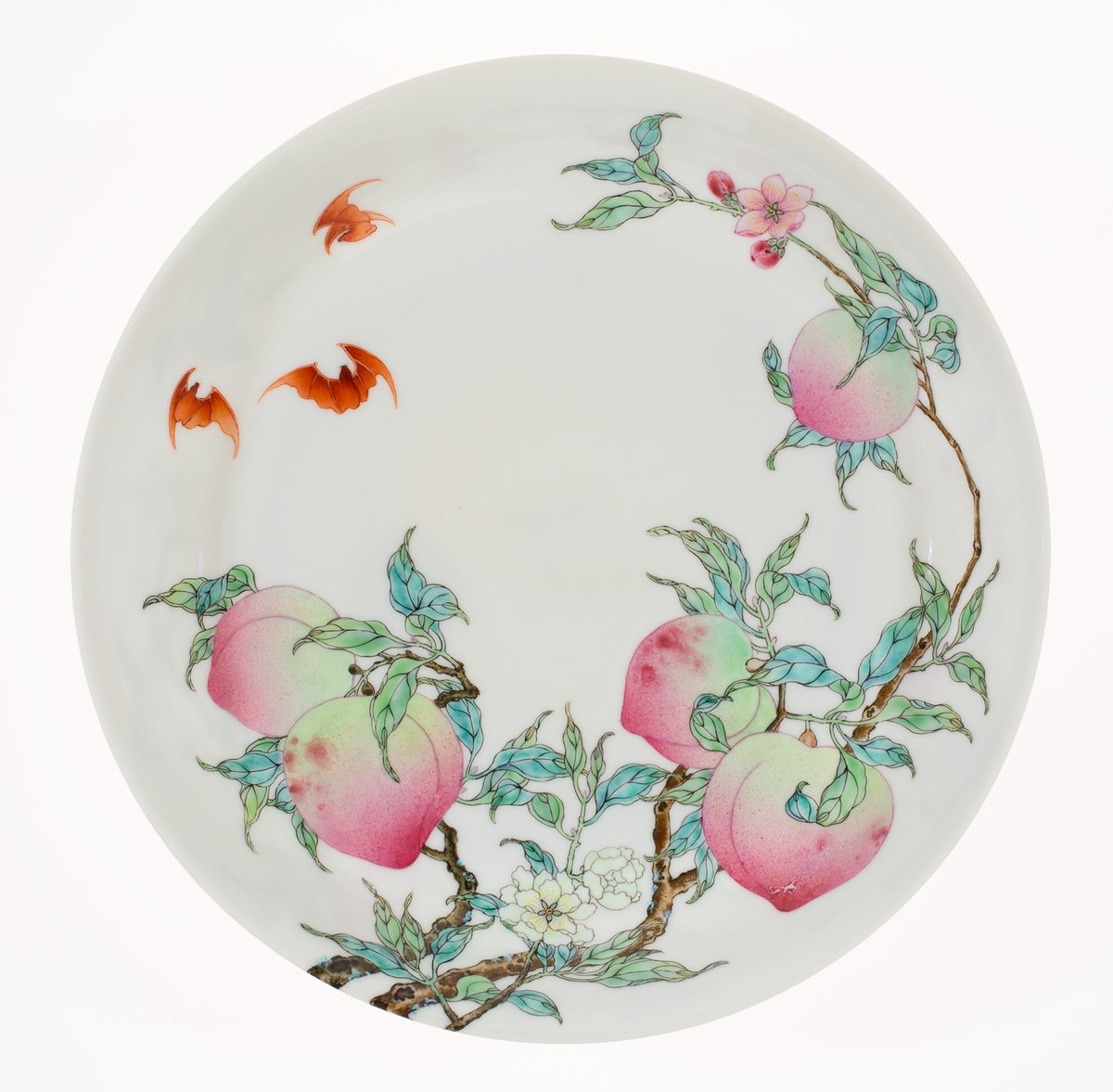
A Chinese porcelain dish painted in soft famille rose enamels, at the Art Institute of Chicago. The peaches blush from pink to pale green, and their pink samples close to the dictionaries’ yellowish-pink peach, much pinker than the web code. The museum notes that the pink enamel was colored with tiny fragments of gold.
Sampled from the peaches and leaves in the Art Institute of Chicago’s photograph (1941.760), released as CC0 (public domain). Colors in a photo shift with the lighting, so read the codes as close, not exact.
Palettes are sampled in-house.
A pale, creamy orange. The usual web code is #FFE5B4 (RGB 255, 229, 180). Dictionaries describe peach as a pinker color, a moderate yellowish pink.
It depends on who you ask. The web’s peach is a pale orange, close to cream. Dictionaries call peach a yellowish pink, and people in the xkcd survey picked a deeper orange. All three borrow from the fruit, which is orange-yellow inside and pink on the skin.
Peach (#FFE5B4) is paler and leans toward yellow. Apricot (#FBCEB1) is a little deeper and leans toward pink.
Mint for a soft, sweet look, teal or navy for contrast, coral for a warm tonal pairing, and charcoal for something modern.
After the fruit. The word comes through French from the Latin for “Persian fruit”, because the Romans thought peaches came from Persia. They were first grown in China.
No. CSS has peachpuff (#FFDAB9), which is a little pinker, and moccasin (#FFE4B5), which is practically identical to peach.