Periwinkle

A soft lavender blue, named after the small spring flower of the periwinkle vine.

Overview

Periwinkle is a pale blue with a touch of purple, the color of the periwinkle flower. Its classic code is #CCCCFF: equal red and green with full blue, a gentle, cool pastel.

The plant behind the name, Vinca minor, is a creeping evergreen grown as ground cover, with five-petaled blue-violet flowers in spring. English has had a name for it since before the 12th century, but “periwinkle” only appears as a color name in 1922.

Is it blue or purple? Dictionaries call it a light purplish blue, and by our calculation its dominant wavelength falls in the blue part of the spectrum. Next to lavender it looks blue; next to sky blue it looks purple.

When people name colors themselves, their periwinkle is much stronger than the classic code. The average “periwinkle” in the xkcd color survey, #8E82FE, is a vivid blue-violet.

HEX#CCCCFF
RGBrgb(204, 204, 255)
HSLhsl(240, 100%, 90%)
HSV240°, 20%, 100%
CMYK20, 20, 0, 0
OKLCHoklch(86.2% 0.070 284.8)
Every code converts from the HEX value #CCCCFF. #CCCCFF matches the periwinkle sample in Maerz and Paul’s A Dictionary of Color (1930), as cited on Wikipedia. CMYK is a screen-based estimate; print results vary.
Periwinkle color card, hex #CCCCFF: “Gone in a periwinkle of an eye”

Periwinkle on the color map

People’s average periwinkle is far stronger than the pale dictionary sample, and “periwinkle blue” comes out only a little bluer than plain “periwinkle”. The outline is an approximate range, not a measured one.

Shades and tints

Tints with white

Shades with black

Tones with gray

Periwinkle sits in the middle. Tints add white, shades add black and tones add gray, in 10% steps out from it. Tap any swatch to copy its code.

Light and dark periwinkle

#E0E0FF
Light periwinkleMixed 40% with white. A whisper of blue; good as a page background.
#CCCCFF
PeriwinkleThe reference color.
#7275C4
Dark periwinkleA deeper, stronger blue-violet with a page of its own, not a plain mix with black. See dark periwinkle

Colors that go with periwinkle

Pairings that work in rooms, outfits and interfaces.

Periwinkle and navy

Classic and crisp. Works for weddings, stationery and menswear.

Periwinkle and butter yellow

Its near-opposite. Fresh, springlike and friendly.

Periwinkle and coral

Playful contrast for summer and children’s brands.

Periwinkle and slate

Quiet and modern. Good for interfaces.

Periwinkle and sage

Soft and garden-like. Calm for interiors.

Periwinkle and plum

Tonal and rich, from pale to deep.

Color-wheel palettes

Pick a palette to see where its colors sit on the color wheel. The caret marks periwinkle. Tap a band to copy its code.

Similar colors

Light blue66%Columbia blue72%PeriwinkleLight gray65%Gainsboro61%Mauve63%Thistle72%

Lined up by hue around periwinkle. Hover a color to see how similar it is.The bar under each name shows how similar it is. Similarity comes from the distance between the two colors in OKLab, a model of how we see color.

Periwinkle vs lavender

Periwinkle#CCCCFF · hue 240°
  • Leans blue
  • Lighter and softer
  • Named after the periwinkle flower
Lavender#B57EDC · hue 275°
  • Leans purple
  • Darker and stronger
  • Named after the lavender plant

Meaning

  • Calm
  • Spring
  • Softness
  • Friendliness
  • Coolness

Periwinkle feels calm, friendly and fresh. It has the cool of blue without its seriousness, and a hint of purple’s playfulness, which makes it popular for spring weddings, children’s rooms and soft interfaces. Like most named colors, it hasn’t been studied on its own; the research below tests light colors and blues in general.

Pale colors feel calmer

One lab study

In a 1994 study with color chips, brighter, less saturated colors were rated more pleasant and less arousing, and purple-blue was among the least arousing hues. Periwinkle is all three, though it was not tested by name.1
Blues are the best-liked colors

Tested on blue only

In lab studies, color preference peaks at blue. One explanation is that people link blues with things they like, such as clear skies and clean water.2

Its look shifts with its neighbors

Well established

Next to blue, periwinkle looks more violet; next to purple, it looks bluer. Surrounding colors change how any color looks, a well-studied effect, and an in-between color like periwinkle can seem to switch sides.3

Sources (3)
  1. Valdez, P. & Mehrabian, A. (1994). Effects of color on emotions. Journal of Experimental Psychology: General, 123(4), 394–409. doi:10.1037/0096-3445.123.4.394
  2. Palmer, S. E. & Schloss, K. B. (2010). An ecological valence theory of human color preference. Proceedings of the National Academy of Sciences, 107(19), 8877–8882. doi:10.1073/pnas.0906172107
  3. Shevell, S. K. & Kingdom, F. A. A. (2008). Color in complex scenes. Annual Review of Psychology, 59, 143–166. doi:10.1146/annurev.psych.59.103006.093619

History

Periwinkle was a plant name for centuries before it was a color. The flower turns up in old flower books; the color name is barely a hundred years old.

  1. Before 1100s

    Old English already has a name for the plant, perwince, from the Latin pervinca.1

  2. 1608

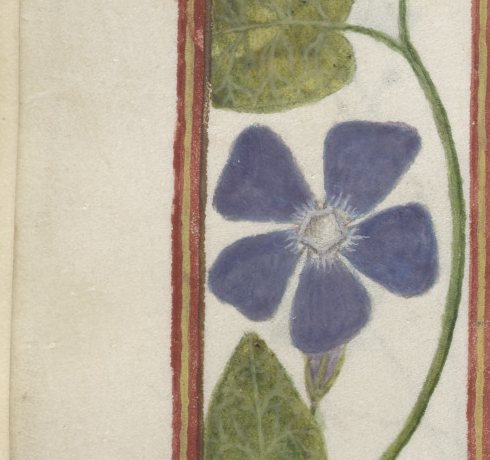
    A French book of flower paintings frames one of its pages with blue-violet periwinkles.2

  3. 1922

    First recorded use of “periwinkle” as a color name in English.3

  4. 1930

    Maerz and Paul’s A Dictionary of Color prints a periwinkle sample that matches #CCCCFF.3

  5. 1997

    Baseball’s Anaheim Angels unveil new uniforms with navy, periwinkle and red as their main colors.4

Sources (4)
  1. Merriam-Webster, “periwinkle”, etymology and first known use.
  2. Cleveland Museum of Art, “Dianthus with Periwinkle Border”, from Florilegium (A Book of Flower Studies), France, 1608.
  3. Oxford English Dictionary, 2nd ed. (1989), and Maerz, A. & Paul, M. R. (1930), A Dictionary of Color, both as cited in Wikipedia, “Periwinkle (color)”.
  4. Sports Business Journal (February 1997). “It’s all about periwinkle: Angels unveil new uniforms”.

Periwinkle in use

A painted periwinkle flower with five blue-violet petals and green leaves, inside a red-lined page border
#69697F#858456#DAD2BE#7F694C
ArtPeriwinkle border from a florilegium (1608)

A detail from a French book of flower paintings at the Cleveland Museum of Art. The painted periwinkles have aged to a grayer blue-violet than the living flower, and they are much deeper than the pale color named after it.

#69697F#858456#DAD2BE#7F694C
Source: Cleveland Museum

Palettes are sampled in-house.

Questions

What color is periwinkle?

A pale blue with a touch of purple, named after the periwinkle flower. Its classic code is #CCCCFF, which is RGB 204, 204, 255.

Is periwinkle blue or purple?

It is a blue with a purple lean. Dictionaries define it as a light purplish blue, and it reads as blue next to lavender and as purple next to sky blue. That is why both “periwinkle blue” and “periwinkle purple” are common.

What colors go with periwinkle?

Navy and slate gray keep it crisp; butter yellow and coral make it playful; sage and plum give a softer, garden-like look.

What is the difference between periwinkle and lavender?

Periwinkle (#CCCCFF) leans blue and is lighter. Lavender (#B57EDC) leans purple and is darker and stronger.

What flower is periwinkle named after?

The lesser periwinkle, Vinca minor, an evergreen creeper with five-petaled blue-violet flowers. It is often planted as ground cover.

Is periwinkle a warm or cool color?

Cool. It is a blue at heart, with only a little red, so it sits on the cool side of the color wheel.