Its color depends on age and polish
Collectors’ guidancePewter does not tarnish like silver. Kept polished in daily use, it looks bright. Much old pewter has a patina that ranges from mellow silver to charcoal gray, a look many collectors prefer.1
A soft, cool gray named after the tin alloy of old plates and tankards.
Pewter is a soft, medium gray with a cool, slightly blue cast. The code used here, #899499, has a little more green and blue than red, which keeps it from looking flat. Merriam-Webster defines the color pewter as a bluish gray.
The name comes from the metal, an alloy that is mostly tin. The word reached English from the Anglo-French peutre in the 14th century. For centuries pewter was everyday tableware in Britain and Europe: plates, spoons, drinking pots and church flagons.
Pewter itself changes with age. Polished, it looks like a soft silver. Left alone, it gains a patina that the Pewter Society describes as anything from mellow silver to charcoal gray. In museum photos, old pewter often reads as a warmer gray than the code, such as #A7A393 on a tureen from 1820.
Old pewter is satiny rather than mirror-bright, so a flat swatch suits it better than it suits most metals. A soft gradient from #B8BFC2 to #52595C is enough to suggest metal. Black text is easy to read on pewter; white text works only at large sizes.
| HEX | #899499 | |
|---|---|---|
| RGB | rgb(137, 148, 153) | |
| HSL | hsl(199, 7%, 57%) | |
| HSV | 199°, 10%, 60% | |
| CMYK | 10, 3, 0, 40 | |
| OKLCH | oklch(65.9% 0.015 226.7) |
The xkcd survey has no average for pewter. Light slate gray, the nearest CSS keyword, is a little darker and bluer and sits at the right edge of the outline. The museum pewter samples are warm, yellowish grays, on the far side of the hue circle, so they fall outside the close view. The dictionary’s dark gray has no hue at all and is much darker. The outline is an approximate range, not a measured one.
Tints with white
Shades with black
Tones with gray
Pairings that work in rooms, outfits and interfaces.
Soft and old-fashioned, like a dresser of old plates.
Cool and grown-up. Good for menswear and finance.
A quiet gray brightened by a warm yellow.
Gentle and modern. Nice for bedrooms and stationery.
Calm and natural. Suits outdoor brands.
Tone on tone. Restful for interfaces.
Pick a palette to see where its colors sit on the color wheel. The caret marks pewter. Tap a band to copy its code.
Lined up by hue around pewter. Hover a color to see how similar it is.The bar under each name shows how similar it is. Similarity comes from the distance between the two colors in OKLab, a model of how we see color.
Pewter brings to mind old plates on a dresser, pub tankards and things handed down. Its meanings come from the metal’s long life as everyday tableware. Color research tests broad words like gray, not pewter, so the claims here are about the metal.
Pewter does not tarnish like silver. Kept polished in daily use, it looks bright. Much old pewter has a patina that ranges from mellow silver to charcoal gray, a look many collectors prefer.1
Traditional pewter was tin with as much as 40% lead. Modern pewter replaces the lead with antimony, copper and bismuth to prevent lead poisoning. In Britain, a cheaper grade with more lead went into pots and measures, and a finer grade into plates and spoons.2, 3
Between 1650 and 1780, British households across the social spectrum replaced their wooden plates, called trenchers, with pewter. Even grand houses used pewter alongside silver, until mass-produced ceramics took over.4, 5
Pewter has been made since the Bronze Age and was everyday tableware in Europe for centuries, until mass-produced ceramics replaced it.
The earliest known piece of pewter is buried in an Egyptian tomb.1
The Worshipful Company of Pewterers exists in London by this year. Its rules later set the makeup of English pewter. The word “pewter” itself entered English in the same century.2, 3, 4
A harder pewter strengthened with antimony, called “hard metal”, spreads from Continental Europe to Britain. The Pewter Society calls this the golden age of pewter making.3
Shen Cunzhou, a renowned pewter artist of the early Qing dynasty, makes a pair of inscribed tea caddies now at the Metropolitan Museum of Art.5
British households replace wooden trenchers with pewter plates in huge numbers.6
The Vickers company in Sheffield develops Britannia metal, a lead-free pewter that can be rolled, spun and pressed in factories.3
The coronation banquet of George IV seats 1,268 diners in Westminster Hall. It is the last coronation banquet, and a pewter service is made for it.7, 8
The ISCC-NBS dictionary files Maerz and Paul’s pewter as a dark gray.9
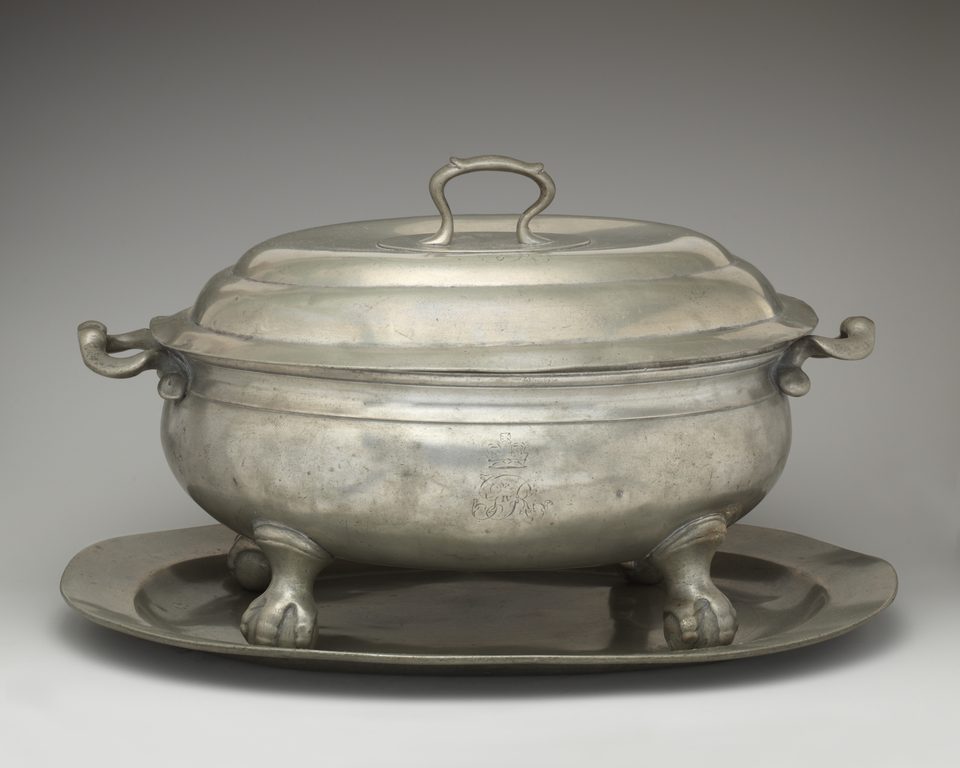
Part of a pewter service made for the coronation banquet of George IV, with a crowned royal monogram on the side. The coronation was planned for 1820 and held in 1821. The pewter reads as a warm gray, about #A7A393, warmer than the bluish web code.
Sampled from the body of the tureen in the Metropolitan Museum of Art’s photograph (41.166.1a, b, .2), released as CC0 (public domain). The banquet story comes from the museum’s description and Wikipedia. Colors in a photo shift with the lighting, so read the codes as close, not exact.
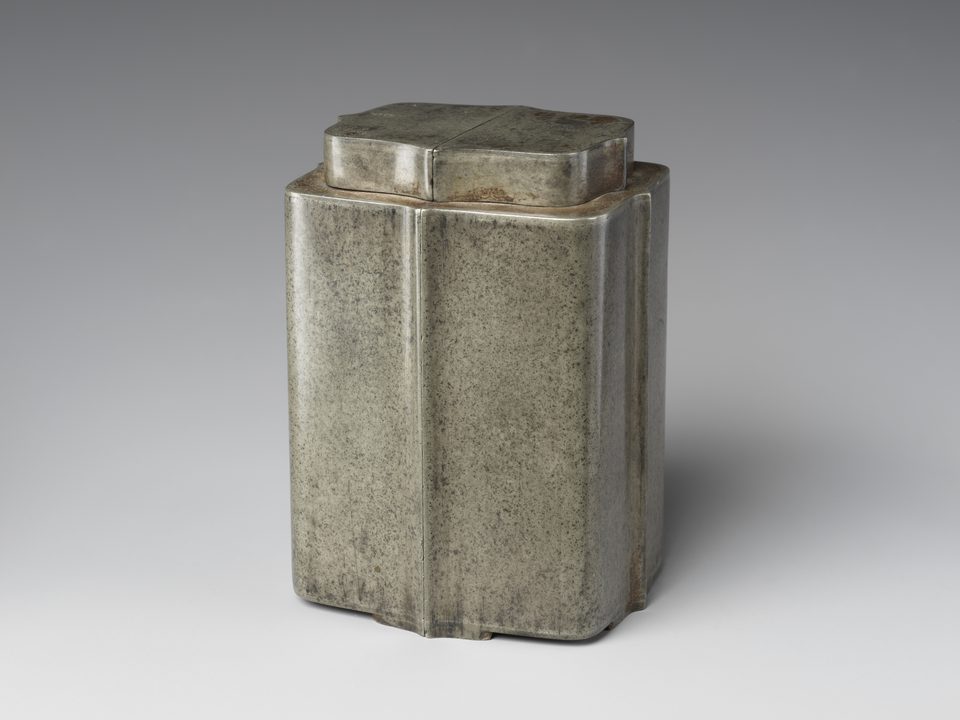
A rare work by the renowned early Qing pewter artist Shen Cunzhou. The inner faces carry incised texts from the Tang, Song and Yuan dynasties. The mottled surface reads as a greenish gray, about #868170.
Sampled from the sides of the caddy in the Metropolitan Museum of Art’s photograph (2020.333a–d), released as CC0 (public domain). The photo shows one caddy of the pair. Colors in a photo shift with the lighting, so read the codes as close, not exact.
Palettes are sampled in-house.
A soft, medium gray with a cool blue cast. The code used here is #899499 (RGB 137, 148, 153).
Mostly tin. Old pewter often contained lead, as much as 40%. Modern pewter uses antimony, copper and bismuth instead.
No. Pewter (#899499) is darker and slightly blue. Silver (#C0C0C0) is lighter and perfectly neutral.
Not like silver. Polished pewter stays bright, but old pewter often darkens to a patina between mellow silver and charcoal gray.
Cream for a cozy, old-fashioned look, navy or charcoal for a modern one, and mustard or blush for a lift.
No. #899499 is a common web value, but no standard defines it. Old pewter in museum photos is often a warmer gray.