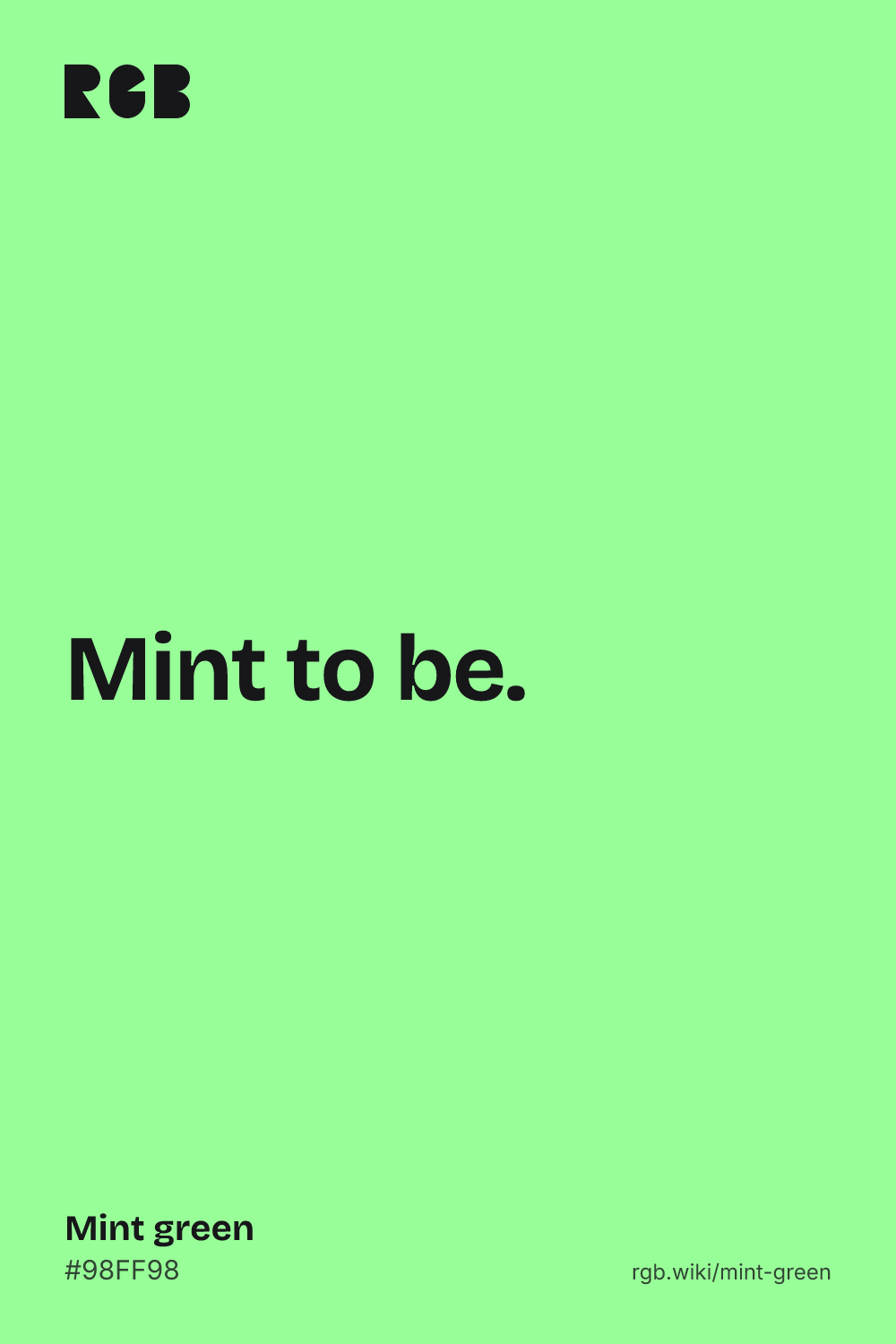
A pale, fresh green named after the herb, though far lighter than its leaves.
Overview
Mint green is a pale, bright green. Its usual web code is #98FF98: green at full strength, with red and blue at a bit more than half, which lifts a pure green toward white.
The name comes from the herb. “Mint” has been a color name in English since 1920, and the first mint in color books was a deep green, much like the leaf.
Since then the name has grown paler. By the 1950s, mint green in mass-market color names meant a light green, and the web code is lighter and brighter still. No standard defines it, and it is almost the same as the CSS keyword palegreen.
Mint green feels fresh and light. It pairs well with white, coral, peach and charcoal, and softens a dark navy.
HEX
#98FF98
RGB
rgb(152, 255, 152)
HSL
hsl(120, 100%, 80%)
HSV
120°, 40%, 100%
CMYK
40, 0, 40, 0
OKLCH
oklch(91.3% 0.168 144.0)
Every code converts from the HEX value #98FF98. No color standard defines #98FF98 as mint green. It is the code given in Wikipedia’s list of colors without a source. The same numbers were pale green in John C. Thomas’s version of the X Window System color list in the 1980s; the CSS keyword palegreen settled on #98FB98, four steps less green. The 1955 ISCC-NBS dictionary and Merriam-Webster both describe mint green as a light green. CMYK is a screen-based estimate; print results vary.
Mint green on the color map
LighterDarker
People’s average mint green in the xkcd survey sits almost on top of the web code, a hair bluer. The dictionary’s mint green sits down and to the right, near the bottom of this view: darker, grayer and bluer. The outline is an approximate range, not a measured one.
Shades and tints
Tintswith white
Shadeswith black
Toneswith gray
Mint green sits in the middle. Tints add white, shades add black and tones add gray, in 10% steps out from it. Tap any swatch to copy its code.
Light and dark mint green
#F5FFFA
Mint creamAlmost white, with a cool green tint. A CSS keyword, mintcream. See mint cream
#C1FFC1
Light mintMixed 40% with white. A soft pastel.
#98FF98
Mint greenThe reference color.
#91D991
Muted mintMixed 30% with gray. Calmer and easier on the eyes.
#49A34B
Dark mint greenA deeper, grassier mid green.
Colors that go with mint green
Pairings that work in rooms, outfits and interfaces.
Mint green and coral
Fresh and summery. Warm coral balances cool mint.
Mint green and white
Clean and airy. Good for kitchens, bathrooms and simple packaging.
Mint green and charcoal
Modern and crisp. The mint glows against a dark gray.
Mint green and peach
Soft and sweet. Suits nurseries, stationery and bakeries.
Mint green and navy
Preppy and nautical. A little mint lifts a deep blue.
Mint green and lavender
A light pastel pair. Playful, and best with a darker text color.
Color-wheel palettes
Pick a palette to see where its colors sit on the color wheel. The caret marks mint green. Tap a band to copy its code.
Green yellow59%Kiwi53%Mint greenSpring green60%Medium spring green63%Seafoam green56%Aquamarine63%
Lined up by hue around mint green. Hover a color to see how similar it is.The bar under each name shows how similar it is. Similarity comes from the distance between the two colors in OKLab, a model of how we see color.
Mint green vs seafoam green
Mint green#98FF98 · hue 120°
A pure pastel green, no blue lean
Brighter and more vivid
Named after the herb
Seafoam green#93E9BE · hue 150°
Cooler, with a touch of blue
Softer and less bright
Named after the froth on the sea
Meaning
Mint leaves
Pastels
Light and bright
Pleasant
Mint green reads as fresh, light and cool, like the herb and its flavor. Yet the color has drifted far from the leaf. The first color called mint was a deep green; by the 1950s, mint green meant a light green; the web code is paler and brighter still. Mood research has not tested mint green itself, but one well-known study links light, bright colors and green hues with pleasure.
Once a deep green
Dictionary record
Maerz and Paul’s 1930 A Dictionary of Color dates mint as a color name to 1920. The 1955 ISCC-NBS dictionary files their mint sample as a dark green and a dark bluish green, close to the leaf and far from today’s pale code.1, 2
A light green by the 1950s
Dictionary
The 1955 dictionary matched color names across trades. Its own example: mint green in mass-market names meant the same as serpentine in fashion, “or in ordinary language, a light green”.2
Light and bright feels pleasant
One lab study
In a 1994 lab study with color chips, brighter colors were rated more pleasant, and green and blue-green were among the most pleasant hues. Mint green is very light and fairly vivid, but the study tested chips by hue, brightness and saturation, not mint green itself.3
Sources (3)
Wikipedia, “Spring green”, section on mint, citing Maerz and Paul’s A Dictionary of Color (1930), p. 199 and plate 29.
Kelly, K. L. & Judd, D. B. (1955). The ISCC-NBS Method of Designating Colors and a Dictionary of Color Names. National Bureau of Standards Circular 553. PDF at NIST. Entries for mint and mint green as tabulated in Jaffer’s color-name dictionaries.
Valdez, P. & Mehrabian, A. (1994). Effects of color on emotions. Journal of Experimental Psychology: General, 123(4), 394–409. doi:10.1037/0096-3445.123.4.394
History
Mint green took the name of an old herb and kept getting lighter, from a deep leaf green to the near-pastel code used on screens today.
Before 1100s
“Mint”, the herb, is an English word, from Old English minte and Latin mentha.1
1920
First recorded use of “mint” as a color name in English.2
1930
Maerz and Paul’s A Dictionary of Color prints a mint sample. The 1955 ISCC-NBS dictionary files it as a dark green.2, 3
1955
The ISCC-NBS dictionary finds that mint green, in mass-market color names, means a light green.3
1989
The X Window System’s color list sets pale green at 152, 251, 152 and adds an almost-white mint cream. A version tuned by John C. Thomas at Tektronix had pale green at 152, 255, 152, the numbers of today’s mint green code.4, 5
2001
SVG 1.0 makes “palegreen” and “mintcream” web color names. Mint green never becomes a keyword.6
Sources (6)
Merriam-Webster, “mint”, etymology and first known use.
Wikipedia, “Spring green”, section on mint, citing Maerz and Paul’s A Dictionary of Color (1930), p. 199 and plate 29.
Kelly, K. L. & Judd, D. B. (1955). The ISCC-NBS Method of Designating Colors and a Dictionary of Color Names. National Bureau of Standards Circular 553. PDF at NIST. Entries as tabulated in Jaffer’s color-name dictionaries.
Wikipedia, “X11 color names”, history of the list; X11 Release 4 shipped the merged list in December 1989 (X.Org archive).
A pale, bright green. The usual web code is #98FF98 (RGB 152, 255, 152). No standard defines it, and dictionaries describe mint green more loosely as a light green.
What is the difference between mint green and seafoam green?
Mint green (#98FF98) is a pure, brighter pastel green. Seafoam green (#93E9BE) is softer and cooler, with a touch of blue.
Is mint green the same as pale green?
Nearly. The CSS keyword palegreen is #98FB98, four steps less green than mint green’s usual code, and the two look the same side by side. An early version of the X Window System color list even used #98FF98 for pale green.
What colors go with mint green?
White for a clean look, coral and peach for warmth, and charcoal or navy for contrast. With lavender it makes a light pastel pair.
Why is it called mint green?
After the herb. The first color called mint, in 1920, was a deep green close to the leaf. The name has grown paler since.
Where does the code #98FF98 come from?
No standard defines it. It is the code given in Wikipedia’s list of colors, and it matches the pale green of one early X Window System color list.