Avocado green

A deep yellow green named after the avocado, and the signature color of the 1970s kitchen.

Overview

Avocado green is a deep, strong yellow green, named after the skin of the avocado. The code used here, #568203, has green well ahead of red and almost no blue, which makes it richer and less gray than olive green. It sits near the middle of the brightness scale: white and black text both pass on it, only just.

Most people know the color from their parents’ or grandparents’ kitchens. Avocado arrived on refrigerators and stoves in the mid-1960s, after coppertone and before harvest gold, and by the 1970s the three, with burnt orange, were the colors of the American kitchen. Bathroom fixtures followed. Today “avocado bathroom” is shorthand for 1970s taste.

The code comes from a color list, not a standard. Wikipedia gives #568203 for avocado, citing a French online color dictionary that is no longer online, and files it under the ISCC-NBS category deep yellow green. No 1930s color dictionary lists avocado at all, and Merriam-Webster defines the color as “a light yellowish green”. People asked to name colors agree with the dictionary: their average avocado green is #87A922, far lighter than this code.

The fruit itself holds several greens. A Hass avocado’s skin goes from green to purple-black as it ripens, while its flesh runs from dark green under the skin, through pale green, to yellow next to the seed. The web code is closest to the skin of an unripe fruit.
HEX#568203
RGBrgb(86, 130, 3)
HSLhsl(81, 95%, 26%)
HSV81°, 98%, 51%
CMYK34, 0, 98, 49
OKLCHoklch(55.3% 0.147 129.5)
Every code converts from the HEX value #568203. #568203 is the avocado given by Wikipedia, which cites the French color dictionary Pourpre.com (now offline, so the value could not be checked against it) and names its ISCC-NBS category as deep yellow green, centered on #467129. No standard defines avocado green: Maerz and Paul’s 1930 A Dictionary of Color has no avocado entry (ISCC-NBS list), and the xkcd survey average is a lighter #87A922. CMYK is a screen-based estimate; print results vary.
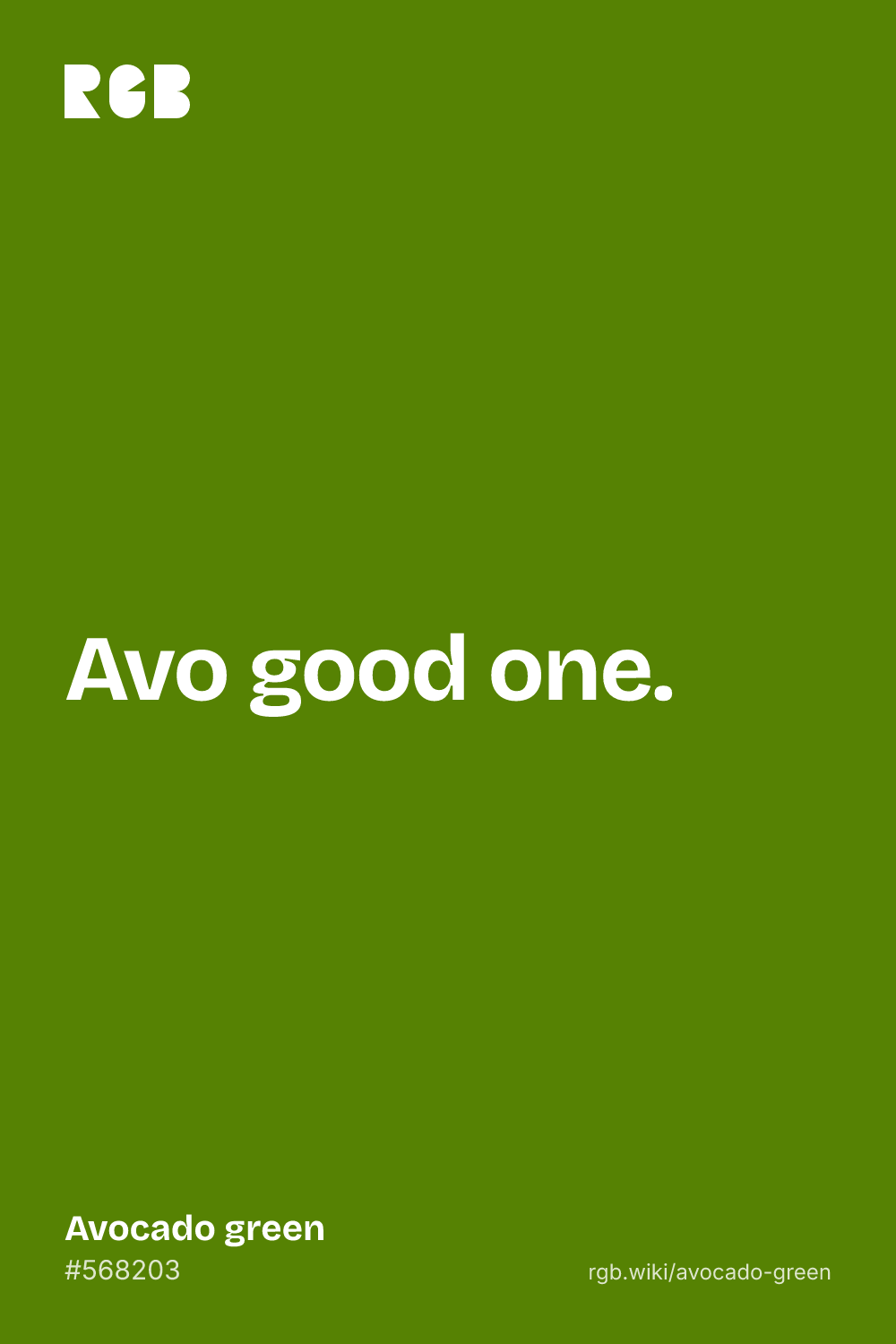
Avocado green color card, hex #568203: “Avo good one”

Avocado green on the color map

People’s average avocado green and avocado in the xkcd survey sit well above the reference, much lighter, and a little to the left, toward yellow; they lie near or past the top of the outline. The center of deep yellow green sits below and to the right: darker, grayer and greener. The outline is an approximate range, not a measured one.

Shades and tints

Tints with white

Shades with black

Tones with gray

Avocado green sits in the middle. Tints add white, shades add black and tones add gray, in 10% steps out from it. Tap any swatch to copy its code.

Light and dark avocado green

#BBCD9A
Pale avocadoMixed 60% with white. Close to the pale flesh of the fruit.
#9AB468
Light avocadoMixed 40% with white.
#87A922
Survey avocado greenThe xkcd survey’s average avocado green, a lighter, yellower take.
#568203
Avocado greenThe reference color.
#467129
Deep yellow greenThe center of the ISCC-NBS category Wikipedia assigns to avocado. Grayer and greener.
#344E02
Dark avocadoMixed 40% with black.

Colors that go with avocado green

Pairings that work in rooms, outfits and interfaces.

Seventies kitchen

The classic appliance trio of avocado, harvest gold and burnt orange, with a wood-brown base. Pure retro.

Halved avocado

Taken from the fruit: skin, pale flesh, the yellow ring by the seed, and the seed itself.

Avocado and cream

Fresh and calm. Suits food, café and home brands.

Avocado and terracotta

Warm clay against a strong green. Good for plant shops and garden design.

Ripe Hass

The purple-black of a ripe skin, lit by the green beneath. Moody and rich.

Avocado on charcoal

A dark interface with avocado as the accent. Use the lighter tint for text and buttons.

Color-wheel palettes

Pick a palette to see where its colors sit on the color wheel. The caret marks avocado green. Tap a band to copy its code.

Similar colors

Olive green74%Olive drab76%Avocado greenScheele's green82%Grass green64%Forest green78%Sea green67%

Lined up by hue around avocado green. Hover a color to see how similar it is.The bar under each name shows how similar it is. Similarity comes from the distance between the two colors in OKLab, a model of how we see color.

Avocado green vs olive green

Avocado green#568203 · hue 81°
  • Darker and much stronger
  • Almost no blue, a pure, rich green
  • Named after the fruit’s skin
Olive green#708238 · hue 75°
  • Lighter and grayer
  • Leans a little more toward yellow
  • Named after green olives

Meaning

  • 1970s kitchens
  • Retro bathrooms
  • The fruit
  • Dated taste

Avocado green means the 1970s. It was one of a handful of earthy colors that covered refrigerators, stoves, sinks and bathtubs in that decade, and it has since become a byword for dated taste, and lately for retro charm. Underneath is the fruit, whose name comes from Nahuatl and whose skin turns from green to black as it ripens. No study has tested avocado green itself for mood or emotion.

A word from Nahuatl

Word history

English avocado is a reworking of Spanish aguacate, from Nahuatl āhuacatl, which meant both the fruit and testicle. The word is recorded in English from 1696, for the fruit. Merriam-Webster also defines avocado as a color, “a light yellowish green”, lighter than the web code.1

A signature 1970s kitchen color

Historical record

A kitchen planning guide from the National Kitchen and Bath Association looks back on the 1970s: “Colors such as coppertone brown, burnt orange, avocado green, and harvest gold were all the rage.” A collectors’ guide notes that by 1971 an electric kitchen unit came in harvest gold, burnt orange and avocado, “which were popular colors at the time.”2, 3

Shorthand for 1970s taste

Cultural commentary

Avocado bathrooms are a stock image of the decade “that taste forgot”. The cultural historian Ben Highmore lists avocado bathroom suites beside lava lamps and flared trousers in nostalgic montages of the 1970s, then argues the decade’s style deserves a second look.4

The skin color tracks ripeness

Plant science

A Hass avocado’s skin changes from green to purple-black as the fruit ripens and softens, as chlorophyll pigments fade and the red-purple anthocyanin cyanidin 3-O-glucoside builds up. The flesh keeps its hue and only grows a little darker and duller. So the green of avocado green is the color of fruit that is not ready yet.5, 6

Sources (6)
  1. Merriam-Webster, “avocado”, definitions, etymology and first known use.
  2. National Kitchen and Bath Association (2013). Kitchen Planning: Guidelines, Codes, Standards, 2nd ed. Hoboken: John Wiley & Sons, p. 19. Google Books.
  3. Stonebach, D. (1994). Kitchen Collectibles. Radnor, PA: Wallace-Homestead, p. 158. Google Books.
  4. Highmore, B. (2022). “In defence of the 1970s, the decade that taste forgot”. The Conversation, 28 December 2022.
  5. Ashton, O. B. et al. (2006). Pigments in avocado tissue and oil. Journal of Agricultural and Food Chemistry, 54(26), 10151–10158. doi:10.1021/jf061809j
  6. Olivares, D. et al. (2024). Effects of delaying the storage of ‘Hass’ avocados under a controlled atmosphere on skin color, bioactive compounds and antioxidant capacity. Plants, 13(11), 1455. doi:10.3390/plants13111455

History

The avocado has been an English word for three centuries, but avocado as a color belongs to the 20th century, and mostly to the kitchen. It rose with the colored appliance in the 1960s and moved on into the bathroom.

  1. 1696

    First known use of “avocado” in English, for the fruit. The word comes through Spanish aguacate from Nahuatl āhuacatl.1

  2. 1930

    Maerz and Paul’s A Dictionary of Color, the main American color dictionary of its day, has no entry for avocado. The color name is later.2

  3. 1965

    A set of paint chips from that year, shown by a reader of the home design site Retro Renovation, already includes avocado in three shades.3

  4. 1966

    An appliance maker’s color timeline dates its avocado to 1966, after coppertone in 1964 and before harvest gold in 1968, and ties the colors to the Danish modern look of the time.3

  5. 1967

    A bathroom fixture maker’s own color timeline lists avocado sinks, tubs and toilets from 1967 to 1979.3

  6. 1971

    By this year, a collectors’ guide records, an electric kitchen unit was sold in harvest gold, burnt orange and avocado, “popular colors at the time.”4

  7. 1970s

    Coppertone brown, burnt orange, avocado green and harvest gold are “all the rage” in American kitchens. Avocado also appears on cars and shag carpets.5, 6

  8. 1976

    The same maker that dated avocado to 1966 launches a revised “Fresh Avocado”, without the darkened edges of the original.3

  9. 2006

    A study of Hass avocados measures the pigments behind the fruit’s colors: the skin turns from green to purple-black with ripening, and the flesh runs from dark green to pale green to yellow near the seed.7

  10. 2010

    In the xkcd color survey, people’s average avocado green is #87A922, much lighter than the web code.8

  11. 2022

    Writing in The Conversation, Ben Highmore lists avocado bathroom suites among the clichés of 1970s nostalgia.9

Sources (9)
  1. Merriam-Webster, “avocado”, definitions, etymology and first known use.
  2. Jaffer, A. “(M) Dictionary of Color”, the ISCC-NBS placements of Maerz and Paul’s color names (1955 dictionary).
  3. Kueber, P. (2020). “When was avocado introduced as a color on kitchen appliances?” Retro Renovation, 26 December 2020, quoting a maker’s color timeline and a reader’s 1965 paint chips.
  4. Stonebach, D. (1994). Kitchen Collectibles. Radnor, PA: Wallace-Homestead, p. 158. Google Books.
  5. National Kitchen and Bath Association (2013). Kitchen Planning: Guidelines, Codes, Standards, 2nd ed. Hoboken: John Wiley & Sons, p. 19. Google Books.
  6. Wikipedia, “Shades of chartreuse: Avocado”, citing St. Clair, K. (2016), The Secret Lives of Color, London: John Murray, pp. 230–231.
  7. Ashton, O. B. et al. (2006). Pigments in avocado tissue and oil. Journal of Agricultural and Food Chemistry, 54(26), 10151–10158. doi:10.1021/jf061809j
  8. Munroe, R. (2010). “Color survey results”. xkcd blog. The survey’s color averages are released as CC0 data.
  9. Highmore, B. (2022). “In defence of the 1970s, the decade that taste forgot”. The Conversation, 28 December 2022.

Questions

What color is avocado green?

A deep, strong yellow green named after the skin of the avocado. The usual code is #568203 (RGB 86, 130, 3). Many people picture it lighter: the average avocado green in a large online survey is #87A922.

Where does the code #568203 come from?

It is the avocado that Wikipedia gives, citing a French online color dictionary. No standard defines avocado green, and older American color dictionaries have no avocado entry, so other lists may give other codes.

When was avocado green popular?

On kitchen appliances from the mid-1960s through the 1970s, alongside harvest gold, coppertone brown and burnt orange. Bathroom fixtures in avocado were common in the 1970s too.

What is the difference between avocado green and olive green?

Avocado green (#568203) is darker and much more saturated, with almost no blue. Olive green (#708238) is lighter and grayer, and leans a little more toward yellow.

What colors go with avocado green?

Harvest gold, burnt orange and warm browns for a retro 1970s look. Cream, terracotta and charcoal for a modern one. A deep plum, like a ripe avocado’s skin, makes a rich contrast.

Why does an avocado’s skin turn black?

In Hass avocados, the green chlorophyll in the skin fades as the fruit ripens and a purple-red pigment, an anthocyanin, builds up, so the skin turns purple-black. Some other varieties stay green when ripe.

Is text readable on avocado green?

Both white and black text pass the 4.5:1 contrast level for body text on #568203, but only just, at about 4.6:1. For small text, use white on a darker shade or dark text on a light tint.