Drawn with for 35,000 years
Radiocarbon datingRadiocarbon dates from 23 charcoal drawings in the Chauvet cave in southern France put most of them between 37,000 and 33,500 years ago.1
A dark blue-gray named after burned wood, though real charcoal is closer to black.
Charcoal is a dark gray with a cool, blue cast. Its usual code is #36454F: a little more blue than green and more green than red, at about a quarter of full brightness. That small tilt toward blue is what sets it apart from a plain dark gray.
The name comes from charcoal, wood burned without air until it is mostly carbon. People have drawn with it for tens of thousands of years: the black animals on the walls of the Chauvet cave in France were drawn in charcoal some 35,000 years ago. As a color word, charcoal goes back to at least 1606.
Real charcoal is not blue. On paper it leaves a soft black or a warm gray, and Merriam-Webster defines charcoal gray as a nearly neutral, slightly greenish black. The blue code comes from a color dictionary: it is the center of dark grayish blue, one of three groups the 1955 ISCC-NBS dictionary gives for charcoal. In the xkcd color survey, people’s average charcoal was #343837, almost neutral.
Charcoal works as a softer stand-in for black. It carries white text easily, and it pairs with almost anything: mustard and coral for warmth, blush and sage for a quieter look.
| HEX | #36454F | |
|---|---|---|
| RGB | rgb(54, 69, 79) | |
| HSL | hsl(204, 19%, 26%) | |
| HSV | 204°, 32%, 31% | |
| CMYK | 32, 13, 0, 69 | |
| OKLCH | oklch(38.1% 0.026 237.5) |
Grays have so little color that a small shift swings their hue a long way on this map. People’s average “charcoal grey” in the xkcd survey sits just outside the outline, to the left: almost neutral, with a hint of green. Their average charcoal is darker and more neutral still, beyond the left edge of this view. Maerz and Paul’s charcoal is a pure gray with no hue at all, so it falls off the map too. The outline is an approximate range, not a measured one.
Tints with white
Shades with black
Tones with gray
Pairings that work in rooms, outfits and interfaces.
Crisp and modern. A gentler contrast than black on white.
Warm against cool. Mustard makes a strong accent.
A dark base with a bright, friendly accent.
Soft and grown-up. Good for stationery and beauty brands.
Calm and natural. Suits homes, gardens and wellness.
Real drawing charcoal is warmer: a brown-black on cream paper.
Pick a palette to see where its colors sit on the color wheel. The caret marks charcoal. Tap a band to copy its code.
Lined up by hue around charcoal. Hover a color to see how similar it is.The bar under each name shows how similar it is. Similarity comes from the distance between the two colors in OKLab, a model of how we see color.
Charcoal is one of the oldest drawing materials there is, and as a color it reads as a quieter, softer black. Designers often use it in place of pure black for text and backgrounds. Research on color and emotion tests basic words such as gray and black, not charcoal itself, so its mood is mostly convention. What the sources do record is its long history in art, and how much people disagree about its exact shade.
Radiocarbon dates from 23 charcoal drawings in the Chauvet cave in southern France put most of them between 37,000 and 33,500 years ago.1
Color dictionaries disagree on what charcoal looks like. The 1955 ISCC-NBS dictionary files one source’s charcoal as a dark grayish blue or a grayish purple, and Maerz and Paul’s “charcoal grey” as plain dark gray. Merriam-Webster calls charcoal gray a nearly neutral, slightly greenish black.2, 3
In the xkcd color survey, where people named over five million colors online, the average charcoal was #343837 and the average “charcoal grey” #3C4142. Both are very slightly green, and much less blue than the usual code.4
Charcoal was a drawing tool long before it was a color name. The blue code it carries today is much younger: it comes from a mid-20th-century color dictionary.
Artists draw black animals in charcoal on the walls of the Chauvet cave in southern France. Radiocarbon dates put most of the drawings in this period.1
Albrecht Dürer draws The Dead Christ in charcoal, on a sheet that bears the date 1505. It is now at the Cleveland Museum of Art.2
First recorded use of “charcoal” as a color name in English.3
Odilon Redon draws Guardian Spirit of the Waters in several kinds of charcoal. It is now at the Art Institute of Chicago.4
Maerz and Paul’s A Dictionary of Color includes “charcoal grey”. The ISCC-NBS dictionary later files it as plain dark gray.5
The ISCC-NBS Dictionary of Color Names files the charcoal of Taylor, Knoche and Granville’s Descriptive Color Names Dictionary under dark grayish blue and two grayish purples. Its center, #36454F, is the code this page and Wikipedia use.5, 6
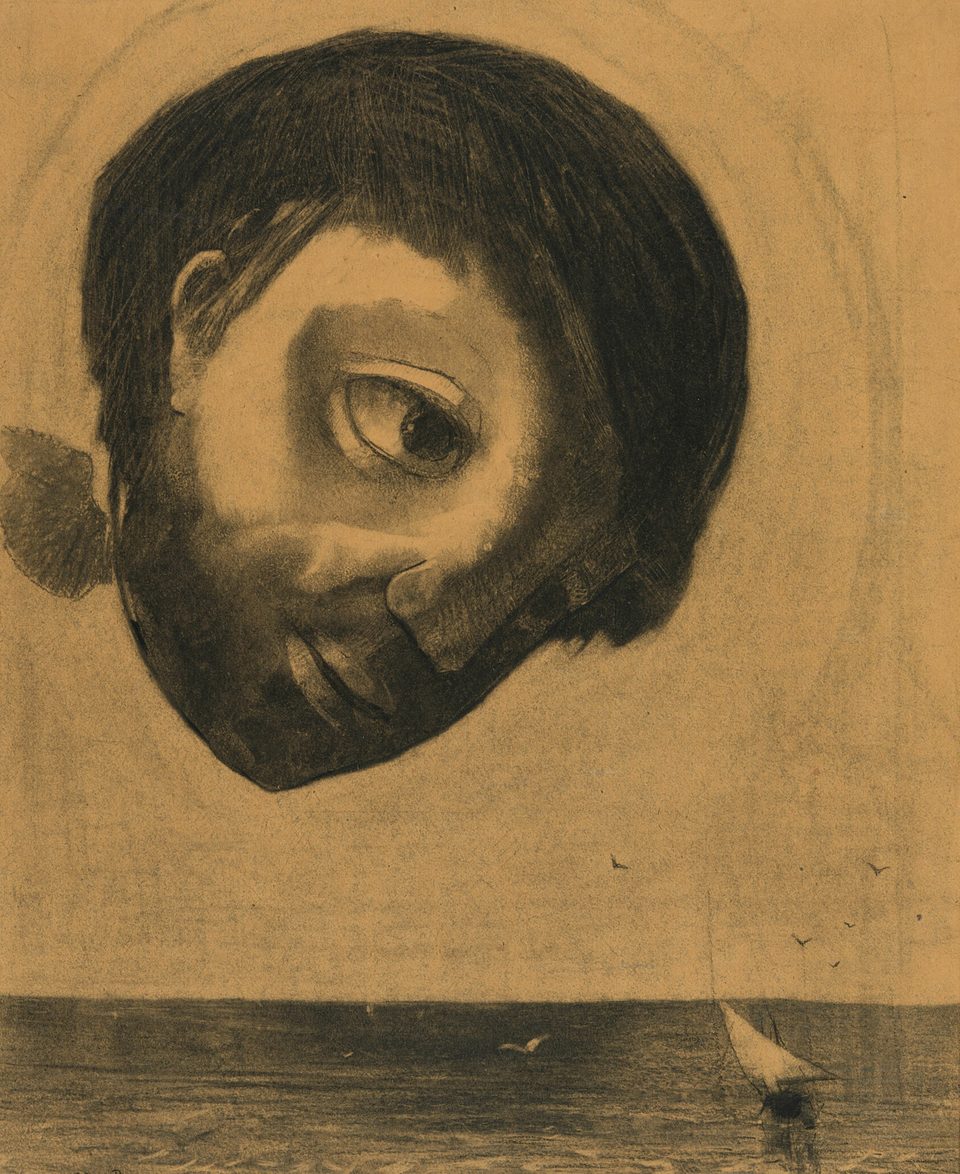
Odilon Redon drew this floating head in several kinds of charcoal, with touches of black chalk. Its darkest strokes read as a warm near-black, about #2D2B21, on paper that has aged to a golden tone: nothing like the blue of the charcoal code.
Sampled from the head in the Art Institute of Chicago’s photograph (1950.1428), released as CC0 (public domain). The medium and the aged paper are described in the museum’s record. Colors in a photo shift with the lighting, so read the codes as close, not exact.
Palettes are sampled in-house.
A dark gray with a cool, blue tint. The usual code is #36454F (RGB 54, 69, 79). Real charcoal, the drawing material, is closer to a soft black.
A very dark gray. Merriam-Webster defines charcoal as a dark gray and charcoal gray as a nearly neutral, slightly greenish black. On screen, #36454F is clearly lighter than pure black, #000000.
Because of a color dictionary. The 1955 ISCC-NBS dictionary filed one source’s charcoal under dark grayish blue, and the center of that group, #36454F, is the code most references use. Charcoal itself is not blue.
Charcoal (#36454F) is much darker. Slate gray (#708090), the CSS keyword slategray, is a mid gray with a similar cool tint.
Mustard and coral for warmth, blush and sage for a quieter look, and white for crisp contrast. Charcoal is dark enough to carry white text.
Yes. The two names are used for the same color, and this page covers both.