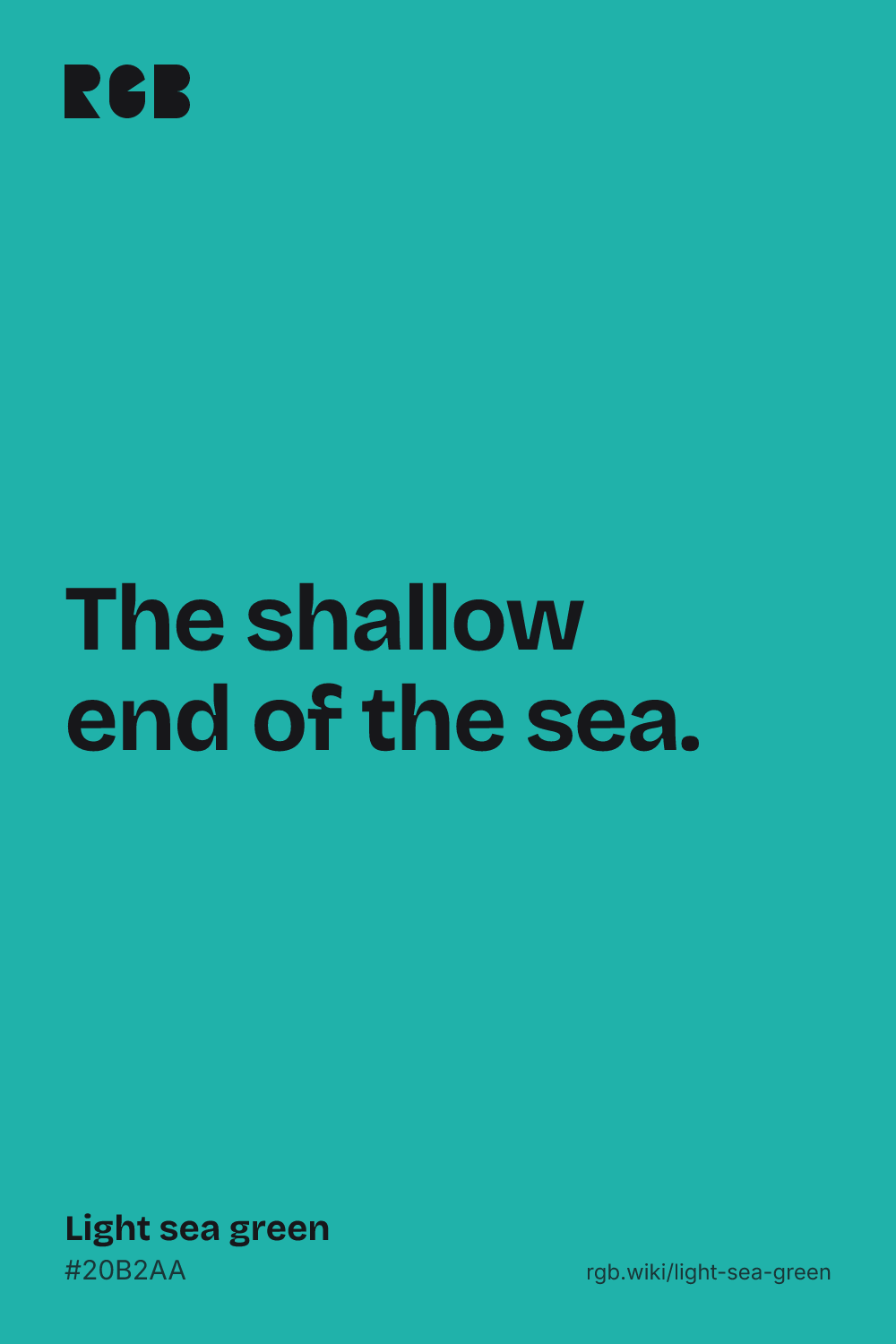
Light sea green is a bright, medium blue-green, like shallow water over white sand. Its code is #20B2AA: very little red, strong green and almost as much blue. That puts its hue at 177°, a hair short of pure cyan at 180°, so it reads less as a green than as a soft turquoise or a light teal.
The name suggests a paler sea green, and it is lighter, but that isn’t the main difference. Sea green, #2E8B57, sits at a hue of 146°, a true green; light sea green is 31° further toward blue. Nor is it the lightest of the family: medium sea green, #3CB371, looks just as light, and dark sea green, #8FBC8F, is lighter than both. The CSS specification itself admits its color names are “not even internally consistent”.
Light sea green is the CSS keyword lightseagreen. It isn’t in the X Window System’s first color list from 1986, in Paul Raveling’s 1989 revision, or in John Thomas’s list matched to crayons. It first appears in the merged list that shipped with X11 Release 4 in December 1989, as the last of four sea greens, and the web adopted it in 2001. No record says who added it or why it was called light. The phrase “sea green” itself is much older, in English since 1598.
On screens, light sea green needs dark text: black on it has a contrast of about 8:1, white only about 2.6:1, too low even for large headings. It pairs well with coral, its near complement, and with navy, warm sand and deep teal.