Colored by traces of metal
Well establishedEmerald is a variety of beryl, a mineral that is colorless when pure. Traces of chromium, vanadium and iron make it green. The most prized stones are bluish green to pure green, vivid and not too dark.1
A bright, slightly bluish green named after the gemstone, with a poisonous past as a paint.
Emerald green is a bright green with a slight blue cast. The code used here, #50C878, matches the emerald green sample in a standard 1930 color dictionary: plenty of green, some blue and a little red, which lightens and softens it.
The name comes from the emerald, a green gemstone, and the word has meant a bright green in English since at least 1508. Real emeralds are usually deeper and more intense than the web code; the most prized are bluish green to pure green.
In the 19th century, emerald green was also a paint, and a dangerous one. The pigment invented in Germany in 1814 was made with copper and arsenic. It colored wallpaper, fabric and paintings, and later, as Paris green, it was sprayed on crops to kill insects.
Emerald green is rich and festive. It pairs well with gold, white and navy, and with coral or blush pink for contrast.
| HEX | #50C878 | |
|---|---|---|
| RGB | rgb(80, 200, 120) | |
| HSL | hsl(140, 52%, 55%) | |
| HSV | 140°, 60%, 78% | |
| CMYK | 60, 0, 40, 22 | |
| OKLCH | oklch(74.5% 0.158 151.5) |
People’s average emerald green in the xkcd survey is much darker and more saturated than the dictionary sample, and sits below the outline. Medium sea green, the nearest CSS keyword, is a little darker and bluer. The outline is an approximate range, not a measured one.
Tints with white
Shades with black
Tones with gray
Pairings that work in rooms, outfits and interfaces.
Rich and festive. A classic for celebrations.
Deep and confident. Good for finance and sport.
Near-opposites: cool green and warm coral. Lively.
Clean and fresh. Suits health and nature brands.
Soft pink tames the green. Popular for weddings.
Bold and luxurious, like a jewel on velvet.
Pick a palette to see where its colors sit on the color wheel. The caret marks emerald green. Tap a band to copy its code.
Lined up by hue around emerald green. Hover a color to see how similar it is.The bar under each name shows how similar it is. Similarity comes from the distance between the two colors in OKLab, a model of how we see color.
Emerald green feels rich, lush and precious. It takes its name and much of its prestige from the gemstone, and its freshness from spring growth; Ireland has been the Emerald Isle since the 1790s. The color also has a dark side: the 19th century’s favorite emerald green paint was made with arsenic. Color research tests broad greens, not emerald green itself.
Emerald is a variety of beryl, a mineral that is colorless when pure. Traces of chromium, vanadium and iron make it green. The most prized stones are bluish green to pure green, vivid and not too dark.1
The emerald green pigment of 1814 was copper acetoarsenite. It was used in toys, candles, fabric and wallpaper, and arsenical wallpaper was linked to widespread sickness and death. As Paris green, it was used to kill insects from 1867.2, 3
Ireland got its nickname from William Drennan’s 1795 song “When Erin First Rose”, which calls the island “the em’rald of Europe” and “the most precious stone”.4, 5
Emerald was a gemstone for thousands of years before it was a color word. In the 1800s it also became a paint, a poison and a pesticide.
First known use of “emerald” to mean a bright green.1
William Drennan’s song “When Erin First Rose” gives Ireland the name “Emerald Isle”.2, 3
Wilhelm Sattler and Friedrich Russ invent emerald green, a copper and arsenic pigment, in Schweinfurt, Germany.4
Under the name Paris green, the pigment becomes an insecticide against the Colorado potato beetle.4, 5
Georges Seurat paints the grass of A Sunday on La Grande Jatte with emerald green.6
In The Wonderful Wizard of Oz, the Emerald City looks green only because everyone wears green spectacles.7
German libraries close off 19th-century books for testing, because green bindings may contain arsenic.4, 8
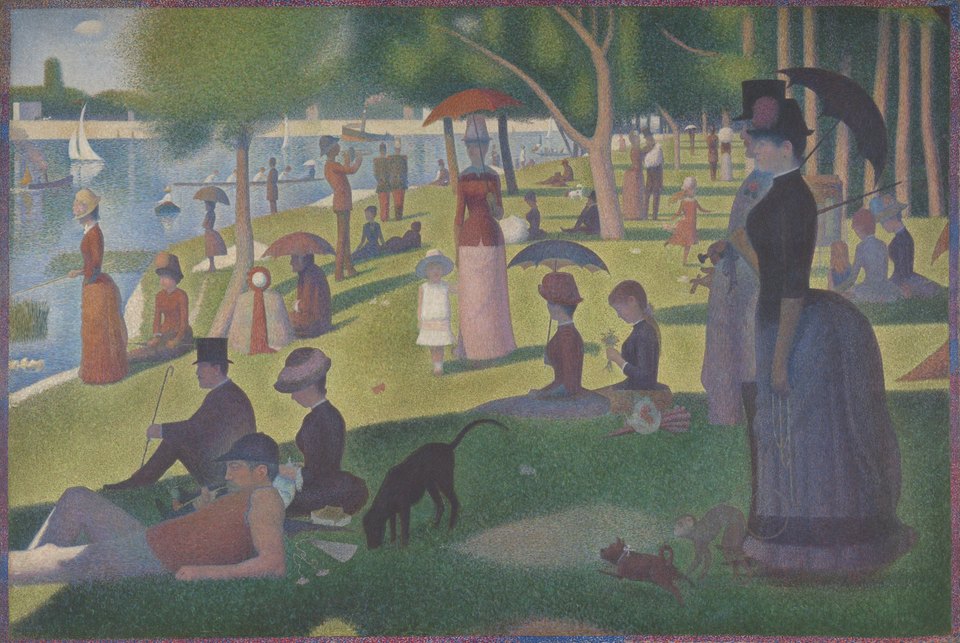
Georges Seurat painted the grass in his best-known work with small dots of emerald green and other pigments. A zinc yellow mixed into the greens has since turned brown, so the sunlit grass now looks olive and the shadows gray-green, far duller than the web code.
Sampled from the grass in the Art Institute of Chicago’s photograph (1926.224), released as CC0 (public domain). The pigments come from the museum’s analysis, as summarized by ColourLex; the browned zinc yellow is described by NPR. Colors in a photo shift with the lighting, so read the codes as close, not exact.

WeChat’s green, #07C160, is darker and more vivid than this page’s code, with the same hue. Its website sets the white two-bubble logo on this green.
The green is the brand color in the stylesheet of WeChat’s website, read on November 18, 2026. The logo shown is the white logo the same page embeds in its banner, unaltered.
Logos belong to their owners and are shown unaltered, only to show where each palette comes from. Palettes are sampled in-house.
A bright green with a slight blue cast. The code used here is #50C878 (RGB 80, 200, 120).
Not quite. The web code is lighter and softer. Fine emeralds are a deeper, more vivid bluish green to pure green.
Emerald green (#50C878) is lighter and brighter. Jade (#00A86B) is darker and bluer.
Gold and white for a classic, festive look, navy or black for depth, and coral or blush pink for contrast.
Yes. The 19th-century pigment called emerald green, later Paris green, was made with arsenic. It was used in wallpaper, fabric and paint, and as an insecticide.
For its green landscape. The name comes from William Drennan’s 1795 song “When Erin First Rose”, which calls Ireland “the em’rald of Europe”.