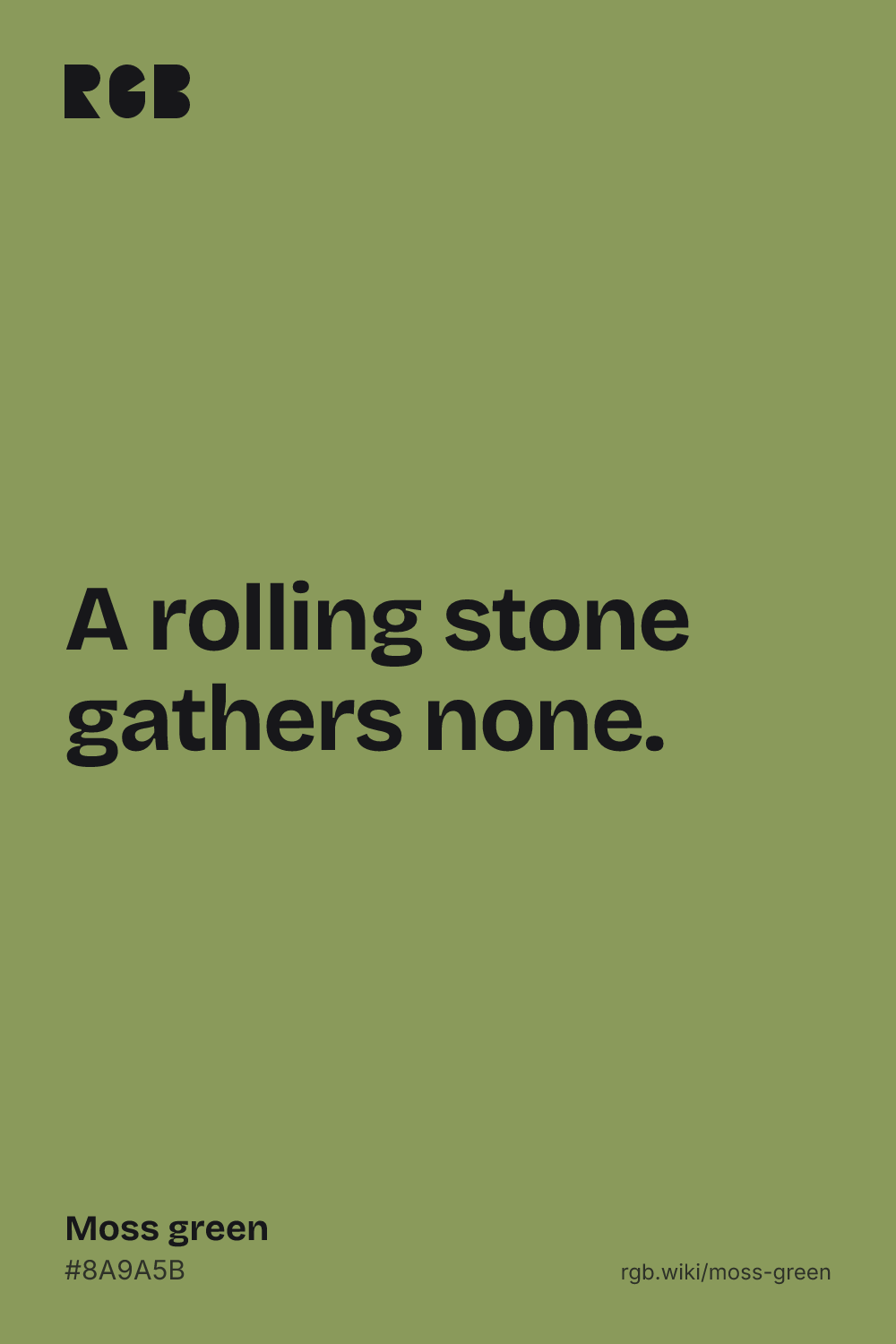
A soft yellow-green, as changeable as the moss it is named for.
Overview
Moss green is a soft, muted yellow-green, the color of a mossy bank. Its code, #8A9A5B, has green in the lead, red close behind and much less blue, which gives a quiet, olive-leaning green at about half brightness. Black text reads well on it. White text works only at large sizes.
The code comes from a color dictionary. In 1955 the ISCC-NBS dictionary filed Maerz and Paul’s moss green sample of 1930 under moderate yellow green, and #8A9A5B is the center of that category. Maerz and Paul’s sea green landed in the same category, so the two names share a code. Merriam-Webster calls moss green “a variable color averaging a moderate yellow-green” and dates the name to 1705.
Variable is the right word. In 1930 Maerz and Paul found “great diversity of opinion” on moss green, and blamed the many kinds of moss and the way one moss changes as it ages. A French color guide for gardeners, published in 1905, showed three: young moss, old moss and dyed moss. British paint makers sold moss greens that ran from brown to pale blue.
Real moss shifts with the weather, too. As it dries, it reflects more red light and slides from green toward yellow-brown, and some peat mosses turn much paler. Rewetted, it greens up within minutes. The web code sits between the two, grayer than the vivid moss of a wet day: people asked to name colors put moss green greener and brighter, at #658B38.
HEX
#8A9A5B
RGB
rgb(138, 154, 91)
HSL
hsl(75, 26%, 48%)
HSV
75°, 41%, 60%
CMYK
10, 0, 41, 40
OKLCH
oklch(65.8% 0.088 120.5)
Every code converts from the HEX value #8A9A5B. #8A9A5B is the center of the ISCC-NBS category moderate yellow green, where the 1955 ISCC-NBS dictionary files the moss green sample in Maerz and Paul’s A Dictionary of Color (1930). CSS has no moss green keyword. CMYK is a screen-based estimate; print results vary.
Moss green on the color map
LighterDarker
Both survey values sit inside the outline to the right and a little below the reference: people’s moss is greener, darker and more vivid than the code. Old moss green sits well to the left, a yellower, olive green, and a little darker. The glazed moss on the Met’s dish sits just above and to the right, almost as light as the code but much grayer, which this map of hue and lightness doesn’t show. The outline is an approximate range, not a measured one.
Shades and tints
Tintswith white
Shadeswith black
Toneswith gray
Moss green sits in the middle. Tints add white, shades add black and tones add gray, in 10% steps out from it. Tap any swatch to copy its code.
Light and dark moss green
Moss green mixed toward white and black, with two greens from the color’s own history.
#D0D7BD
Pale mossMixed 60% with white. A soft gray-green for backgrounds.
#ADB88C
Light mossMixed 30% with white. Close to sage, a little yellower.
#8A9A5B
Moss greenThe reference color.
#658B38
Everyday moss greenPeople’s average moss green in the xkcd survey. Greener and more vivid, like moss after rain.
#867E36
Old moss greenMaerz and Paul’s 1930 shade for moss that has aged, as the ISCC-NBS dictionary files it: a light olive.
#535C37
Deep mossMixed 40% with black. Dark enough for white text at any size.
Colors that go with moss green
Pairings that work in rooms, outfits and interfaces.
Moss and stone
Moss on an old wall. Quiet and natural, good for calm interiors and outdoor brands.
Forest floor
Moss, bark and fern. Earthy and warm, with the brown carrying the weight.
Moss and terracotta
A muted green against fired clay. Warm, homey and a little rustic.
Moss and plum
A soft green with a dusky purple. Unusual and grown-up, good for labels and stationery.
Moss green tones
One hue from pale to deep. Easy to use for charts and layered screens.
Moss garden
Moss, pale gravel and dark timber. A dark, calm scheme with light green accents.
Color-wheel palettes
Pick a palette to see where its colors sit on the color wheel. The caret marks moss green. Tap a band to copy its code.
Dark yellow75%Moss greenOlive green58%Matcha77%Olive drab61%Sage green61%Gray-green83%
Lined up by hue around moss green. Hover a color to see how similar it is.The bar under each name shows how similar it is. Similarity comes from the distance between the two colors in OKLab, a model of how we see color.
Moss green vs sage green
Moss green#8A9A5B · hue 75°
Yellower and more colorful
A little darker
Code from the ISCC-NBS dictionary
Sage green#9CAF88 · hue 89°
Grayer and softer, closer to plain green
A little lighter
A common web value; no standard defines it
Meaning
Living moss
Long time
Staying put
Nobody has studied what moss green itself means. What it carries comes from moss, a plant that only grows where things stay still for a long time, and that idea runs through proverbs, slang and even a national anthem. Research on color preference tests broad hue families, not moss green, so the last claim below is about yellow-greens in general.
Moss grows where nothing moves
Historical record
“A rolling stone gathers no moss” is first written down in Latin around 1023, in Egbert of Liège’s collection Fecunda Ratis. Erasmus made it popular in his Adagia, and the English form appears in John Heywood’s Proverbs of 1546. It began as a warning against restlessness: someone who never settles gains nothing. Today people often read it the other way, as praise for staying free.1
Mossback
Dictionary record
English turned moss into a word for being stuck in the past. Merriam-Webster dates “mossback” to 1853, first for a large, sluggish fish such as a largemouth bass, then for an extremely old-fashioned or reactionary person: someone who has stood still long enough to grow moss.2
Moss as a measure of ages
Historical record
Japan’s national anthem, “Kimigayo”, wishes a reign to last until tiny pebbles grow into boulders “lush with moss”. The words come from an anonymous poem in the Kokin Wakashū, an anthology of about 920, and were sung for centuries as a wish for long life. A 1999 law made the song the national anthem.3
Yellow-greens are rarely favorites
One study, mixed
In a 2010 study at Berkeley, 48 people rated 32 colors. Liking peaked at blue and fell to a low point at yellow-green, and dark yellow, an olive, was the least liked of all. The authors argue that people like colors of things they like, such as clear skies, and dislike colors of things they don’t, such as rotting food. In early follow-up results, people who saw pictures of pleasant green things, such as trees and grassy fields, rated green higher afterward. Moss green itself was not tested, and the sample was small and American.4
Sources (4)
Wikipedia, “A rolling stone gathers no moss”, on Egbert of Liège’s Fecunda Ratis (about 1023), Erasmus’s Adagia and John Heywood’s Proverbs (1546).
Merriam-Webster, “mossback”, definitions and first known use.
Moss green has been an English color word for three centuries, and for most of that time nobody agreed on what it looked like. Color books tried to pin it to a particular moss at a particular age.
1705
First known use of “moss green” as a color name in English.1
1884
The earliest use Maerz and Paul could find when they wrote their dictionary in 1930. Later research pushed the date back to 1705.2
1905
René Oberthür and Henri Dauthenay’s Répertoire de Couleurs, a color guide for gardeners, shows three moss greens: young moss, after the shaggy mosses then used for packing and often found in lawns; old moss, as sold in shops; and dyed moss, used in special packing.3
1930
Maerz and Paul’s A Dictionary of Color prints moss green on plate 21 and notes the “great diversity of opinion” about it. British paint makers’ moss green, they write, “varies widely, from brown to a pale blue”, while American makers’ is a chrome green toned with a little raw umber and chrome yellow.3
1955
The ISCC-NBS dictionary files Maerz and Paul’s moss green as a moderate yellow green, #8A9A5B, the category that also holds their sea green. Their old moss green goes under light olive, #867E36.4
2010
In the xkcd color survey, people’s average moss green is #658B38, greener and more vivid than the dictionary code.5
2018
A study of four Arctic moss communities finds that drying raises the red light mosses reflect, and that their reflectance recovers within minutes of rewetting: the reason moss looks greener after rain.6
Sources (6)
Merriam-Webster, “moss green”, definition and first known use.
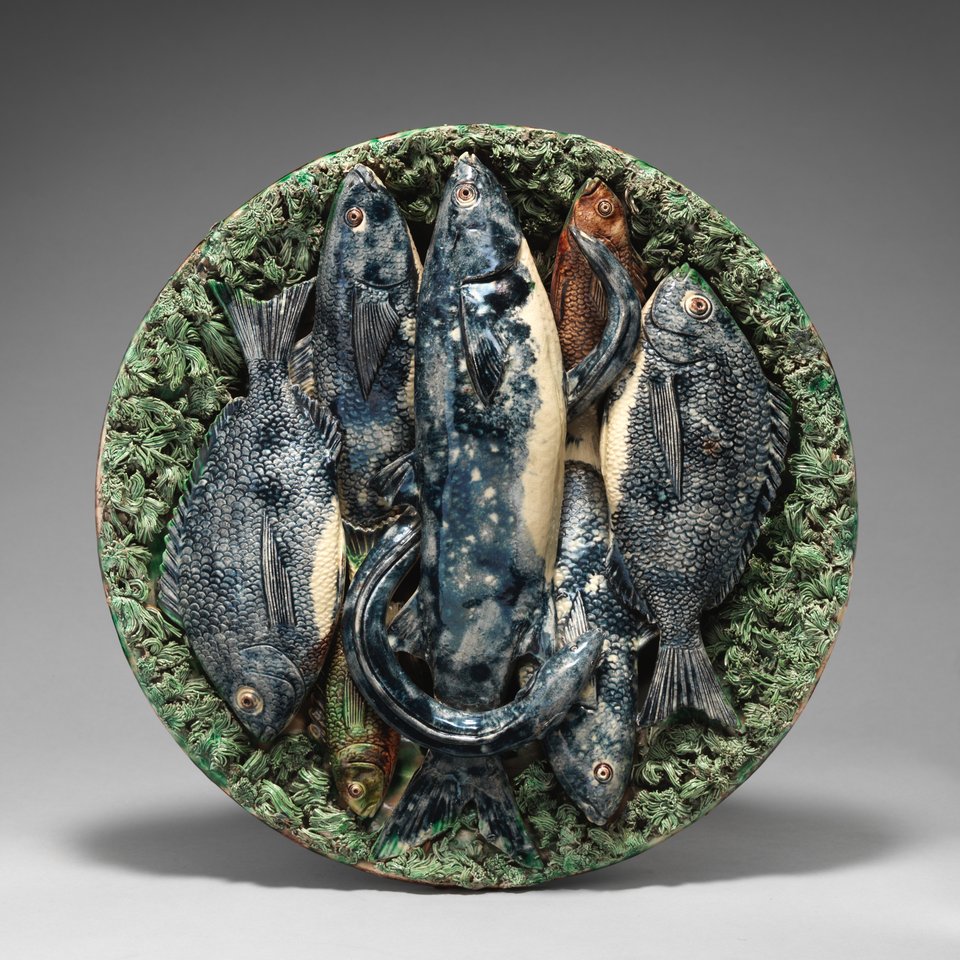
José Francisco de Sousa, a potter in Caldas da Rainha, Portugal, modeled a catch of fish lying on a bed of moss in glazed earthenware. Sampled, the moss is about #8F9B82: almost exactly as light as moss green, but much grayer, with deeper shadows near #475339.
#8F9B82#6C795C#475339#BECEAD
Source: The Met
Source
Sampled from the moss border in The Metropolitan Museum of Art’s photograph (2020.86.21), released as CC0 (public domain). The maker, place and date come from the museum’s record. Colors in a photo shift with the lighting, so read the codes as close, not exact.
Palettes are sampled in-house.
Questions
What is the hex code for moss green?
#8A9A5B (RGB 138, 154, 91; HSL 75°, 26%, 48%). It is the center of the ISCC-NBS category moderate yellow green, where the 1955 dictionary files Maerz and Paul’s moss green. CSS has no moss green keyword, so use the hex code.
Is moss green the same as sage green?
No. Sage green (#9CAF88) is lighter and grayer, with a hue closer to plain green. Moss green (#8A9A5B) is yellower, a little darker and more colorful.
What is the difference between moss green and olive green?
They share almost the same hue, but olive green (#708238) is darker and stronger. Moss green is lighter and softer, the way moss looks next to an unripe olive.
Why do moss green and sea green have the same hex code?
Both codes come from the same color dictionary. In 1955 the ISCC-NBS dictionary sorted the samples in Maerz and Paul’s 1930 color book into broad categories, and their moss green and their sea green both fell into moderate yellow green, whose center is #8A9A5B. The CSS keyword seagreen (#2E8B57) is a different, bluer color.
Why does moss turn brown when it dries?
As moss loses water, it reflects more red light, which shifts its color from green toward yellow-brown, and some peat mosses turn much paler. In a 2018 study of Arctic mosses, their reflectance recovered within minutes of rewetting, which is why moss looks greener after rain.
Can you use white text on moss green?
Only for large or bold text. White on #8A9A5B has a contrast ratio of about 3.1 to 1. Black or a dark charcoal reads much better, at about 6.9 to 1 for black. For white text, use the deep moss shade (#535C37).
What colors go with moss green?
Stone gray and cream for a quiet look, bark brown for an earthy one, terracotta for warmth, dusky plum for something unusual, and dark timber with pale gravel for a moss garden feel.