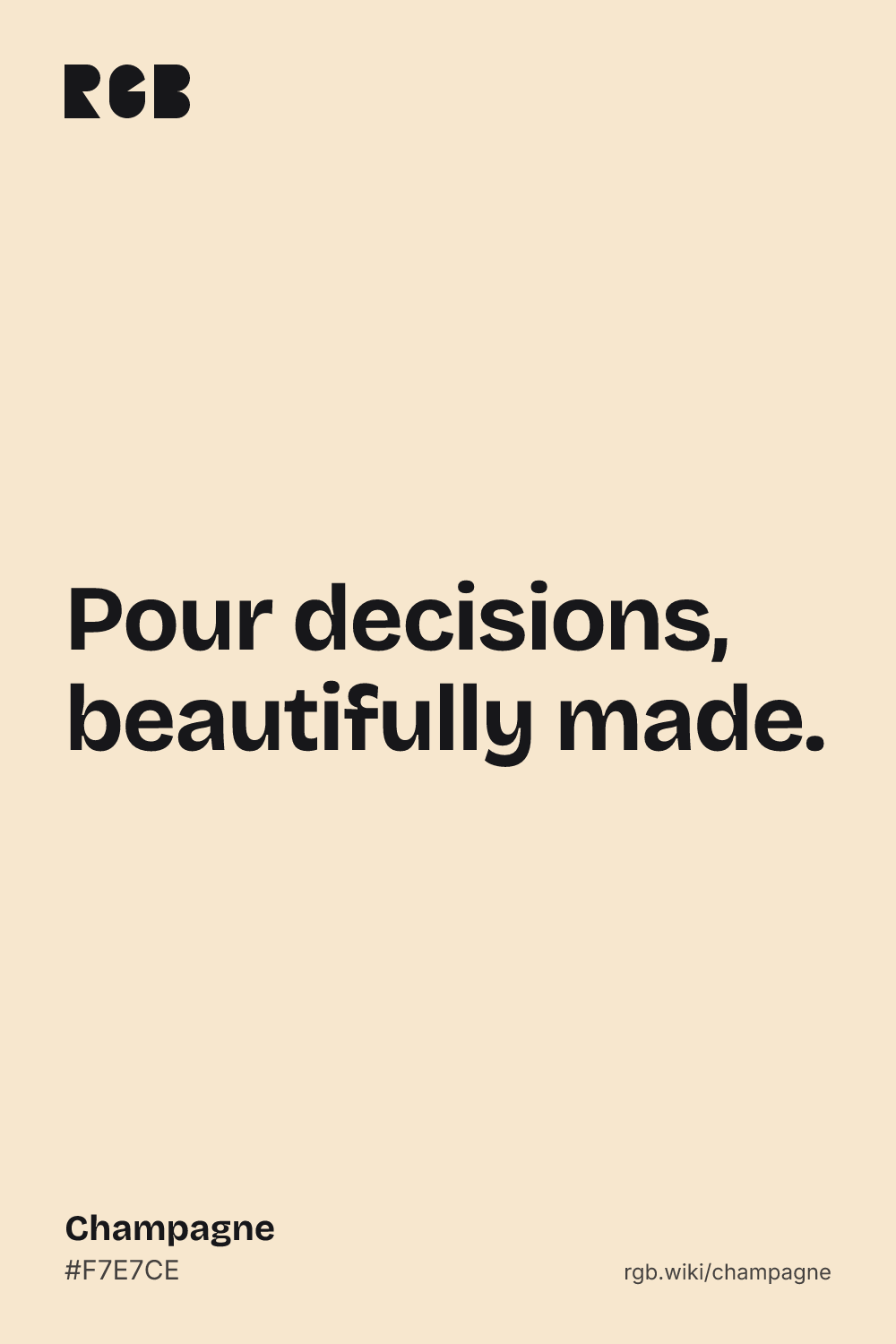
A pale, peachy beige named after the sparkling wine of Champagne.
Overview
Champagne is a pale, peachy beige. Its usual web code is #F7E7CE: red high, green a little lower and blue lower again, which tints white toward peach.
The name comes from the sparkling wine of Champagne, in northeastern France. The wine’s name is legally protected and belongs to wine made under the region’s rules. As a color word, champagne dates from 1915.
Champagne is a loose name. Merriam-Webster’s definition runs from pale orange yellow to light grayish-yellowish brown, and the 1955 ISCC-NBS dictionary filed one color book’s champagne in four groups. The web code sits at the light, peachy end of that range.
Champagne works as a warm neutral for weddings, interiors and packaging. It pairs well with dusty pink, gold, navy and charcoal.
HEX
#F7E7CE
RGB
rgb(247, 231, 206)
HSL
hsl(37, 72%, 89%)
HSV
37°, 17%, 97%
CMYK
0, 6, 17, 3
OKLCH
oklch(93.4% 0.037 79.1)
Every code converts from the HEX value #F7E7CE. #F7E7CE is given on Wikipedia as a match for the champagne sample in Maerz and Paul’s A Dictionary of Color (1930), plate 11. Champagne has no CSS keyword and no official code. The 1955 ISCC-NBS dictionary files Maerz and Paul’s champagne across four groups, from pale orange yellow to yellowish gray. CMYK is a screen-based estimate; print results vary.
Champagne on the color map
LighterDarker
The xkcd survey has no average for champagne. The dictionary’s light champagne sits just below and to the left of the web code, inside the outline: a little darker and more orange. Its dark champagne sits far below, near the bottom of this view. The outline is an approximate range, not a measured one.
Shades and tints
Tintswith white
Shadeswith black
Toneswith gray
Champagne sits in the middle. Tints add white, shades add black and tones add gray, in 10% steps out from it. Tap any swatch to copy its code.
Light and dark champagne
#FAF1E2
Pale champagneMixed 40% with white. A soft, warm off-white.
#F3E5AB
Medium champagneYellower. The pale yellow the 1955 dictionary gives an interior decorators’ champagne; the same code as vanilla. See vanilla
#F7E7CE
ChampagneThe reference color.
#FAD6A5
Deep champagnePeachier and more orange. The dictionary’s pale orange yellow.
#C2B280
Dark champagneMuch darker and grayer: the dictionary’s grayish yellow, the same code as ecru. See ecru
Colors that go with champagne
Pairings that work in rooms, outfits and interfaces.
Champagne and dusty pink
Soft and romantic. Suits weddings and stationery.
Champagne and gold
Festive and warm. Good for invitations and celebrations.
Champagne and navy
Classic and polished. Navy gives the pale tone a crisp edge.
Champagne and charcoal
Quiet and modern. Good for interfaces and menswear.
Champagne and sage
Soft and natural. A calm pairing for homes.
Champagne and burgundy
Rich and wintry, like red wine by candlelight.
Color-wheel palettes
Pick a palette to see where its colors sit on the color wheel. The caret marks champagne. Tap a band to copy its code.
Lined up by hue around champagne. Hover a color to see how similar it is.The bar under each name shows how similar it is. Similarity comes from the distance between the two colors in OKLab, a model of how we see color.
Champagne vs beige
Champagne#F7E7CE · hue 37°
Peachier, with an orange tint
Named after the sparkling wine
No CSS keyword
Beige#F5F5DC · hue 60°
Grayer, with a yellow tint
Named after undyed wool
A CSS keyword, beige
Meaning
Sparkling wine
A protected name
Diamonds
Horse coats
Champagne reads as festive and luxurious, after the sparkling wine. The wine’s name is protected by law and tied to one region of France. As a color word, champagne covers a wide range, from pale peach to light grayish brown, and it also names light brown diamonds and a horse coat color with its own gene. As with most named colors, mood research tests broad hues, not champagne itself.
A protected wine name
Official record
Champagne was officially recognized as an Appellation d’Origine Contrôlée on June 29, 1936, after a 1927 law fixed the boundaries of its vineyard area. It is a legally protected name: only producers working within the appellation’s rules may use it for their wine.1
A horse color with its own gene
Genetics study
In horses, champagne is a coat color caused by a single dominant gene. A 2008 study traced it to one change in the gene SLC36A1: all 85 champagne horses tested carried it, and none of the 97 others did. The color can be hard to tell apart from the effect of the cream dilution gene.2
A trade name for diamonds
Trade usage
GIA, the gem institute, describes champagne diamonds as light brown on its D-to-Z color scale. It notes that names like champagne and cognac are “marketing and trade names,” not grades on lab reports.3
Cook, D., Brooks, S., Bellone, R. & Bailey, E. (2008). Missense mutation in exon 2 of SLC36A1 responsible for champagne dilution in horses. PLOS Genetics, 4(9), e1000195. doi:10.1371/journal.pgen.1000195
Champagne the wine gave its name to a color in the early 1900s, just as the region was winning legal protection for the name itself.
1664
First known use of “champagne” in English, for the sparkling wine named after the Champagne region of France.1
1915
First recorded use of “champagne” as a color name in English.2
1927
A French law fixes the boundaries of the Champagne vineyard area.3
1930
Maerz and Paul’s A Dictionary of Color prints a champagne sample, the match for today’s #F7E7CE.2
1936
Champagne is officially recognized as an Appellation d’Origine Contrôlée on June 29.3
1955
The ISCC-NBS dictionary shows how loose the color name is: it files Maerz and Paul’s champagne in four groups, from pale orange yellow to yellowish gray.4
2008
Researchers find the gene behind the champagne coat color in horses.5
Sources (5)
Merriam-Webster, “champagne”, definitions, etymology and first known use.
Wikipedia, “Champagne (color)”, citing Maerz and Paul’s A Dictionary of Color (1930), p. 192 and plate 11.
Kelly, K. L. & Judd, D. B. (1955). The ISCC-NBS Method of Designating Colors and a Dictionary of Color Names. National Bureau of Standards Circular 553. PDF at NIST. Entries for champagne as tabulated in Jaffer’s color-name dictionaries.
Cook, D., Brooks, S., Bellone, R. & Bailey, E. (2008). Missense mutation in exon 2 of SLC36A1 responsible for champagne dilution in horses. PLOS Genetics, 4(9), e1000195. doi:10.1371/journal.pgen.1000195
Questions
What color is champagne?
A pale, peachy beige. The usual web code is #F7E7CE (RGB 247, 231, 206). The name is loose, though: dictionaries stretch it from pale orange yellow to light grayish brown.
What is the difference between champagne and beige?
Champagne (#F7E7CE) has a peach or orange tint. Beige (#F5F5DC) is grayer and leans yellow. Beige is also a CSS keyword; champagne is not.
What is the difference between champagne and ivory?
Ivory (#FFFFF0) is lighter, almost white, with a faint yellow tint. Champagne is a little darker and peachier.
Is champagne gold or beige?
Closer to beige. The web code is a pale, peachy beige, much lighter and softer than gold. Some dictionary champagnes are darker, a light grayish brown.
What colors go with champagne?
Dusty pink and gold for weddings and celebrations, navy and charcoal for contrast, and sage or burgundy for something natural or rich.
Why is it called champagne?
After the typical color of the sparkling wine of Champagne, in northeastern France. It has been a color name in English since 1915.