Amber

A warm yellow-orange named after golden fossil resin, and the color of caution on the road.

Overview

Amber is a warm yellow-orange, halfway between yellow and orange on the color wheel. Its usual web code is #FFBF00: full red, three-quarters green and no blue.

The name comes from the fossil tree resin carved into beads and charms since ancient times. The word itself came into English from Arabic ʿanbar, which first meant ambergris, a waxy substance from whales. It was first used as a color name in 1500. Eyes are called amber when the iris is golden to coppery brown; All About Vision estimates that about 5% of people have them.

Real amber is rarely this bright. Polished resin runs from pale honey to deep cherry brown, and Merriam-Webster defines the color as a dark orange yellow. The amber of traffic lights and turn signals is a deeper orange again, set by a range of light measurements rather than a hex code.

On screens, #FFBF00 reads as bright, warm and a little cautionary. It shines on dark backgrounds, in highlights, warnings and buttons. For text on white, use a much darker shade: amber on white is hard to read.

HEX#FFBF00
RGBrgb(255, 191, 0)
HSLhsl(45, 100%, 50%)
HSV45°, 100%, 100%
CMYK0, 25, 100, 0
OKLCHoklch(84.0% 0.172 84.1)
Every code converts from the HEX value #FFBF00. #FFBF00 is the amber most references use, the point halfway between yellow and orange on an RGB color wheel; no color standard defines it. Vehicle lighting rules define amber light only as a small range of chromaticity, and the screen color nearest the middle of that range is a deeper orange, about #FF7E00. CMYK is a screen-based estimate; print results vary.
Amber color card, hex #FFBF00: “Amber-dextrous: yellow and orange at once”

Amber on the color map

People’s average amber in the xkcd survey is a touch more orange, well inside the outline. Signal amber sits outside it to the left and lower down: the amber of turn signals is a deeper orange than the web code. The amber bead is darker still, at the lower left, closer to the real resin. The outline is an approximate range, not a measured one.

Shades and tints

Tints with white

Shades with black

Tones with gray

Amber sits in the middle. Tints add white, shades add black and tones add gray, in 10% steps out from it. Tap any swatch to copy its code.

Light and dark amber

#FFD966
Light amberMixed 40% with white. A soft, buttery yellow.
#FFBF00
AmberThe reference color.
#F4C430
SaffronA little softer and more golden, named after the spice. See saffron
#997300
Dark amberMixed 40% with black. It turns olive brown, not orange.

Colors that go with amber

Pairings that work in rooms, outfits and interfaces.

Amber and navy

Warm on cool. Strong contrast for headers and calls to action.

Amber and charcoal

The look of caution signs. Clear, direct and hard to miss.

Amber and teal

Near-opposites that stay friendly. Good for travel and food.

Amber and walnut

Honey and wood. Cozy, like a lamp-lit room.

Amber and violet

Complementary colors. Bold and playful.

Amber and sage

A warm accent on soft green. Calm and natural.

Color-wheel palettes

Pick a palette to see where its colors sit on the color wheel. The caret marks amber. Tap a band to copy its code.

Similar colors

Yellow-orange73%Chrome yellow71%Orpiment77%AmberSunflower93%Saffron90%Safety yellow74%

Lined up by hue around amber. Hover a color to see how similar it is.The bar under each name shows how similar it is. Similarity comes from the distance between the two colors in OKLab, a model of how we see color.

Amber vs gold

Amber#FFBF00 · hue 45°
  • More orange
  • Named after fossil resin
  • No official web code
Gold#FFD700 · hue 51°
  • More yellow and lighter
  • Named after the metal
  • A CSS keyword, gold

Meaning

  • Fossil resin
  • Amber eyes
  • Traffic lights
  • Turn signals
  • Caution

Amber means warmth in a jewelry box and caution on the road. Its meanings come from two places: the golden fossil resin prized for thousands of years, and the signal lights that tell drivers to slow down. Mood studies test broad color words such as orange or yellow, not amber itself, so the claims here stick to the record.

The word first meant ambergris

Dictionary record

English borrowed amber in the 1300s from Arabic ʿanbar, by way of Latin and French. At first it meant ambergris, a waxy substance from sperm whales. The fossil resin took over the name in the early 1400s, possibly because both were found washed up on beaches.1, 2
Amber Alerts are named for a girl

Government record

AMBER Alerts are not named after the color. The system began in 1996, when Dallas–Fort Worth broadcasters and police set up an early warning for abducted children, as a legacy to nine-year-old Amber Hagerman of Arlington, Texas. AMBER also stands for America’s Missing: Broadcast Emergency Response.3

Amber turn signals may prevent some crashes

One government study

A 2009 report by the US National Highway Traffic Safety Administration found amber rear turn signals 5.3% more effective than red ones at preventing crashes where a careful driver would signal. US rules allow either color, so this is one analysis, not a settled law.4

Sources (4)
  1. Merriam-Webster, “amber”, definition, etymology and first known use.
  2. Wikipedia, “Amber”, etymology section, citing the University of Michigan’s Middle English Compendium.
  3. US Department of Justice, Office of Justice Programs, “About AMBER Alert”.
  4. National Highway Traffic Safety Administration (2009). Technical Report on the Effectiveness of Amber Rear Turn Signals for Reducing Rear Impacts. Notice in the Federal Register, 11 May 2009.

History

Amber was a gem and a trade good long before it was a color name. The word took a detour through ambergris, gave English the word electric, and ended up on every traffic light.

  1. 1300s

    Amber enters English from Arabic ʿanbar, by way of Latin and French. At first it means ambergris.1, 2

  2. Early 1400s

    English takes up the French sense, fossil resin, then called white or yellow amber. It becomes the main meaning as ambergris falls out of use.2

  3. 1500

    First recorded use of amber as a color name in English.3

  4. 1600

    William Gilbert coins the Latin electricus, “amber-like”, in De Magnete. Rubbed amber holds a static charge, and the Greek word for amber, ēlektron, gives English the word electric.2

  5. 1920

    William Potts, superintendent of signals for the Detroit police, builds a four-way, three-color traffic light, the first with an amber “caution” light.4

  6. 1968

    The Vienna Convention on Road Signs and Signals sets the international three-light signal: red, amber and green.4

  7. 1996

    Dallas–Fort Worth broadcasters and police start the first AMBER Alert plan, named for Amber Hagerman.5

  8. 2009

    A US government study finds amber rear turn signals 5.3% more effective than red ones at preventing some rear-end crashes.6

  9. 2011

    UN Regulation No. 48, as published in the EU’s Official Journal, makes amber the color for direction indicators and defines it by four chromaticity points, not one exact color.7

Sources (7)
  1. Merriam-Webster, “amber”, etymology and first known use.
  2. Wikipedia, “Amber”, etymology section, citing the Middle English Compendium and Heilbron, J. L. (1979), Electricity in the 17th and 18th Centuries, p. 169.
  3. Wikipedia, “Amber (color)”, citing Maerz, A. & Paul, M. R. (1930), A Dictionary of Color, p. 189.
  4. Wikipedia, “Traffic light”, history and Vienna Convention sections.
  5. US Department of Justice, Office of Justice Programs, “About AMBER Alert”.
  6. National Highway Traffic Safety Administration (2009). Technical Report on the Effectiveness of Amber Rear Turn Signals for Reducing Rear Impacts.
  7. Regulation No 48 of the UN/ECE, installation of lighting and light-signalling devices. Official Journal of the European Union, L 323, 6 December 2011, paragraphs 2.29.3 and 5.15.

Amber in use

All brand colors
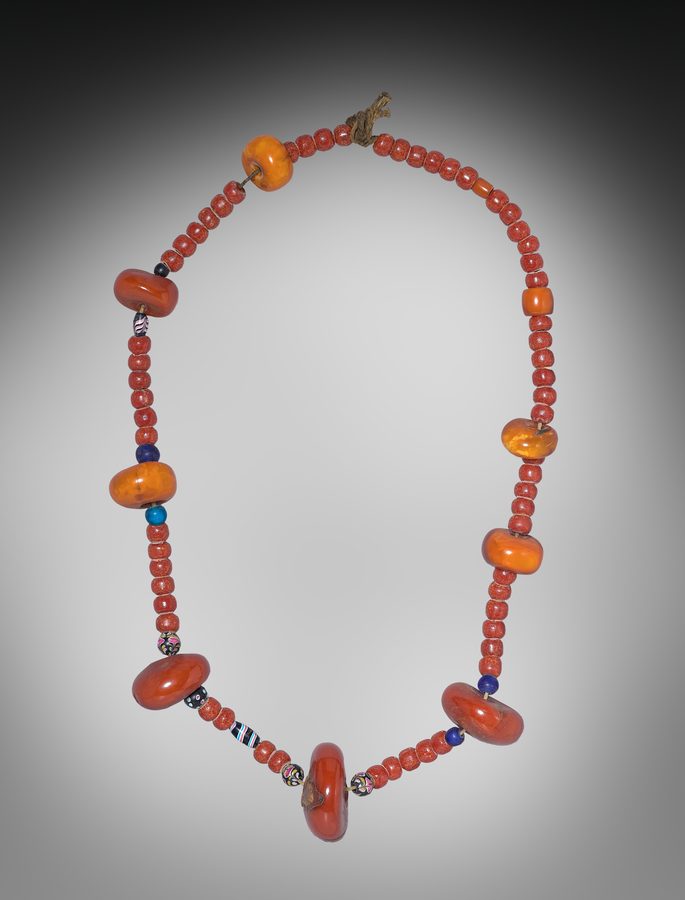
A long necklace of small red beads laid in a loop on a gray background, with eight large, translucent amber beads in orange and red-brown and a few blue and patterned glass beads
#C97120#D46D2E#AB4F3A#994538
JewelryTibetan necklace (about 1900)

A necklace of amber, bone and glass beads at the Cleveland Museum of Art, likely worn by a wealthy layperson. The museum notes that the amber came to Tibet from the Baltic Sea region. The big, glowing beads run from golden orange to deep red-brown, all darker and redder than the web code.

#C97120#D46D2E#AB4F3A#994538
Source: Cleveland Museum of Art
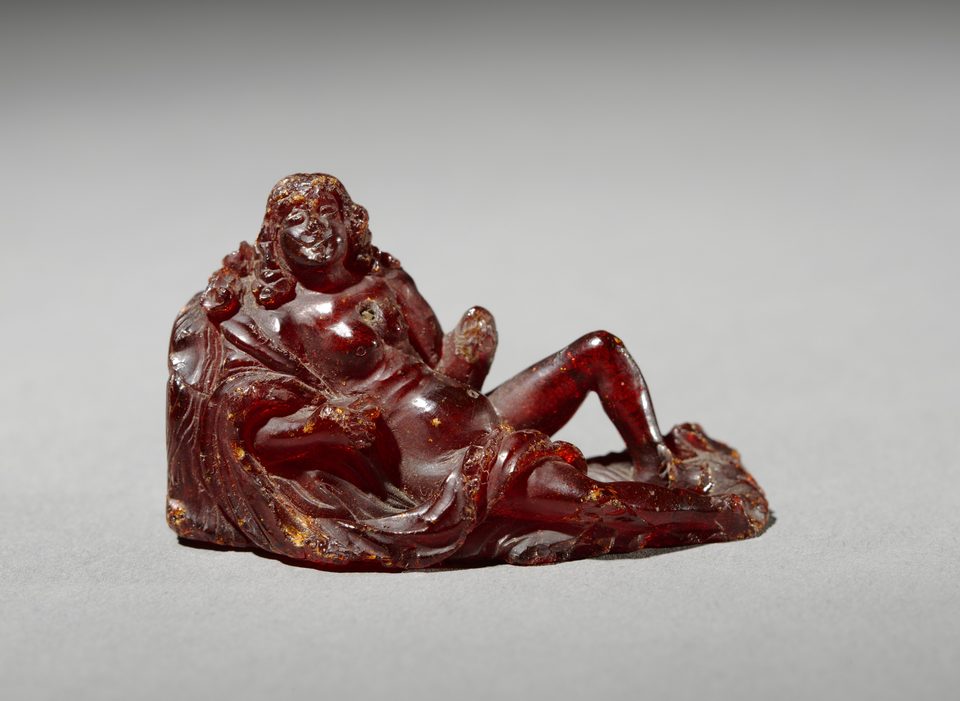
A tiny carved figure of a reclining woman in dark red, translucent amber, leaning on folds of drapery, on a gray background
#47100E#530F0E#6C3B33#96756B
SculptureStatuette of a reclining woman (100 BCE–100 CE)

A Greek or Roman carving only 2.5 cm long, at the Cleveland Museum of Art. The museum describes it as amber, fossilized tree sap, yet it is a deep cherry red: a reminder that amber the material is not always amber the color.

#47100E#530F0E#6C3B33#96756B
Source: Cleveland Museum of Art

Logos belong to their owners and are shown unaltered, only to show where each palette comes from. Palettes are sampled in-house.

Questions

What color is amber?

A warm yellow-orange, halfway between yellow and orange. The usual web code is #FFBF00 (RGB 255, 191, 0).

Where does the code #FFBF00 come from?

No standard defines it. It is the halfway point between yellow and orange on an RGB color wheel, and it is the code most references use.

Is traffic light amber the same as #FFBF00?

No. Signal amber is defined by a range of light measurements, not a hex code, and it is a deeper orange. The screen color nearest the middle of the vehicle-lighting range is about #FF7E00.

Are Amber Alerts named after the color?

No. They honor Amber Hagerman, a nine-year-old girl abducted and murdered in Arlington, Texas, in 1996. AMBER also stands for America’s Missing: Broadcast Emergency Response.

What are amber eyes?

Eyes with a golden to coppery brown iris, thought to be rich in the reddish-yellow pigment pheomelanin. All About Vision estimates that about 5% of people have them.

What is the difference between amber and gold?

Gold (#FFD700) is a CSS keyword and leans toward yellow. Amber has less green in its code, so it looks more orange.