Maroon

A dark brownish red, named after the French word for chestnut.

Overview

Maroon is a dark brownish red. Its web code is #800000: red at half strength, with no green or blue at all. It is one of the 16 original web colors, first picked from the VGA graphics of early Windows PCs.

The name comes from French marron, chestnut, and has been a color word in English since 1779. In French, marron is also an everyday word for brown, and English dictionaries still disagree on whether maroon is a dark red or a brownish one.

In everyday speech, maroon is darker and cooler than the web code. In the xkcd color survey, people’s average maroon was #650021, almost the same as their average burgundy. Official maroons vary too: Queensland’s leans purple, and Texas A&M’s is nearly black.

Maroon is a classic school color. With gold, white or gray it looks traditional and confident, and it is dark enough to carry white text.

HEX#800000
RGBrgb(128, 0, 0)
HSLhsl(0, 100%, 25%)
HSV0°, 100%, 50%
CMYK0, 100, 100, 50
OKLCHoklch(37.7% 0.155 29.2)
Every code converts from the HEX value #800000. #800000 is the CSS keyword maroon, one of the 16 color names in HTML 3.2 (1997) and still defined in the CSS Color Module Level 4. The University of Chicago’s official Maroon uses the same code. CMYK is a screen-based estimate; print results vary.
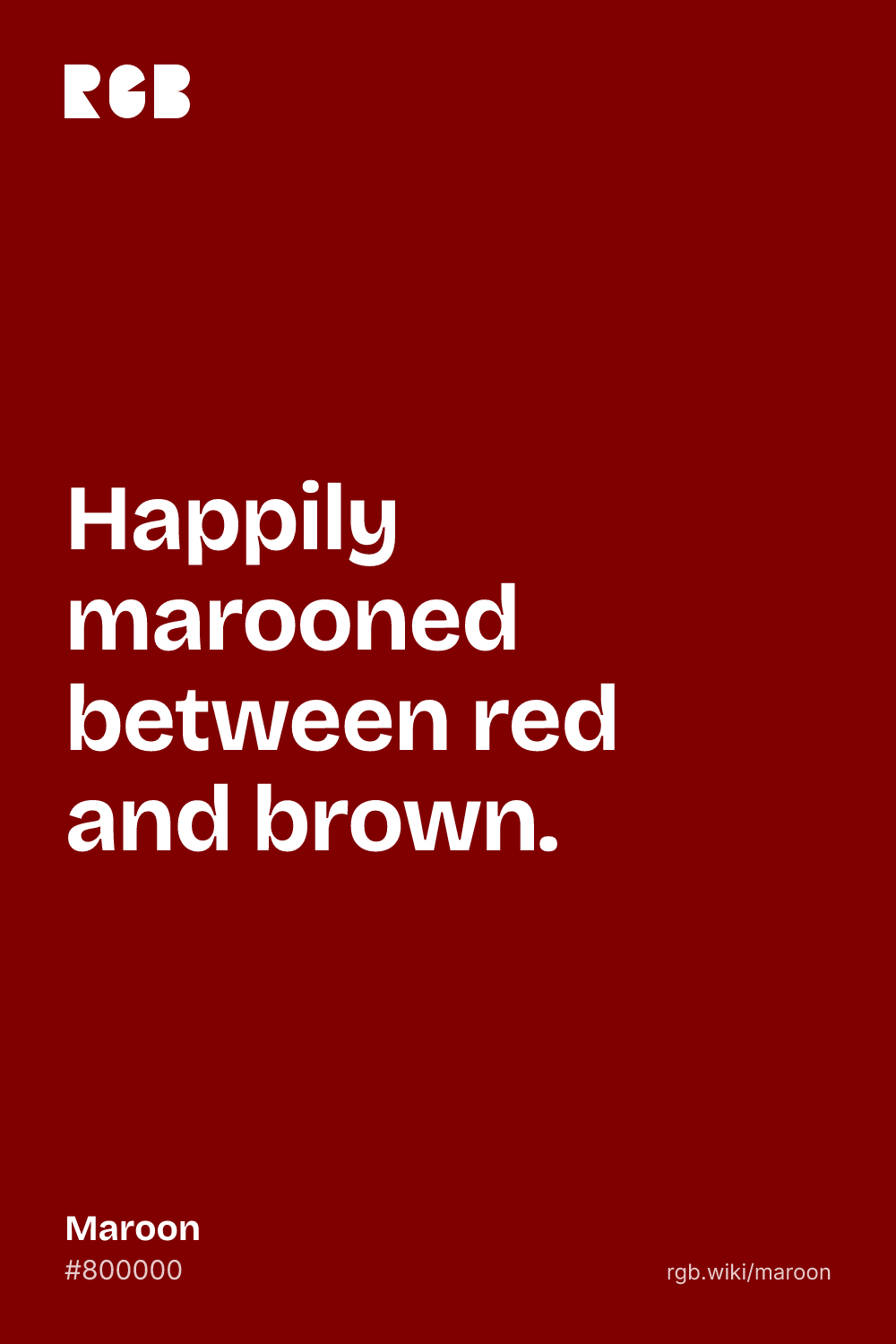
Maroon color card, hex #800000: “Happily marooned between red and brown”

Maroon on the color map

People’s average maroon in the xkcd survey is darker and leans toward purple, almost the same as their average burgundy (#610023). X11 maroon sits outside the outline, up and to the left: much lighter and pinker. The web kept HTML’s code instead. The outline is an approximate range, not a measured one.

Shades and tints

Tints with white

Shades with black

Tones with gray

Maroon sits in the middle. Tints add white, shades add black and tones add gray, in 10% steps out from it. Tap any swatch to copy its code.

Light and dark maroon

#993333
Light maroonMixed 20% with white. A little brighter and softer.
#800000
MaroonThe reference color.
#4C0201
Dark maroonA deep, nearly black red, close to Texas A&M’s Aggie Maroon.

Colors that go with maroon

Pairings that work in rooms, outfits and interfaces.

Maroon and gold

The classic school pairing. Warm, proud and traditional.

Maroon and gray

Sober and modern. Gray keeps maroon from feeling heavy.

Maroon and navy

Deep and serious. Suits law, finance and libraries.

Maroon and cream

Warm and bookish. A safe choice for long text.

Maroon and teal

Exact opposites on screen. Use teal as a small accent.

Maroon and blush

Soft contrast. Good for weddings and stationery.

Color-wheel palettes

Pick a palette to see where its colors sit on the color wheel. The caret marks maroon. Tap a band to copy its code.

Similar colors

Claret73%Burgundy86%Carmine74%Sangria79%Blood red88%MaroonDark red87%

Lined up by hue around maroon. Hover a color to see how similar it is.The bar under each name shows how similar it is. Similarity comes from the distance between the two colors in OKLab, a model of how we see color.

Maroon vs burgundy

Maroon#800000 · hue 0°
  • Pure dark red with no blue
  • Reads warmer and browner
  • Named after the chestnut
Burgundy#800020 · hue 345°
  • Leans purple, from a touch of blue
  • Reads cooler and more like wine
  • Named after the wine of Burgundy

Meaning

  • School colors
  • Sport
  • Airborne troops
  • Queensland
  • Chestnut

Maroon reads as dark, warm and dependable. It is the color of school sweaters and team jerseys: many universities wear it, often with gold or white. It is also the beret color of airborne troops and the official color of the Australian state of Queensland. Its name means chestnut. As with most named colors, research on color and emotion tests broad hues such as red, not maroon itself.

The beret of airborne troops

Historical record

British paratroopers adopted a maroon beret in 1942, and it became an international symbol of airborne forces. German troops in North Africa called the British paratroopers “Red Devils”, after their berets and their fighting.1
A color word of its own

One study

When 51 American English speakers named 330 color chips in their own words, maroon was one of four high-agreement names beyond the basic eleven, with peach, teal and lavender. More women than men named colors this way.2

In speech, close to burgundy

Online survey

In the xkcd color survey, where people named over five million colors online, the average maroon (#650021) and the average burgundy (#610023) came out almost the same. Both are darker and more purple than the web’s maroon.3

Sources (3)
  1. Wikipedia, “Maroon beret”, citing Rebecca Skinner’s British Paratrooper 1940–45 (2015) and David Reynolds’s Paras (1998).
  2. Lindsey, D. T. & Brown, A. M. (2014). The color lexicon of American English. Journal of Vision, 14(2), 17. doi:10.1167/14.2.17
  3. Munroe, R. (2010). “Color survey results”. xkcd blog. The survey’s color averages are released as CC0 data.

History

Maroon started out as the French word for chestnut. As a color it found its home in schools and sport, and later on soldiers’ heads and on the web.

  1. 1779

    First recorded use of “maroon” as a color name in English, from French marron, chestnut.1

  2. 1894

    On May 5, students and faculty make maroon the University of Chicago’s color. It replaces goldenrod yellow, which, said football coach Amos Alonzo Stagg, “ran, soiled easily”. The teams become the Maroons.2

  3. 1896

    Virginia Tech picks burnt orange and Chicago maroon, because no other college uses that pair, and wears them for the first time on October 26.3

  4. 1942

    British paratroopers adopt the maroon beret. Airborne forces around the world later follow.4

  5. 1997

    HTML 3.2 includes “maroon” among its 16 color names, at #800000.5

  6. 2003

    On November 13, Queensland names maroon its official state color.6

Sources (6)
  1. Merriam-Webster, “maroon”, definition, etymology and first known use.
  2. University of Chicago Athletics, “Maroon, Maroons, and the Phoenix”.
  3. Virginia Tech, “History and Traditions”.
  4. Wikipedia, “Maroon beret”, citing Rebecca Skinner’s British Paratrooper 1940–45 (2015) and David Reynolds’s Paras (1998).
  5. W3C (1997). HTML 3.2 Reference Specification, color names (“originally picked as being the standard 16 colors supported with the Windows VGA palette”).
  6. Queensland Government, “State colour and emblems”.

Maroon in use

#73182C
Official colorQueensland’s state color

Queensland, Australia, made maroon its official color in 2003. The government’s web code, #73182C, has the purple lean of people’s everyday maroon, unlike the pure red of the web code.

#73182C
Source: Queensland Gov.

Logos belong to their owners and are shown unaltered, only to show where each palette comes from. Palettes are sampled in-house.

Questions

What color is maroon?

A dark brownish red. The web code is #800000 (RGB 128, 0, 0): red at half strength, with no green or blue.

What is the difference between maroon and burgundy?

Maroon (#800000) is pure dark red, so it looks warmer and a little brown. Burgundy (#800020) adds a small amount of blue, which pushes it toward purple and wine. In everyday speech the two overlap a lot.

Is maroon red or brown?

Dictionaries disagree: Merriam-Webster calls it a dark red, others a brownish red. The name comes from the French word for chestnut, and in French marron also means brown.

What colors go with maroon?

Gold and white are the classic school pairings. Gray, navy and cream look calm and serious, and blush pink makes it softer.

Why is it called maroon?

After marron, the French word for chestnut. Maroon has been a color name in English since 1779.

What is the opposite of maroon?

On screen, teal (#008080) is its exact opposite: maroon has only red, at half strength, and teal has only green and blue, at half strength.
