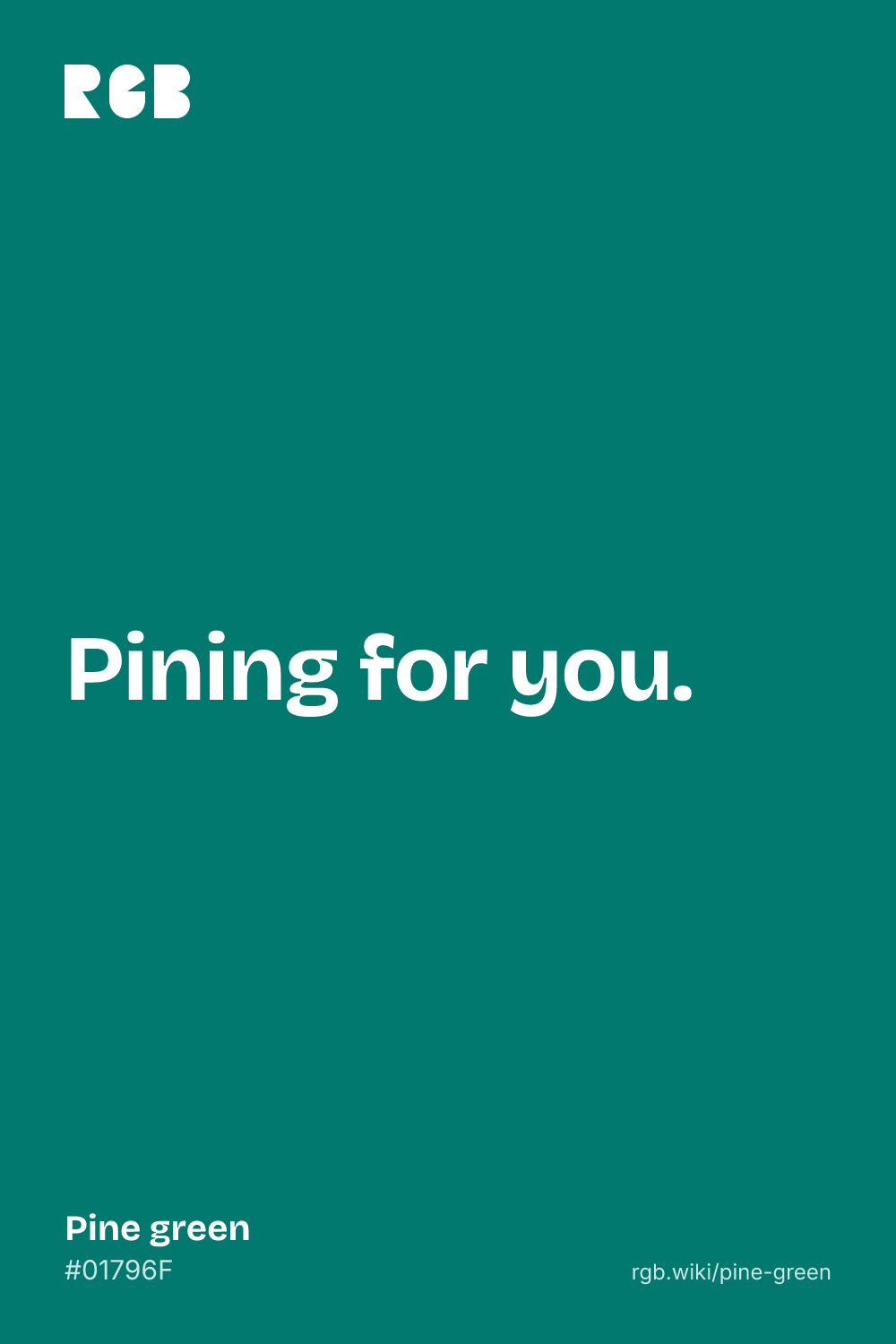
A deep bluish green named after pine trees, though real pine needles are grayer.
Overview
Pine green is a deep green with a strong blue lean. The code most color lists use, #01796F, has almost no red and nearly as much blue as green, which puts it close to teal.
The name comes from pine trees, the evergreen conifers that carry their needles in bunches. A 1930 color dictionary listed a dark bluish green as “pine tree”, a color name first recorded in 1923. Merriam-Webster defines pine green as “a variable color averaging a dark green”, yellower than evergreen or bottle green and bluer than forest green.
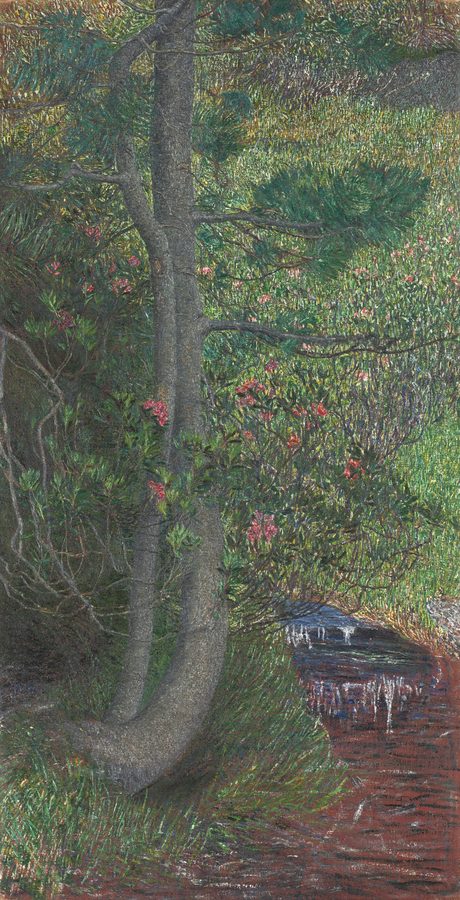
No standard defines the code, and it is lighter and bluer than most pines. In the xkcd color survey, people’s average pine green was #0A481E, a dark forest green. In paintings, pine needles are grayer still: the branches in Giovanni Segantini’s Pine Tree (about 1897) sample at about #415846.
Pine green is calm and wintry. It pairs well with cream, copper, red and navy, and it carries white text.
HEX
#01796F
RGB
rgb(1, 121, 111)
HSL
hsl(175, 98%, 24%)
HSV
175°, 99%, 47%
CMYK
99, 0, 8, 53
OKLCH
oklch(51.8% 0.091 184.8)
Every code converts from the HEX value #01796F. #01796F is the pine green most color lists use, but we could not trace it to a published color standard. Dictionaries put pine green darker: the 1955 ISCC-NBS dictionary files the pine green of Taylor, Knoche and Granville’s Descriptive Color Names Dictionary as moderate green (#3B7861) and dark green, and Maerz and Paul’s “pine tree” (1930) as dark bluish green (#004B49). Treat this page’s code as typical, not official. CMYK is a screen-based estimate; print results vary.
Pine green on the color map
LighterDarker
People’s pine green and pine in the xkcd survey are much yellower than the web code, far to the left, and their pine green is darker too. The dictionary’s pine green is a little yellower and grayer, inside the outline. Maerz and Paul’s pine tree is darker and slightly bluer, below it. The outline is an approximate range, not a measured one.
Shades and tints
Tintswith white
Shadeswith black
Toneswith gray
Pine green sits in the middle. Tints add white, shades add black and tones add gray, in 10% steps out from it. Tap any swatch to copy its code.
Light and dark pine green
#B3D7D4
Pale pine greenMixed 70% with white. A cool, misty blue-green.
#67AFA9
Light pine greenMixed 40% with white. Soft and fresh.
#01796F
Pine greenThe reference color.
#1E5945
SpruceA darker, grayer conifer green, with a page of its own. See spruce
#004B49
1930 pine treeThe darker bluish green that Maerz and Paul’s 1930 dictionary called pine tree.
Colors that go with pine green
Pairings that work in rooms, outfits and interfaces.
Pine green and cream
Warm and woodsy. Good for cabins and cafés.
Pine green and red
The holiday pairing. Festive without being loud.
Pine green and copper
Rich and earthy. Suits kitchens and craft brands.
Pine green and navy
Deep and cool. A quiet choice for outdoor brands.
Pine green and snow
Crisp and wintry, like pines after snowfall.
Pine green and mustard
Retro and cheerful. Mustard warms the cool green.
Color-wheel palettes
Pick a palette to see where its colors sit on the color wheel. The caret marks pine green. Tap a band to copy its code.
Lined up by hue around pine green. Hover a color to see how similar it is.The bar under each name shows how similar it is. Similarity comes from the distance between the two colors in OKLab, a model of how we see color.
Pine green vs teal
Pine green#01796F · hue 175°
A touch greener and darker
No standard code
Named after pine trees
Teal#008080 · hue 180°
Exactly between green and blue
The CSS keyword teal
Named after a duck
Meaning
Pine forests
Long life
Winter
Painting
Pine green reads as woods, winter and calm. Because pines keep their needles all year, they stand for long life and steadfastness in East Asian art, and they keep green in the landscape through northern winters. Research on color and emotion tests broad hues such as green, not pine green, so claims about its mood are convention rather than evidence.
A symbol of long life
Historical record
In Chinese art, the pine stands for longevity and steadfastness because it keeps its green needles all year, and with plum and bamboo it makes up the Three Friends of Winter. Japanese painters used it the same way: a scroll from 1801 at the Cleveland Museum of Art pairs “eternally green” pines with peaches and deer as symbols of long life.1, 2
People picture it darker and yellower
Online survey
In the xkcd color survey, where people named millions of colors online, the average pine green was #0A481E and the average pine #2B5D34. Both are darker and much yellower than the web code, closer to a forest green.3
Dictionaries never agreed
Dictionaries
Merriam-Webster calls pine green “a variable color”. Maerz and Paul’s 1930 pine tree is a dark bluish green, and the pine green of another dictionary spans moderate to dark green. The common web code is lighter and bluer than all of them.4, 5
Sources (5)
Wikipedia, “Pine”, Culture, citing Wolfram Eberhard’s A Dictionary of Chinese Symbols (2003).
Kelly, K. L. & Judd, D. B. (1955). The ISCC-NBS Method of Designating Colors and a Dictionary of Color Names. NBS Circular 553. Entries as listed by John Foster and Aubrey Jaffer: Descriptive Color Names Dictionary and Maerz and Paul.
History
Pine green is a young color name for a very old tree. Its story runs through painting, the color dictionaries of the 20th century and the web.
1801
Japanese painter Toda Tadanaka pairs evergreen pines with peaches and deer in a pair of scrolls about long life.1
About 1897
Giovanni Segantini paints Pine Tree, a close-up of a pine in the Swiss Alps in small, broken strokes of brilliant color.2
1923
First recorded use of “pine tree” as a color name in English.3
1930
Maerz and Paul’s A Dictionary of Color shows a pine tree sample on its plate 31: a dark bluish green.3, 4
1955
The ISCC-NBS dictionary files one dictionary’s pine green under moderate green and dark green, and Maerz and Paul’s pine tree under dark bluish green.4
Cleveland Museum of Art, “Pine Tree”, Giovanni Segantini, about 1897, oil on canvas (1982.124).
Wikipedia, “Shades of green”, Pine green, citing Maerz and Paul’s A Dictionary of Color (1930), page 190 and plate 31.
Kelly, K. L. & Judd, D. B. (1955). The ISCC-NBS Method of Designating Colors and a Dictionary of Color Names. NBS Circular 553. Entries as listed by John Foster and Aubrey Jaffer: Descriptive Color Names Dictionary and Maerz and Paul.
Giovanni Segantini painted this pine in the Swiss Alps close up, in small strokes of brilliant color. Its needles still come out as grayish, yellowish greens, darker and duller than the web’s pine green and closer to people’s average pine in the xkcd survey.
#415846#576A52#6F7D5E#889472
Source: Cleveland Museum of Art
Source
Sampled from the pine branches in the Cleveland Museum of Art’s photograph (1982.124), released as CC0 (public domain). Colors in a photo shift with the lighting, so read the codes as close, not exact.
#007272
BrandingDNB
The Norwegian bank’s green, #007272, the fill of its logo, is a little darker and bluer than this page’s code.
#007272
Source: DNB logo file
Source
The green is the fill in DNB’s own logo, the inline SVG in its website header. The logo shown is that file.
Logos belong to their owners and are shown unaltered, only to show where each palette comes from. Palettes are sampled in-house.
Questions
What color is pine green?
A deep green with a strong blue lean. The usual web code is #01796F (RGB 1, 121, 111), though no standard defines it.
Is pine green the same as teal?
No, but they are close. Teal (#008080) has equal green and blue; pine green (#01796F) is a little greener and darker. Real pine needles are much yellower and grayer than either.
What is the difference between pine green and forest green?
Forest green (#228B22), the CSS keyword, is a vivid, yellower green. Pine green is bluer and deeper.
What colors go with pine green?
Cream and copper for warmth, red for the holidays, navy for a cool look, and white for something crisp.
Why is it called pine green?
After pine trees, which keep their green needles all year. A 1930 color dictionary called a similar dark bluish green pine tree.
What does the pine symbolize?
Long life and steadfastness, especially in Chinese and Japanese art, because pines stay green through the winter.