Fuchsia

A vivid purple-pink, full red plus full blue, named after the fuchsia flower.

Overview

Fuchsia is a vivid purple-pink. Its web code is #FF00FF: red and blue at full strength with no green, the most intense mix of the two a screen can show.

The name comes from the fuchsia, a flowering shrub mostly from Central and South America, named after the 16th-century German botanist Leonhart Fuchs. Fuchsia has been a color name in English since at least 1892.

On the web, fuchsia and magenta are the same color: CSS defines both as #FF00FF. Printers and dictionaries use magenta for a redder color, which has its own page here. Real fuchsia flowers are deeper still, often with purple petals inside red sepals.

Fuchsia is loud. It works best as an accent, with black, white or navy, or with lime and orange for something festive.

HEX#FF00FF
RGBrgb(255, 0, 255)
HSLhsl(300, 100%, 50%)
HSV300°, 100%, 100%
CMYK0, 100, 0, 0
OKLCHoklch(70.2% 0.322 328.4)
Every code converts from the HEX value #FF00FF. #FF00FF is the CSS keyword fuchsia, one of the 16 color names in HTML 3.2 (1997) and still defined in the CSS Color Module Level 4, where magenta has the same code. CMYK is a screen-based estimate; print results vary.
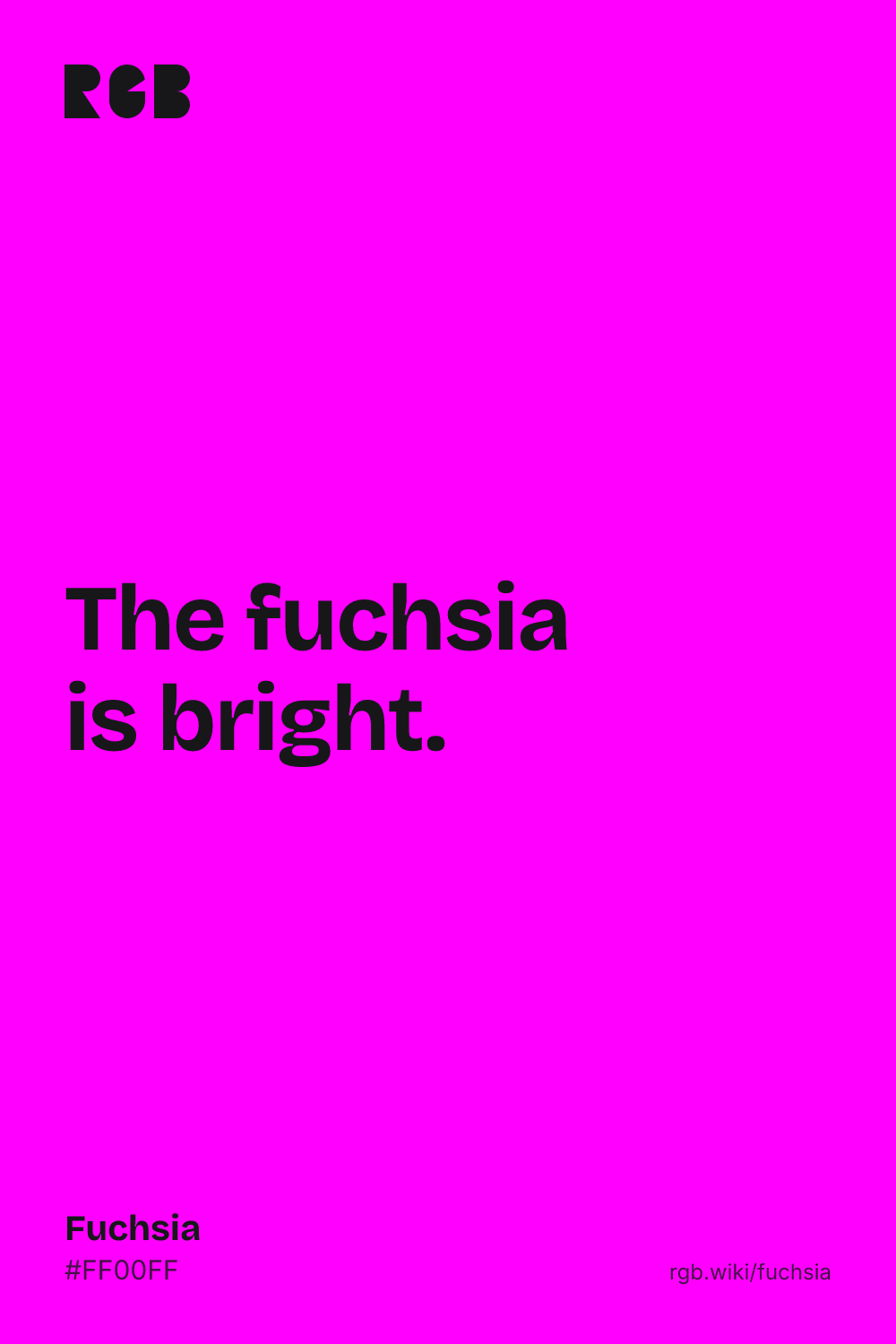
Fuchsia color card, hex #FF00FF: “The fuchsia is bright”

Fuchsia on the color map

People’s average fuchsia in the xkcd survey is very close to the web code, a little darker and pinker. Process magenta sits to the right, toward red, just outside the outline. The outline is an approximate range, not a measured one.

Shades and tints

Tints with white

Shades with black

Tones with gray

Fuchsia sits in the middle. Tints add white, shades add black and tones add gray, in 10% steps out from it. Tap any swatch to copy its code.

Light and dark fuchsia

#FFB2FF
Pale fuchsiaMixed 70% with white. A soft pink-lilac.
#FF66FF
Light fuchsiaMixed 40% with white. Bright and candy-like.
#FF00FF
FuchsiaThe reference color.
#8B008B
Dark magentaThe CSS keyword darkmagenta. It darkens CSS magenta, the same code as fuchsia, so it is really a dark fuchsia. See magenta

Colors that go with fuchsia

Pairings that work in rooms, outfits and interfaces.

Fuchsia and lime

Loud opposites. Festive and playful.

Fuchsia and black

Bold and dramatic. Fuchsia glows on black.

Fuchsia and orange

Hot and loud. A favorite for festivals and sales.

Fuchsia and navy

Navy calms fuchsia down. Smart and modern.

Fuchsia and turquoise

Electric and tropical. Strong on posters.

Fuchsia and lilac

Tonal and softer: purple-pinks from loud to light.

Color-wheel palettes

Pick a palette to see where its colors sit on the color wheel. The caret marks fuchsia. Tap a band to copy its code.

Similar colors

Electric purple37%Heliotrope40%Pink-purple53%FuchsiaNeon pink89%Shocking pink53%Barbie pink39%

Lined up by hue around fuchsia. Hover a color to see how similar it is.The bar under each name shows how similar it is. Similarity comes from the distance between the two colors in OKLab, a model of how we see color.

Fuchsia vs magenta

Fuchsia#FF00FF · hue 300°
  • Equal red and blue, a purple-pink
  • Named after the fuchsia flower
  • The same code as CSS magenta
Magenta#FF0090 · hue 326°
  • Leans toward red
  • One of the three printing inks
  • Named after a battle

Meaning

  • Flowers
  • Hummingbirds
  • Dye
  • Boldness
  • Screens

Fuchsia reads as loud, playful and confident, a pink pushed toward purple. Its name and much of its image come from the fuchsia flower, whose hanging red and purple blooms draw hummingbirds. It also named one of the first synthetic dyes, and on screens it is pure red plus pure blue light. Its link with femininity is cultural: studies of color and gender test broad hues, and their results do not hold everywhere.

Two names, one code

Web standards

CSS defines fuchsia and magenta as the same color, #FF00FF. Fuchsia was one of the 16 color names in HTML 3.2, taken from the Windows VGA palette; magenta joined it as a second name for the code in SVG 1.0 in 2001.1, 2, 3
Colored for hummingbirds

Field study

Many wild fuchsias have bright red sepals around purple petals, and most species are pollinated by birds. In southern Chile, a field study found Fuchsia magellanica pollinated mainly by a hummingbird, the green-backed firecrown, and by a native bumblebee.4, 5

Women’s favorite? Not everywhere

Two studies

In a 2007 study of 208 young adults in Britain, women leaned more than men toward pinks and purples. A 2013 study found no such difference between the sexes among the Himba of rural Namibia. Neither tested fuchsia by name.6, 7

Sources (7)
  1. W3C, CSS Color Module Level 4, named colors.
  2. W3C (1997). HTML 3.2 Reference Specification.
  3. W3C (2001). Scalable Vector Graphics (SVG) 1.0, recognized color keyword names.
  4. Wikipedia, “Fuchsia” (the plant).
  5. Valdivia, C. E., Orellana, J. I. & Murúa, M. (2025). Nectar robbing by the invasive bumblebee Bombus terrestris changes the behavior of native flower visitors of Fuchsia magellanica but not seed set. PeerJ, 13, e20253. doi:10.7717/peerj.20253
  6. Scientific American (2007). “When it comes to color, women have pink eye”, on Hurlbert, A. C. & Ling, Y. (2007), Current Biology, 17(16), R623–R625.
  7. Taylor, C., Clifford, A. & Franklin, A. (2013). Color preferences are not universal. Journal of Experimental Psychology: General, 142(4), 1015–1027. doi:10.1037/a0030273

History

Fuchsia was a botanist’s name, then a flower, then a dye and finally a screen color. The color name is about two centuries younger than the flower.

  1. 1542

    German botanist Leonhart Fuchs publishes his herbal, De historia stirpium, with about 500 woodcuts of plants.1

  2. 1703

    French botanist Charles Plumier names the fuchsia after Fuchs, from a plant he found on Hispaniola in 1696–97.2

  3. 1788

    Fuchsia coccinea reaches Kew Gardens, one of the first fuchsias grown in England.2

  4. 1859

    In France, François-Emmanuel Verguin patents a red-purple aniline dye named fuchsine, after the flower. It is soon also sold as magenta.3

  5. 1892

    First recorded use of “fuchsia” as a color name in English.3

  6. 1997

    HTML 3.2 lists fuchsia among its 16 color names, as #FF00FF.4

  7. 2001

    The SVG standard adds “magenta” as a second name for the same code.5

Sources (5)
  1. Wikipedia, “Leonhart Fuchs”.
  2. Wikipedia, “Fuchsia” (the plant).
  3. Wikipedia, “Fuchsia (color)”, citing Philip Ball’s Bright Earth (2001) and Maerz and Paul’s A Dictionary of Color (1930).
  4. W3C (1997). HTML 3.2 Reference Specification.
  5. W3C (2001). Scalable Vector Graphics (SVG) 1.0, recognized color keyword names.

Fuchsia in use

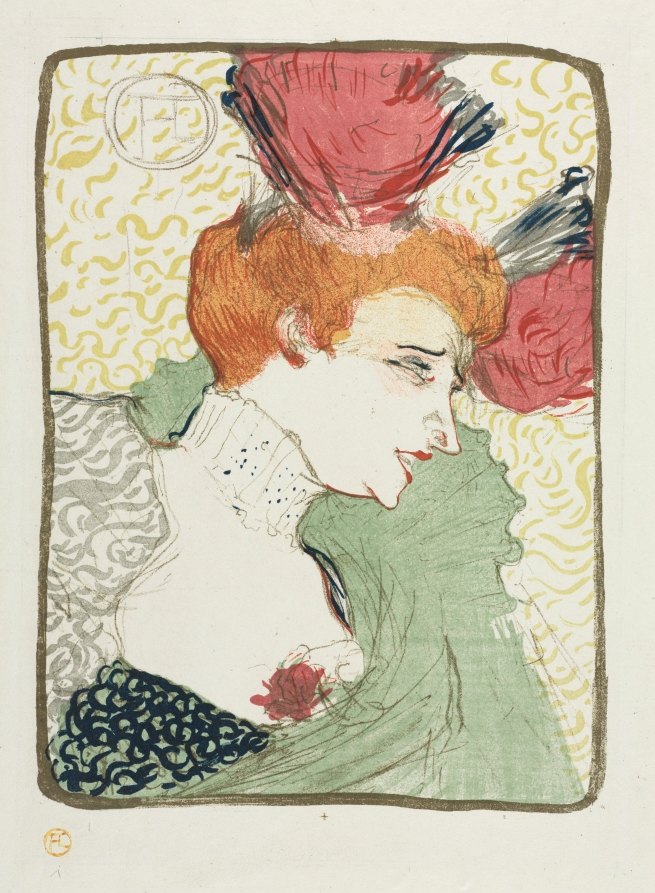
Lithograph of the actress Marcelle Lender in profile, with orange hair, rose-red fuchsia flowers in her hair and a pale green cape
#CD7670#B8BB99#2F383B#E7E3D4
PrintBust of Mademoiselle Lender (1895)

Henri de Toulouse-Lautrec’s color lithograph of the actress Marcelle Lender, at the Cleveland Museum of Art. The museum describes the flowers in her hair as fuchsias. Printed in a soft rose red, they show how far real fuchsia sits from the screen’s #FF00FF.

#CD7670#B8BB99#2F383B#E7E3D4
Source: Cleveland Museum of Art

Palettes are sampled in-house.

Questions

What color is fuchsia?

A vivid purple-pink. The web code is #FF00FF (RGB 255, 0, 255): full red and full blue, with no green.

Is fuchsia the same as magenta?

On screens, yes: CSS gives both names the same code, #FF00FF. In printing and in color dictionaries, magenta usually means a redder color, shown on this site as #FF0090.

Is fuchsia pink or purple?

It sits between the two, with equal parts red and blue. Many people call it a hot pink, and color references file it under both pink and purple.

What colors go with fuchsia?

Black, white and navy let it stand out. Lime, orange and turquoise make loud, festive pairs, and lilac a softer tonal one.

How do you spell and say fuchsia?

F-U-C-H-S-I-A, after the botanist Leonhart Fuchs. In English it is said FEW-shuh, which is why it is often misspelled “fuschia”.

Why is it called fuchsia?

After the fuchsia flower, which the French botanist Charles Plumier named in honor of Leonhart Fuchs around 1703. Fuchsia was first recorded as a color name in 1892.