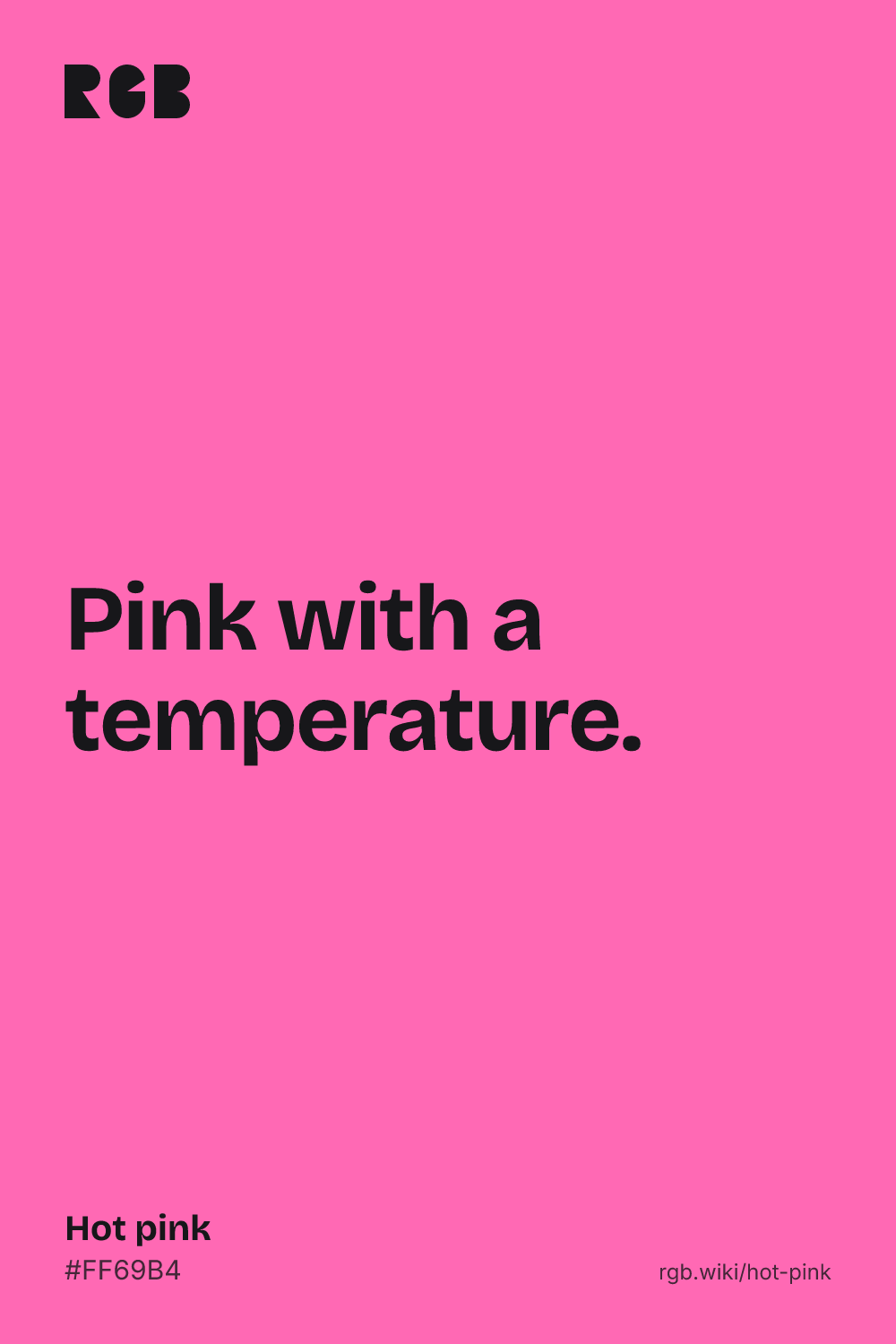
A bright, warm pink that began as Schiaparelli’s shocking pink.
Overview
Hot pink is a bright, saturated pink. Its web code is #FF69B4, the CSS keyword hotpink: full red, with green at about 40% and blue at about 70%. On screen it is rose with about 40% white mixed in.
The color came before the name. In 1937 the Paris designer Elsa Schiaparelli named a perfume, Shocking, after the vivid pink that had become her signature. In North America the same loud pink was called hot pink by the 1950s, and that name stuck.
Everyday hot pink is louder than the web code. In the xkcd color survey, people’s average hot pink was #FF028D, darker and far more vivid, and almost the same as the CSS keyword deeppink (#FF1493). The web’s hotpink, taken from an old Unix color list, is a lighter, softer pink.
Hot pink works best as an accent. It glows next to black, navy and white, and it clashes happily with orange and lime. Dark text reads well on it; white text does not.
HEX
#FF69B4
RGB
rgb(255, 105, 180)
HSL
hsl(330, 100%, 71%)
HSV
330°, 59%, 100%
CMYK
0, 59, 29, 0
OKLCH
oklch(72.8% 0.197 352.0)
Every code converts from the HEX value #FF69B4. #FF69B4 is the CSS keyword hotpink, defined in the CSS Color Module Level 4. It comes from the X11 color names of Unix workstations and was first written into a web standard in SVG 1.0 (2001). CMYK is a screen-based estimate; print results vary.
Hot pink on the color map
LighterDarker
People’s average hot pink and CSS deeppink sit just below the web code and a little to the right: darker, a touch redder and far more vivid. People’s shocking pink sits straight below it. The map shows hue and lightness, not vividness, so all three stay inside the outline. The outline is an approximate range, not a measured one.
Shades and tints
Tintswith white
Shadeswith black
Toneswith gray
Hot pink sits in the middle. Tints add white, shades add black and tones add gray, in 10% steps out from it. Tap any swatch to copy its code.
Light and dark hot pink
#FFA5D2
Light hot pinkMixed 40% with white. A soft candy pink.
#FF69B4
Hot pinkThe reference color.
#FF1493
Deep pinkThe CSS keyword deeppink. Darker and more vivid, close to what most people call hot pink. See deep pink
#FC0FC0
Shocking pinkSchiaparelli’s color, with a page of its own. More vivid and a little more purple. See shocking pink
#993F6C
Dark hot pinkMixed 40% with black. A deep raspberry that holds white text.
Colors that go with hot pink
Pairings that work in rooms, outfits and interfaces.
Hot pink and black
Bold and nocturnal. Hot pink glows on black.
Hot pink and lime
Loud opposites. Playful and summery.
Hot pink and navy
Navy calms hot pink down. Smart enough for work.
Hot pink and orange
A deliberate clash. Strong for posters and sales.
Hot pink and gold
Glamorous and festive. Use gold sparingly.
Hot pink and white
Crisp and fresh. Let white do most of the work.
Color-wheel palettes
Pick a palette to see where its colors sit on the color wheel. The caret marks hot pink. Tap a band to copy its code.
Lined up by hue around hot pink. Hover a color to see how similar it is.The bar under each name shows how similar it is. Similarity comes from the distance between the two colors in OKLab, a model of how we see color.
Hot pink vs fuchsia
Hot pink#FF69B4 · hue 330°
A true pink, lighter and warmer
Some green and less blue
A fashion name from the 1950s
Fuchsia#FF00FF · hue 300°
A purple-pink at full strength
Full red and full blue, no green
Named after a flower
Meaning
Shocking pink
Fashion
Glamour
Boldness
Screens
Hot pink reads as loud, playful and confident, a color meant to be noticed. It began in Paris fashion as Schiaparelli’s shocking pink, took its American name in the 1950s and later became the look of Barbie. Its link with girls is younger than it seems. Studies of color and emotion test broad colors such as pink, not hot pink itself, so most of what is said about its mood is convention.
Born as shocking pink
Historical record
Elsa Schiaparelli made a vivid pink her signature color in the 1930s, and in 1937 she launched a perfume named after it, Shocking. Merriam-Webster dates “shocking pink” to the same year. In North America the color was called hot pink by the 1950s.1, 2, 3
Barbie went pink in the 1970s
News report
The first Barbie doll went on sale in 1959, but Mattel did not use mostly pink packaging until the 1970s. Mattel says Barbie Pink is not a registered trademark, though it counts the color as a famous trademark of the brand.4
Pink for girls is a recent rule
Museum curator
A 1918 children’s clothing catalog advised pink for boys and blue for girls, calling pink the stronger color. A curator at the Museum of Fine Arts, Boston, calls pink for girls “a post-World War II phenomenon”. This is about pink in general, not hot pink alone.5
Hot pink began as a Paris designer’s shocking pink. It became an American fashion color, the look of a famous doll and a web keyword.
1937
On April 29, Elsa Schiaparelli launches her perfume Shocking, named after the vivid pink that had become her signature. “Shocking pink” is first recorded as a color name the same year.1, 2
1950s
In North America, the intense pink called shocking pink in the 1930s is now called hot pink.3
1959
Mattel’s first Barbie doll goes on sale. Mostly pink packaging follows in the 1970s.4
2001
SVG 1.0 lists hotpink among its color keywords, at #FF69B4. CSS later adopts the same list.5, 6
2010
In the xkcd color survey, people’s average hot pink comes out at #FF028D, far more vivid than the web code.7
2023
As the Barbie film opens, Mattel says Barbie Pink is not a registered trademark but a famous trademark of the brand. Director Greta Gerwig confirms her crew bought every can of pink paint from one company.4
Munroe, R. (2010). “Color survey results”. xkcd blog. The survey’s color averages are released as CC0 data.
Questions
What color is hot pink?
A bright, saturated pink. The web code is #FF69B4 (RGB 255, 105, 180): full red, with green at about 40% and blue at about 70%.
Is hot pink the same as shocking pink?
They are close relatives. Shocking pink was Elsa Schiaparelli’s name for her vivid pink in 1937, and in North America the same kind of color was called hot pink by the 1950s. On this site, shocking pink (#FC0FC0) is more vivid and a little more purple than the web’s hot pink.
What is the difference between hot pink and fuchsia?
Fuchsia (#FF00FF) is full red plus full blue, a purple-pink. Hot pink (#FF69B4) has less blue and some green, so it is lighter and warmer: a true pink.
Why does hot pink look different on different sites?
There are really two hot pinks. The CSS keyword hotpink is a fairly light pink, #FF69B4. Most people picture something darker and louder: in the xkcd color survey the average hot pink was #FF028D, close to the CSS keyword deeppink (#FF1493).
Is hot pink a CSS color?
Yes. Write hotpink, as one word, in CSS or HTML and the browser shows #FF69B4. It has been a web color keyword since SVG 1.0 in 2001 and is defined in CSS Color Module Level 4.
What colors go with hot pink?
Black, navy and white make it stand out. Lime and orange make loud, festive pairs, and gold adds glamour.