Overview
Purple is a mix of red and blue. Unlike violet, which sits at the far end of the rainbow, purple has no wavelength of its own: we see it when red and blue light arrive together.
The CSS keyword purple is #800080, red and blue at half strength. At full strength the same mix is fuchsia, #FF00FF.
The word comes from the Latin purpura, the dye made from sea snails that is now called Tyrian purple. Today’s named purples run from pale lilac and lavender to deep aubergine and indigo.
| HEX | #800080 | |
|---|---|---|
| RGB | rgb(128, 0, 128) | |
| HSL | hsl(300, 100%, 25%) | |
| HSV | 300°, 100%, 50% | |
| CMYK | 0, 100, 0, 50 | |
| OKLCH | oklch(42.1% 0.193 328.4) |
Types of purple
Pale purples
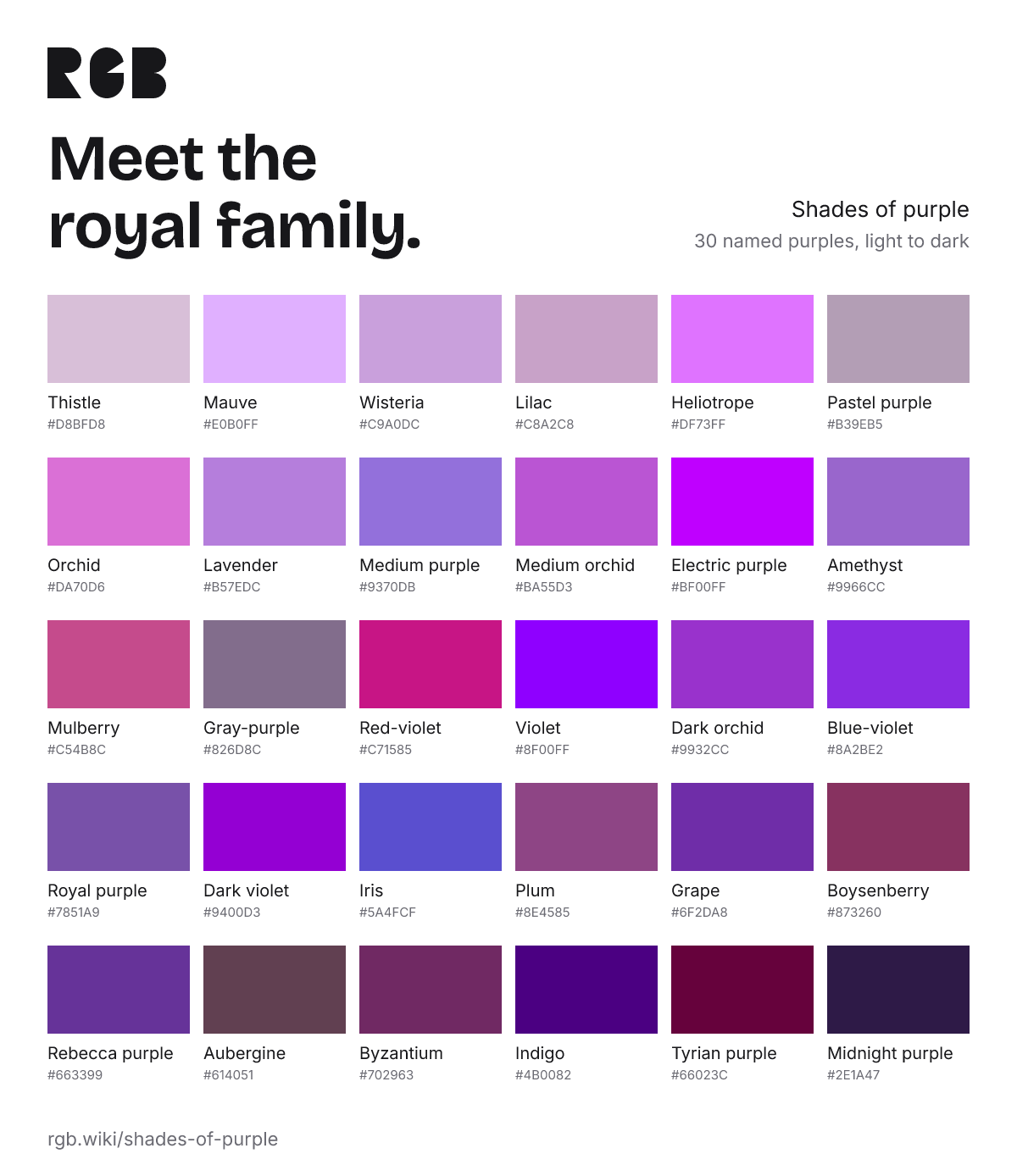
Purple with plenty of white: thistle, wisteria, lilac, mauve, pastel purple and lavender.
Red-purples
Purples that lean toward red: orchid, mulberry, red-violet, plum and boysenberry.
Blue-purples
Purples that lean toward blue: blue-violet, violet, royal purple, iris and indigo.
Bright purples
Vivid, saturated purples: heliotrope, electric purple, amethyst and grape.
Dark purples
The deepest purples: Byzantium, aubergine, Tyrian purple and midnight purple.
Light, dark and other purples
Plain names like these have no single official code. Each card shows a typical value; click it to copy.
All 30 purples, light to dark