An old fruit word
Word historyThe word pear goes back to Old English peru, from the Latin pirum, and Merriam-Webster dates it to before the 12th century. The color name is far younger: its code first appears in 2008, with no source.1, 6
A bright yellow-green named after the pear, though real pear skins are softer, and many are not green at all.
Pear is a bright, slightly yellow green named after the skin of the fruit. Its usual code, #D1E231, has strong green, almost as much red and very little blue. That puts it on the yellow side of yellow-green, close to a greenish lemon, and light enough that black text reads well on it while white text does not.
The code has a short history. It first appeared in October 2008, when a Wikipedia editor added a “pear” swatch to the article on chartreuse and described it as the color of Anjou or Bartlett pears. No source was given, and no standard defines it; color lists then copied it. People’s own idea of pear is close: in the xkcd color survey, the average color people called pear was #CBF85F, a little lighter and greener.
Real pears are softer and much more varied than the code. Bartlett pears are green and turn yellow as they ripen, Anjou pears keep their green or red skin, Bosc pears are a russeted cinnamon brown, and many varieties carry a red blush where the sun reaches them. In old fruit prints and still lifes, the green of a pear samples as a muted olive, nearer to the 1948 color name winter pear, filed as a moderate yellow green (#8A9A5B).
On screens, #D1E231 works as a fresh, sunny accent. It glows against dark olive, charcoal or navy, turns autumnal next to russet brown and pear red, and makes a lively near-opposite to plum purple. As a background it needs dark text: black on pear reaches 14.6:1.
| HEX | #D1E231 | |
|---|---|---|
| RGB | rgb(209, 226, 49) | |
| HSL | hsl(66, 75%, 54%) | |
| HSV | 66°, 78%, 89% | |
| CMYK | 8, 0, 78, 11 | |
| OKLCH | oklch(87.1% 0.185 115.3) |
People’s average pear in the xkcd survey sits inside the outline, above the reference and a little to the right: lighter and greener. Wikipedia’s current swatch sits near the top of the outline, lighter and more intense. The dictionary’s winter pear is much darker and grayer, off the bottom of this view, so it is pinned to the edge. The outline is an approximate range, not a measured one.
Tints with white
Shades with black
Tones with gray
Pairings that work in rooms, outfits and interfaces.
Green to gold, the way a Bartlett pear changes on the counter. Fresh and warm.
Pear green with the deep wine red of red-skinned pears. Rich, so use the red sparingly.
Cinnamon and bark browns from russeted pears, with pear as the bright note. Autumnal.
After the dark aquatint grounds of Regency fruit books. Pear glows on the deep olive.
Near-opposites on the color wheel. Bold and playful.
A dark theme with pear as the accent. Sporty and clear.
Pick a palette to see where its colors sit on the color wheel. The caret marks pear. Tap a band to copy its code.
Lined up by hue around pear. Hover a color to see how similar it is.The bar under each name shows how similar it is. Similarity comes from the distance between the two colors in OKLab, a model of how we see color.
Pear’s meanings come from the fruit itself. The name is one of the oldest fruit words in English, and the skin’s color tells a story of ripening, sunlight and variety. Painters have used that range of greens, golds and reds in still lifes for centuries. Studies of color and emotion test broad words such as green and yellow, not pear.
The word pear goes back to Old English peru, from the Latin pirum, and Merriam-Webster dates it to before the 12th century. The color name is far younger: its code first appears in 2008, with no source.1, 6
Pears are picked mature but unripe and ripen off the tree. Bartlett pears turn from green to yellow as they ripen, but Anjou, Bosc, Comice, Seckel and most other varieties barely change color, so growers advise pressing near the stem instead.2
The yellowing of a green pear comes mainly from chlorophyll breaking down in the peel. In a study of two Chinese pear varieties, blocking the ripening hormone ethylene kept the peel green longer and slowed the genes that break chlorophyll down.3
Red Anjou arose as a bud mutation of green Anjou. A Cornell study found its red peel holds more anthocyanins, the pigments of red apples and berries, with higher activity of the gene MYB10 that switches them on. The flesh of the two pears showed no difference.4
Bosc pears are known for a russet skin of warm cinnamon brown. Russeting is a rough layer rich in suberin, the waxy substance of cork, which builds up over the green skin as the fruit grows.5, 7
The pear is an old fruit and a young color code. Its skins were painted and printed long before a web swatch existed, and those images show a softer, more varied fruit than #D1E231.
The fruit’s name is in English as Old English peru, from the Latin pirum.1
The Williams pear is thought to arise in a schoolmaster’s garden at Aldermaston, England. Its green skin turns yellow as it ripens.2
George Brookshaw’s Pomona Britannica prints pears in green, red-blushed gold and russet against a dark aquatint ground.3
Americans learn that the pear Enoch Bartlett had named after himself is the English Williams. In North America it stays the Bartlett.2
Vincent van Gogh paints Grapes, Lemons, Pears, and Apples with a single green and ochre pear on a lilac cloth.4
Paul Cézanne paints Still Life with Apples and Pears, its pears in soft yellow-greens.5
Plochere’s color system includes “winter pear”, later filed by the ISCC-NBS dictionary as moderate yellow green.6
On 4 October, a Wikipedia editor adds “pear”, #D1E231, to the article on chartreuse, without a source. Color lists copy the code.7
The xkcd color survey publishes its results. The average color people named pear is #CBF85F, close to the code.8
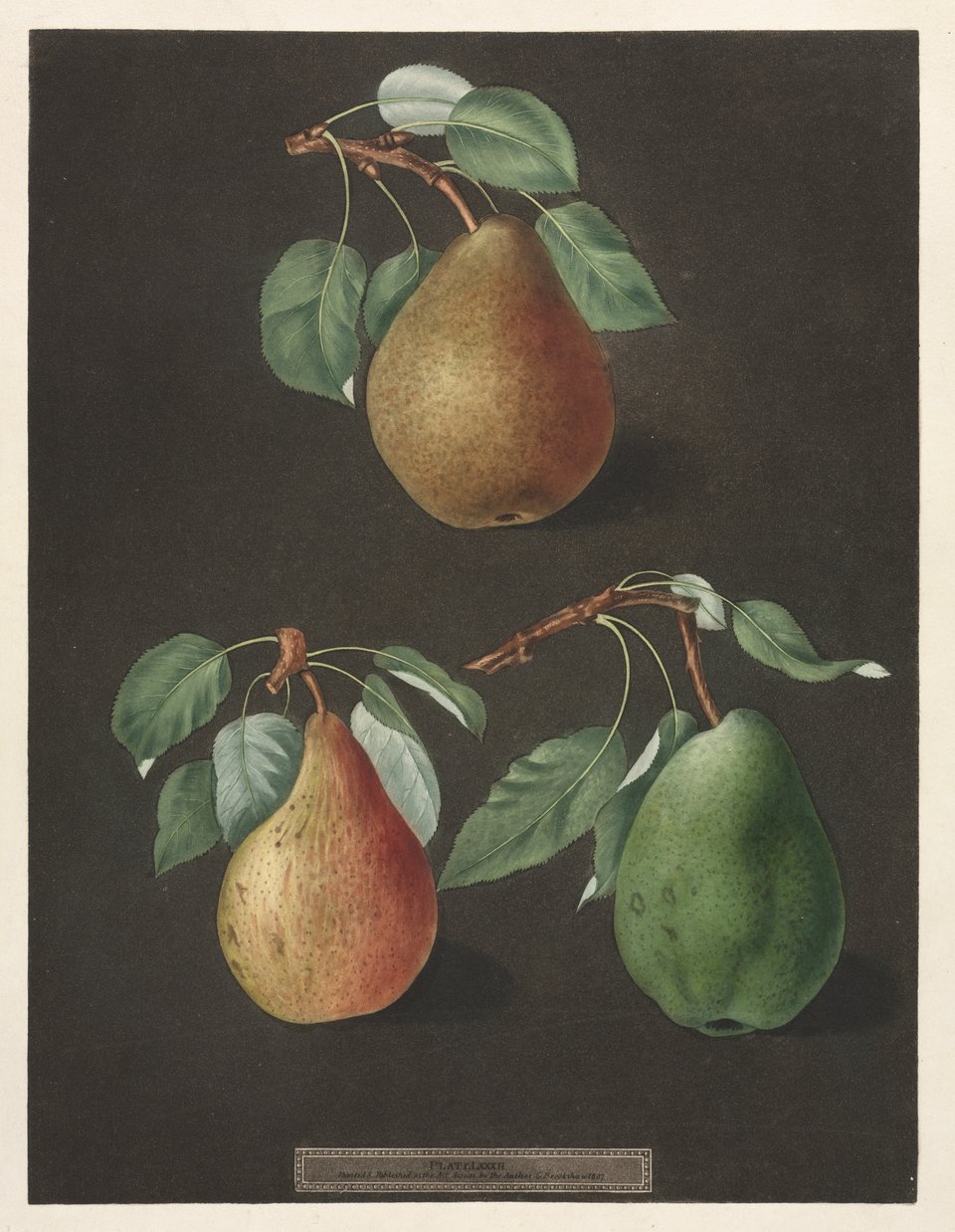
A plate from a book of the finest fruit grown in England, with Hampton Court’s gardens as its showcase. It shows three pears in aquatint: a green one, a red-blushed gold one and a russeted one. The green pear samples as a muted olive, about #7C8C60, the blush about #A3734F. Real pear skin is much softer than #D1E231.
Sampled from the green pear, the blushed pear and the russeted pear in the Cleveland Museum of Art’s photograph (1955.313), released as CC0 (public domain). Colors in a photo shift with the lighting and old prints fade, so read the codes as close, not exact.
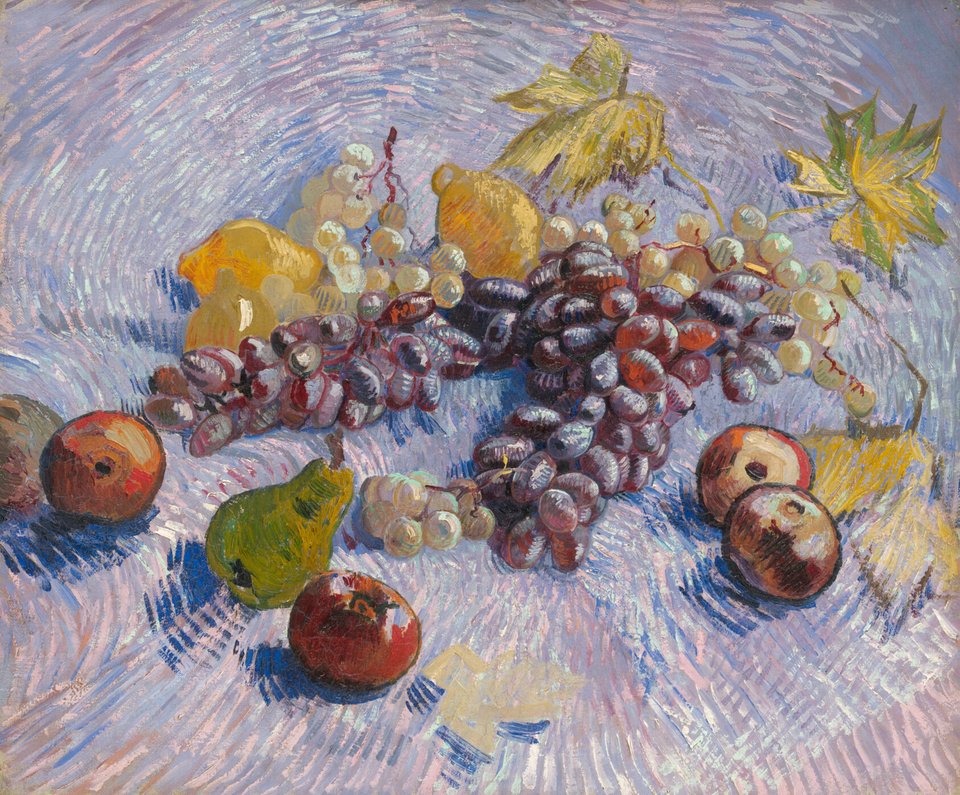
Van Gogh’s single pear is built from olive green and ochre strokes, about #5B6221 and #97750D, set against a swirling lilac cloth. The pear reads bright next to the lilac, though its paint is darker than the web code.
Sampled from the pear and the cloth in the Art Institute of Chicago’s photograph (1949.215), released as CC0 (public domain). Colors in a photo shift with the lighting, so read the codes as close, not exact.
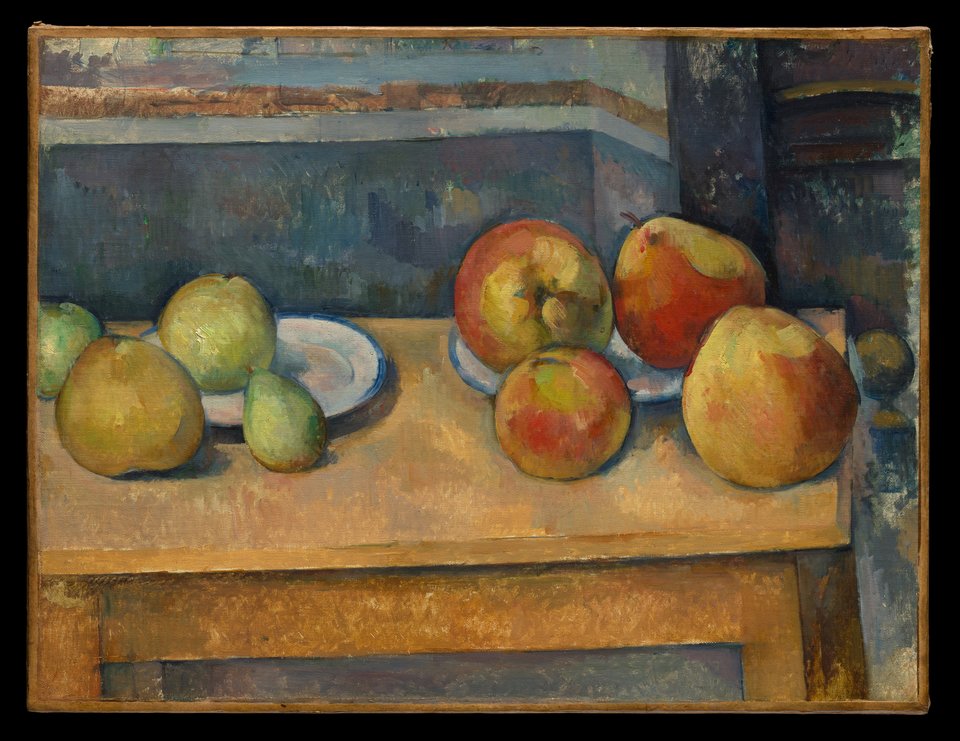
Cézanne’s pears on the left of the table are soft yellow-greens, about #A3A661 to #BBBC6F, shaded with olive and ochre. They are the grayer, gentler cousins of the web pear.
Sampled from the pears and the table in the Metropolitan Museum of Art’s photograph (61.101.3), released as CC0 (public domain). Colors in a photo shift with the lighting, so read the codes as close, not exact.
Palettes are sampled in-house.
A bright, slightly yellow green named after the skin of the pear. Its usual code is #D1E231 (RGB 209, 226, 49).
No standard defines it. It first appeared in a Wikipedia edit in October 2008, which added a pear swatch to the article on chartreuse without a source, and color lists copied it from there. People’s average pear in the xkcd color survey, #CBF85F, is close.
Both. Its hue sits at about 66 degrees, on the yellow side of yellow-green, which is why it can look like a greenish lemon. Most color lists file it with the greens.
Not quite. Real pear skin is softer and more varied: green Bartlett and Anjou pears are closer to a muted olive green, ripe Bartletts are golden yellow, Bosc pears are cinnamon brown and red pears are deep wine red.
Bartlett pears lose chlorophyll in their peel as they ripen, so they turn from green to yellow. Most other varieties, such as Anjou, Bosc and Comice, barely change color, so the best ripeness test is gentle pressure near the stem.
Electric lime, #CCFF00, is brighter and slightly greener, at the very edge of what a screen can show. Pear, #D1E231, is softer and a little yellower.
Pear works with dark olive, charcoal and navy, where it glows; with russet brown and wine red for an autumn look; and with plum purple, its near-opposite, for a bold pairing.
No. White on #D1E231 reaches only 1.4:1 contrast. Use black or a dark color, which reaches about 14.6:1, or darken the pear to about #687118 for white text.