The brightest green of the 1800s, made with arsenic, then sprayed on crops as poison.
Overview
Paris green is the arsenic green of 1814, brighter and bluer than the Scheele’s green it replaced. It is copper acetoarsenite, and it was also sold as emerald green, Schweinfurt green and Vienna green. Here its code is #3EB489, a cool, bright bluish green.
The name causes confusion. Most color lists give Paris green as #50C878, which is Maerz and Paul’s emerald green and the code of this site’s emerald green page. The same 1930 dictionary also has a sample called paris green, which the ISCC-NBS files as strong bluish green, #3EB489. The pigment itself ran from pale blue-green when finely ground to a deeper green when coarse.
Painters loved it: Monet, Gauguin and Seurat used it, and it reached a Korean Buddhist scroll by 1878. But it held arsenic and poisoned the people who made and handled it. From 1867 American farmers sprayed it on potato beetles, and it became the first widely used chemical insecticide.
On screen, #3EB489 is fresh and minty. White text on it reaches only about 2.6:1, so use dark text: black reaches about 8:1.
HEX
#3EB489
RGB
rgb(62, 180, 137)
HSL
hsl(158, 49%, 47%)
HSV
158°, 66%, 71%
CMYK
66, 0, 24, 29
OKLCH
oklch(69.3% 0.123 165.1)
Every code converts from the HEX value #3EB489. No color standard defines Paris green. The ISCC-NBS dictionary files the paris green sample in Maerz and Paul’s A Dictionary of Color (1930) under strong bluish green, #3EB489, the code used here, and under moderate yellowish green. Wikipedia and most color sites show #50C878, which is the same dictionary’s emerald green and the code of this site’s emerald green page. CMYK is a screen-based estimate; print results vary.
Paris green on the color map
LighterDarker
Wikipedia’s code sits inside the outline, up and to the left: lighter and a little yellower. The dictionary’s second filing sits on the lower left edge: darker, duller and yellower. That spread fits the pigment, which ran from pale blue-green when finely ground to a deeper green when coarse. The outline is an approximate range, not a measured one.
Shades and tints
Tintswith white
Shadeswith black
Toneswith gray
Paris green sits in the middle. Tints add white, shades add black and tones add gray, in 10% steps out from it. Tap any swatch to copy its code.
Light and dark paris green
Tints and shades of Paris green, then the codes and pigments it is mixed up with.
#C5E8DC
Pale Paris greenMixed 70% with white. A soft, cool mint.
#8BD2B8
Light Paris greenMixed 40% with white. A fresh seafoam.
#3EB489
Paris greenThe reference color.
#2B7E60
Dark Paris greenMixed 30% with black. A deep bottle green.
#50C878
Emerald greenThe code most sites give for Paris green: Maerz and Paul’s emerald green. See emerald green
#679267
Dictionary’s other Paris greenISCC-NBS moderate yellowish green, the second group for the 1930 sample.
#4F8F23
Scheele’s greenThe older, yellower arsenic green that Paris green replaced. See scheele's green
Colors that go with paris green
Pairings that work in rooms, outfits and interfaces.
Green and blush
Near-opposites, softened. Fresh and a little romantic.
Green and gilt
Like gilt titles on a green cloth binding of the 1850s.
Gauguin’s Arles
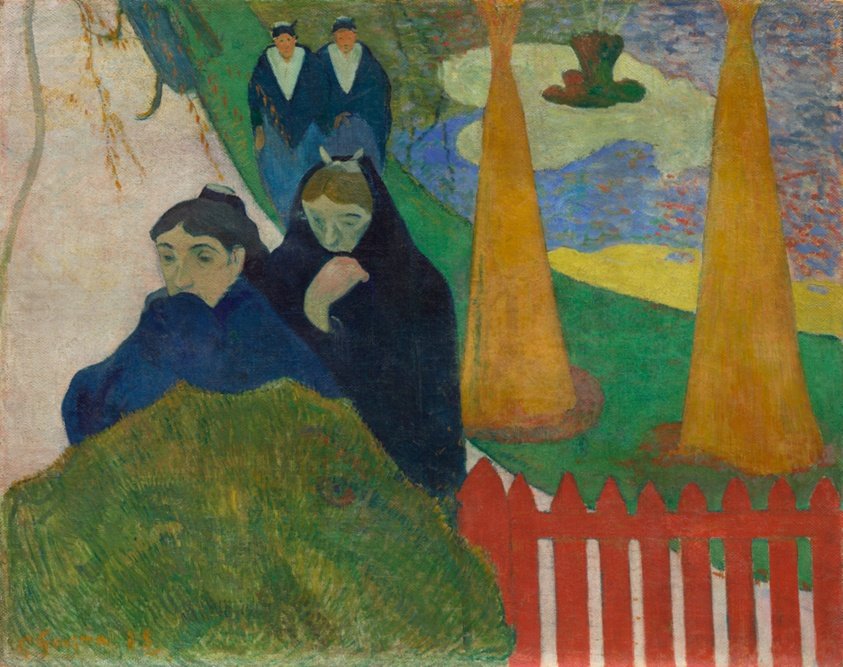
Sampled from Arlésiennes (Mistral), where emerald green colors the grass by the pond.
Temple painting
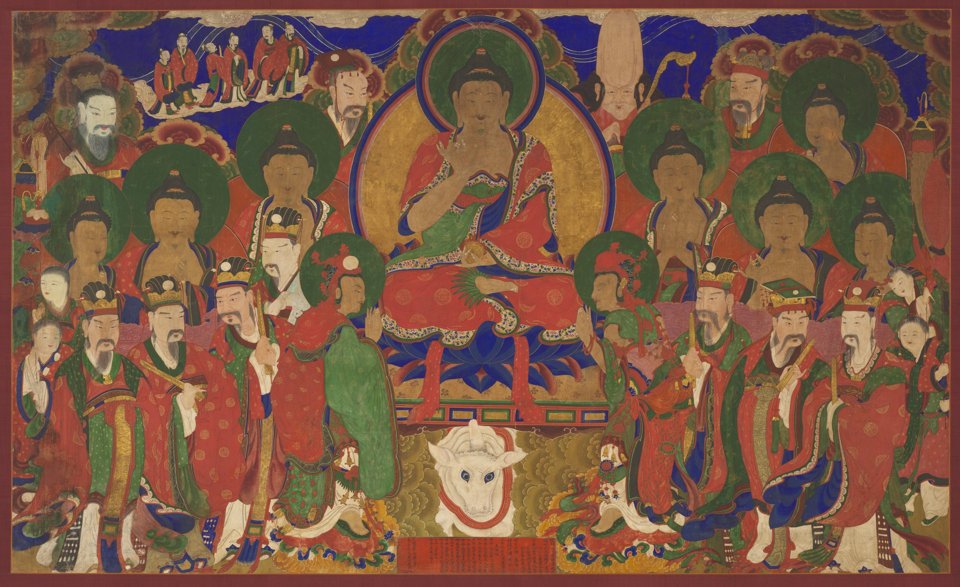
Sampled from a Korean Buddhist scroll of 1878 with emerald green robes.
Paris green and navy
Cool and crisp, with a brass accent.
Color-wheel palettes
Pick a palette to see where its colors sit on the color wheel. The caret marks paris green. Tap a band to copy its code.
Lined up by hue around paris green. Hover a color to see how similar it is.The bar under each name shows how similar it is. Similarity comes from the distance between the two colors in OKLab, a model of how we see color.
Paris green vs emerald green
Paris green#3EB489 · hue 158°
Bluer and a little darker
Copper acetoarsenite, from 1814
Its code is the dictionary’s paris green
Emerald green#50C878 · hue 140°
Lighter and a little yellower
Named after the gemstone
The code most sites give for Paris green
Meaning
Copper and arsenic
Poison green
Insecticide
Painters’ green
Paris green means beauty with a price. It was the most brilliant green of the 1800s, in paintings, ball gowns and wallpaper, and one of the most poisonous things in the house. Later it became a farm poison. Color research tests the broad word green, not this pigment, so nothing here is about mood.
Made to beat Scheele’s green
Pigment history
Wilhelm Sattler and Friedrich Russ began making it in Schweinfurt, Germany, in 1814, looking for a green that would darken less than Scheele’s green. It is copper acetoarsenite, Colour Index Pigment Green 21. The recipe stayed a trade secret until Justus von Liebig published it in 1822.1, 2
The most toxic pigment in bulk
Historical record
A 1908 manual called emerald green the most toxic pigment produced in quantity. It was fixed onto ball-gown fabric, and dancers’ movements shook it into the air. Workers who made the fine powder suffered both acute and chronic arsenic poisoning.1, 2
From paint to pesticide
Historical record
In 1867 farmers in Illinois and Indiana found that it killed the Colorado potato beetle, and by the 1880s it was the world’s first widely used chemical insecticide. In 1944 and 1945 it was sprayed from airplanes against malaria in Italy, Sardinia and Corsica.2
A name from the sewers?
Thinly sourced
The name Paris green is usually explained by its use against rats in the sewers of Paris. That story rests on a single source, and the pigment was German: it was first sold as Schweinfurt green.2
It darkens with time
Technical record
Paris green tends to darken and turn brown. An 1888 test showed watercolors made with it darkening in light and air, and Théodore Rousseau’s Descente des Vaches has changed visibly. Its copper also blackens next to sulfur: Camille Pissarro complained that a landscape mixed from cadmium and emerald green had turned “absolutely black.”1, 2
Sources (2)
Fiedler, I. & Bayard, M. A. (1997). “Emerald Green and Scheele’s Green.” In E. W. FitzHugh (ed.), Artists’ Pigments: A Handbook of Their History and Characteristics, vol. 3, pp. 219–271. National Gallery of Art (PDF).
Wikipedia, “Paris green”, citing Fiedler and Bayard’s Artists’ Pigments, vol. 3, and Sorensen, Brethren of the Net: American Entomology, 1840–1880 (1995).
History
Paris green began as a better Scheele’s green and ended as a pesticide. In between, it was the green of the Impressionists.
1814
Wilhelm Sattler and the pharmacist Friedrich Russ begin making Schweinfurt green in Schweinfurt, Germany, as a longer-lasting rival to Scheele’s green.1
1822
Justus von Liebig publishes the recipe, until then a trade secret.1
1830s
J. M. W. Turner, who used Scheele’s green about 1805, has switched to emerald green.1
1861
Punch reports the inquest into a young artificial-flower maker killed by arsenic green, noting that France has banned the pigment in flower making.2
1862
Édouard Manet paints Music in the Tuileries Gardens. Analysis later finds both Scheele’s green and emerald green in its foliage.1
1867
Farmers in Illinois and Indiana find that Paris green kills the Colorado potato beetle. It becomes the first widely used chemical insecticide.3
1882
Germany bans emerald green in toys, wallpaper and tableware.1
1888
Paul Gauguin paints Arlésiennes (Mistral), using emerald green for the grass by the water.1
1944–45
Paris green is sprayed from airplanes over Italy, Sardinia and Corsica to fight malaria.3
1960s
Emerald green leaves artists’ paint ranges in Europe and the United States. Its use as an insecticide lasts into the early 1980s.1
2019
Conservators at Winterthur Library find emerald green on 19th-century cloth book covers. Of nearly 350 green bindings tested, 39 contain arsenic.4
Sources (4)
Fiedler, I. & Bayard, M. A. (1997). “Emerald Green and Scheele’s Green.” In E. W. FitzHugh (ed.), Artists’ Pigments: A Handbook of Their History and Characteristics, vol. 3, pp. 219–271. National Gallery of Art (PDF).
Wikipedia, “Paris green”, citing Fiedler and Bayard’s Artists’ Pigments, vol. 3, and Sorensen, Brethren of the Net: American Entomology, 1840–1880 (1995).
Paul Gauguin painted this scene of women walking in a public garden in Arles during his two months with Van Gogh, across the street from their house. A pigment study at the Art Institute of Chicago found emerald green, the pigment also sold as Paris green, in the grass along the water. On the canvas that grass reads deeper and darker than the code used here.
#2B7648#AF8230#1B2D3C#9B3C28
Source: Art Institute of Chicago
Source
Sampled from the Art Institute of Chicago’s photograph (1934.391), released as CC0 (public domain). The setting comes from the museum’s description; the pigment identification is from Fiedler and Bayard’s chapter in Artists’ Pigments, vol. 3 (National Gallery of Art), which reproduces this painting as its example of emerald green. Colors in a photo shift with the lighting, so read the codes as close, not exact.
#647948#A4493A#A1794C#37345B
PaintingThe Assembly of Tejaprabha Buddha (1878)
A large Korean Buddhist scroll commissioned by ladies of the royal court. When the Cleveland Museum of Art analyzed it, the light green of the robes turned out to be emerald green, not the ground malachite Korean painters traditionally used. The European poison green had reached Korea within a few decades. Conservators now handle the scroll with gloves and masks.
#647948#A4493A#A1794C#37345B
Source: Cleveland Museum of Art
Source
Sampled from the Cleveland Museum of Art’s photograph (1998.120), released as CC0 (public domain). The pigment analysis (X-ray fluorescence, then infrared spectroscopy) and the handling precautions come from the conservation statement in the museum’s record. Colors in a photo shift with the lighting, so read the codes as close, not exact.
Palettes are sampled in-house.
Questions
What color is Paris green?
A bright, cool bluish green. The code used here is #3EB489 (RGB 62, 180, 137), where a 1930 color dictionary files its Paris green sample. Many sites give #50C878, which is that dictionary’s emerald green.
Is Paris green the same as emerald green?
As a pigment, yes: Paris green was also sold as emerald green. As screen colors they differ. Emerald green, named after the gemstone, is usually #50C878, and this site uses the dictionary’s Paris green, #3EB489.
What is the difference between Paris green and Scheele’s green?
Scheele’s green (1775) is a copper arsenite. Paris green (1814) is a copper acetoarsenite made by trying to improve it. Paris green is brighter and bluer, and it was less prone to darkening.
Why is it called Paris green?
It is usually said to come from its use against rats in the sewers of Paris, though that story is thinly sourced. The pigment itself was German: it was first made in Schweinfurt in 1814 and sold as Schweinfurt green.
Is Paris green poisonous?
Yes, very. It contains arsenic. It poisoned factory workers and people who handled it, and it was later used on purpose as an insecticide and rat poison.
Is Paris green still used?
No. It left artists’ paint ranges in the 1960s, and its use as an insecticide ended in the early 1980s. Paints sold as emerald green today imitate the color with modern pigments.
What colors go with Paris green?
Blush pink for a soft contrast, old gold and cream for a Victorian look, deep navy for a cool scheme, and the warm ochres and reds of Gauguin’s Arles.