Scheele's green

A grassy green named after an arsenic pigment that colored, and poisoned, Victorian homes.

Overview

Scheele’s green is an arsenic green from 1775. Its usual web code is #4F8F23, a strong grass green with a slight yellow lean. The Swedish chemist Carl Wilhelm Scheele found it while studying arsenic, and he recommended it to painters.

It was a compound of copper and arsenic. Over the next decades it colored wallpaper, fabric, artificial flowers, toys and book covers across Europe and America. In 1814 a brighter, bluer successor arrived, Paris green, and pigment historians call the two the “poison greens.”

The real pigments never had a single color. Scheele’s green ran from pale yellow-green to deep green, depending on how much arsenic went into the batch, and a 1997 pigment handbook could find no reference sample to document it. The web code is a stand-in for the grassy middle of that range.

On screen, #4F8F23 is a sturdy, natural green. White text on it reaches only about 4:1, so keep white for large type and use dark text for small type. It pairs well with cream, old gold, oxblood and soft pink.
HEX#4F8F23
RGBrgb(79, 143, 35)
HSLhsl(96, 61%, 35%)
HSV96°, 76%, 56%
CMYK45, 0, 76, 44
OKLCHoklch(58.5% 0.154 135.5)
Every code converts from the HEX value #4F8F23. No color standard defines Scheele’s green, and #4F8F23 has no published source. Wikipedia shows #478800, taken from a color-name website. The ISCC-NBS dictionary files the Scheele’s green sample in Maerz and Paul’s A Dictionary of Color (1930) under both strong yellow green and strong yellowish green; #4F8F23 falls between the two in hue, a little darker. CMYK is a screen-based estimate; print results vary.
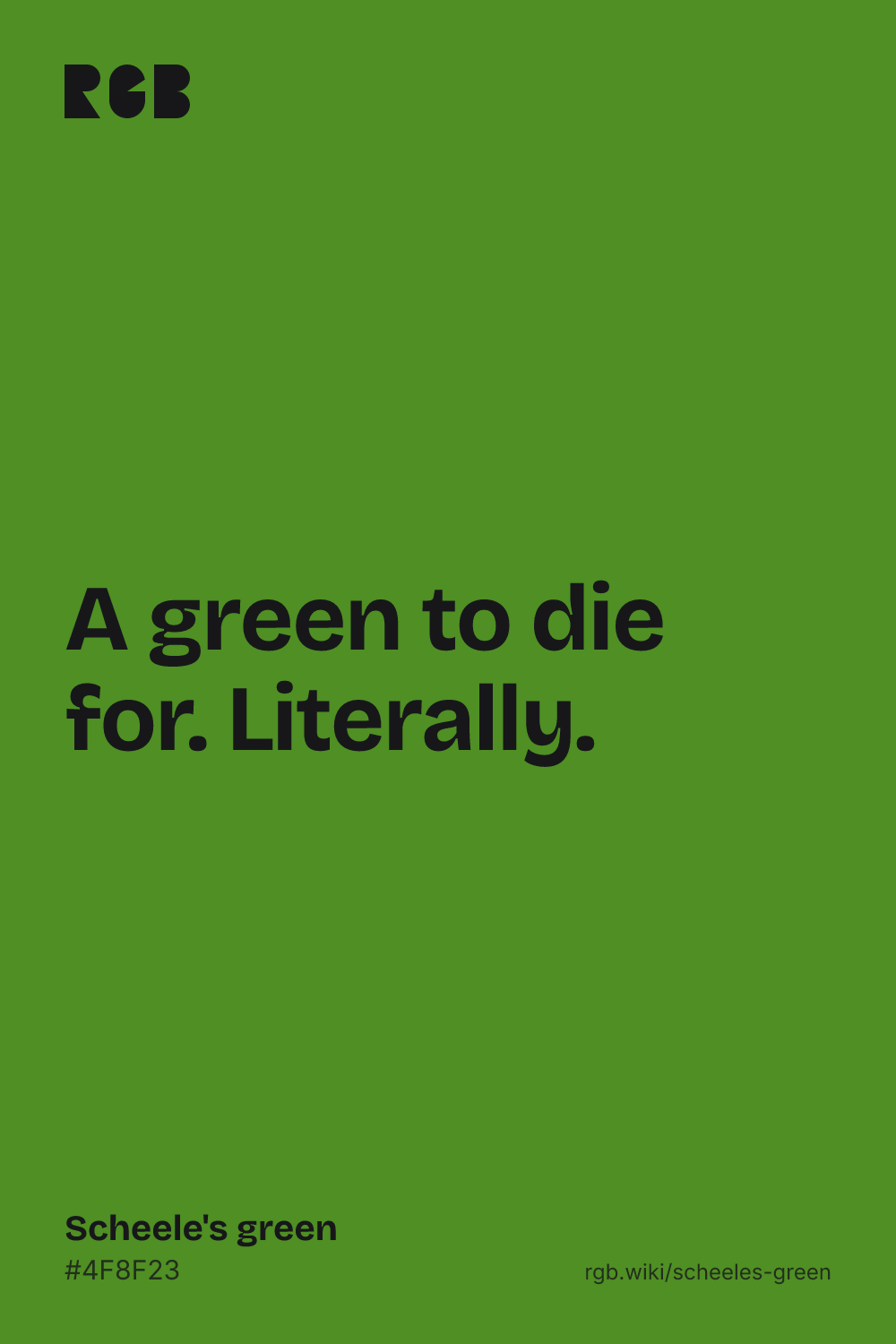
Scheele's green color card, hex #4F8F23: “A green to die for. Literally”

Scheele's green on the color map

All four Scheele’s green values sit inside the outline: Wikipedia’s code a little darker than the reference, the two dictionary centers lighter, one yellower and one bluer. That spread is the pigment’s own: its color changed with each recipe. The outline is an approximate range, not a measured one.

Shades and tints

Tints with white

Shades with black

Tones with gray

Scheele's green sits in the middle. Tints add white, shades add black and tones add gray, in 10% steps out from it. Tap any swatch to copy its code.

Light and dark scheele's green

#CADDBD
Pale Scheele’s greenMixed 70% with white. A soft, sage-like tint.
#95BC7B
Light Scheele’s greenMixed 40% with white. A fresh leaf green.
#4F8F23
Scheele’s greenThe reference color.
#3EB489
Paris greenThe brighter, bluer arsenic green of 1814, also sold as emerald green. See paris green
#478800
Wikipedia’s Scheele’s greenA slightly deeper, purer green, from a color-name website.
#2F5615
Dark Scheele’s greenMixed 40% with black. A deep ivy green that holds white text.

Colors that go with scheele's green

Pairings that work in rooms, outfits and interfaces.

Victorian parlor

Green walls, oxblood upholstery and gilt frames: the rooms these pigments were made for.

Green and old gold

Rich and dark, like gilt lettering on a green cloth binding.

Green and blush

Near-opposites, softened. Fresh and a little romantic.

Botanical print

Leaf greens on paper white. Calm and natural.

Color-wheel palettes

Pick a palette to see where its colors sit on the color wheel. The caret marks scheele's green. Tap a band to copy its code.

Similar colors

Olive green69%Olive drab84%Avocado green82%Scheele's greenGrass green80%Forest green81%Sea green70%

Lined up by hue around scheele's green. Hover a color to see how similar it is.The bar under each name shows how similar it is. Similarity comes from the distance between the two colors in OKLab, a model of how we see color.

Scheele’s green vs Paris green

Scheele’s green#4F8F23 · hue 96°
  • Darker, with a yellow lean
  • Copper arsenite, from 1775
  • Darkens more easily
Paris green#3EB489 · hue 158°
  • Lighter and bluer
  • Copper acetoarsenite, from 1814
  • Also sold as emerald green

Meaning

  • Copper and arsenic
  • Victorian wallpaper
  • Poison green
  • Napoleon’s rooms

Scheele’s green means one thing above all: the beautiful and the poisonous in the same object. It was the first bright green made from copper and arsenic, and it filled Victorian homes in wallpaper, dresses and paper flowers before doctors and the press turned against it. Some famous stories about it hold up; others, like wallpaper gas and Napoleon’s death, are shakier than they sound.

Scheele’s green came first

Pigment history

Carl Wilhelm Scheele discovered his green in 1775 while researching arsenic, and he published the recipe in 1778, recommending it to painters. Paris green, also sold as emerald green, came from trying to improve it. It was made in Schweinfurt, Germany, from 1814, and its recipe stayed a trade secret until 1822.1

The “poison greens”

Historical record

Pigment historians call Scheele’s green and Paris green the “poison greens.” Both were made with arsenic, and they were fixed onto wallpaper, ball-gown fabric and paper flowers. In 1861 Punch reported an inquest into a young woman who died from the arsenic green she handled making artificial flower leaves.1, 2

Wallpaper gas is doubtful

Debated

A popular story says damp, moldy wallpaper turned these pigments into a deadly gas. In 1893 Bartolomeo Gosio did show that molds release an arsenic gas, later identified as trimethylarsine, and two deaths in 1932 were blamed on it. But later work found the gas has low toxicity. That leaves dust from flaking pigment as the other main suspect.1, 3

Napoleon’s green rooms

Long debated

Napoleon’s rooms on St. Helena were bright green, and arsenic in his hair led to theories that the walls poisoned him. A 2008 study found high arsenic in his childhood hair too, and in the hair of his son and of Joséphine, and a 2021 panel of pathologists concluded he died of stomach cancer with bleeding. A 2021 review argues that medicines containing antimony, mercury or arsenic may have worsened the bleeding.3, 4, 5

A green that turns black

Painters’ records

Both greens contain copper, which blackens on contact with sulfur, whether from polluted air or from pigments like cadmium yellow. Camille Pissarro complained of a spring landscape, mixed from cadmium and emerald green, that had turned “absolutely black.”1

Sources (5)
  1. Fiedler, I. & Bayard, M. A. (1997). “Emerald Green and Scheele’s Green.” In E. W. FitzHugh (ed.), Artists’ Pigments: A Handbook of Their History and Characteristics, vol. 3, pp. 219–271. National Gallery of Art (PDF).
  2. “Pretty Poison-Wreaths,” Punch, 41 (1861), p. 233, as indexed by Science in the Nineteenth-Century Periodical (Universities of Leeds and Sheffield).
  3. Wikipedia, “Scheele’s green”, citing Challenger (1955), Cullen & Bentley, “The toxicity of trimethylarsine: an urban myth,” Journal of Environmental Monitoring 7 (2005), and St. Clair, The Secret Lives of Colour (2016).
  4. Lugli, A. et al. (2021). The gastric disease of Napoleon Bonaparte: brief report for the bicentenary of Napoleon’s death on St. Helena in 1821. Virchows Archiv, 479(5), 1055–1060. doi:10.1007/s00428-021-03061-1
  5. Marchetti, D., Cittadini, F. & De Giovanni, N. (2021). Did poisoning play a role in Napoleon’s death? A systematic review. Clinical Toxicology, 59(7), 658–672. doi:10.1080/15563650.2020.1843658

History

Scheele’s green had about four decades to itself. Its story runs from an apothecary’s lab in Sweden to Victorian parlors, where its successor took over.

  1. 1775

    Carl Wilhelm Scheele, a Swedish chemist, discovers a copper arsenite green while researching arsenic.1

  2. 1778

    Scheele publishes his recipe in the journal of the Royal Swedish Academy of Sciences and recommends the green to painters.1

  3. About 1805

    J. M. W. Turner uses Scheele’s green in an oil sketch, Guildford from the Banks of the Wey. By the 1830s he has switched to Paris green, sold as emerald green.1

  4. 1814

    Wilhelm Sattler and the pharmacist Friedrich Russ begin making Schweinfurt green, later called emerald green and Paris green, to replace Scheele’s green.1

  5. 1839

    The Bavarian government issues a royal warning about the dangers of arsenic greens in homes.1

  6. 1861

    Punch reports the inquest into a young artificial-flower maker killed by arsenic green, noting that France has banned the pigment in flower making.2

  7. 1862

    Édouard Manet paints Music in the Tuileries Gardens. Analysis later finds both Scheele’s green and emerald green in its foliage.1

  8. 1874

    Robert Kedzie, a Michigan doctor, publishes Shadows from the Walls of Death, bound with 86 samples of arsenic wallpaper. Most of the 100 copies are later destroyed.3

Sources (3)
  1. Fiedler, I. & Bayard, M. A. (1997). “Emerald Green and Scheele’s Green.” In E. W. FitzHugh (ed.), Artists’ Pigments: A Handbook of Their History and Characteristics, vol. 3, pp. 219–271. National Gallery of Art (PDF).
  2. “Pretty Poison-Wreaths,” Punch, 41 (1861), p. 233, as indexed by Science in the Nineteenth-Century Periodical (Universities of Leeds and Sheffield).
  3. Wikipedia, “Shadows from the Walls of Death”, and the National Library of Medicine’s catalog record and scan of Kedzie’s 1874 book.

Questions

What color is Scheele’s green?

A strong grass green with a slight yellow lean. The code used here is #4F8F23 (RGB 79, 143, 35). The real pigment varied from pale yellow-green to deep green, depending on the recipe.

What is the difference between Scheele’s green and Paris green?

Scheele’s green (1775) is a copper arsenite. Paris green (1814), also called emerald green or Schweinfurt green, is a copper acetoarsenite made by trying to improve it. Paris green is brighter and bluer, and it was less prone to darkening.

Was Scheele’s green really poisonous?

Yes. Both greens contain arsenic, and pigment historians call them the poison greens. Workers who made them, people who handled them and families who lived with green wallpaper were all exposed, mainly through dust.

Did green wallpaper kill Napoleon?

Probably not. His rooms on St. Helena were green and his hair held arsenic, but his childhood hair did too. A 2021 review of his autopsy reports by pathologists concluded he died of stomach cancer with bleeding.

Is Scheele’s green still made?

No. Real Scheele’s green is no longer made as an artists’ pigment, and neither is Paris green. Paints sold under these names today imitate the color with modern pigments.

Are old green books dangerous?

Some are. Cloth covers from about the 1840s to 1860s were sometimes colored with arsenic green. The Poison Book Project advises that bright green 19th-century bindings be identified, handled and stored with caution.

What colors go with Scheele’s green?

Cream and old gold for a Victorian look, oxblood for depth, soft blush pink for contrast, and paper white with lighter leaf greens for a botanical feel.