Eucalyptus

A soft blue-gray green named after the gum trees of Australia.

Overview

Eucalyptus is a muted, medium green with a cool, blue-gray cast. The code used here, #5F8575, keeps its red and blue not far below its green, which grays it down. It is the eucalyptus code most web color lists use, but no standard defines it.

The color is named after the gum trees of Australia. The genus name comes from the Greek eu, well, and kalyptos, covered, after the little cap that covers each flower bud until it opens.

Real eucalyptus leaves cover a wide range. Many are coated in a fine white wax that turns their green a powdery blue-gray. The young leaves of the Tasmanian blue gum are waxy blue, while the grown tree’s leaves are a glossy green. One species, Eucalyptus cinerea, is named for the ashen look of its bloom. The code sits between the two: bluer and grayer than a mature gum, but greener than the waxiest young leaves.

A 1930 color dictionary had its own eucalyptus green, which a later standard files as a grayish yellow green, close to sage green. The web code is bluer. On screen, #5F8575 is calm and natural. Black text reads a little better on it than white, and white works at larger sizes. It pairs well with cream, warm gold, terracotta and charcoal.
HEX#5F8575
RGBrgb(95, 133, 117)
HSLhsl(155, 17%, 45%)
HSV155°, 29%, 52%
CMYK29, 0, 12, 48
OKLCHoklch(58.3% 0.049 166.8)
Every code converts from the HEX value #5F8575. No color standard defines eucalyptus. #5F8575 is the code most web color lists use. Maerz and Paul’s A Dictionary of Color (1930) has a eucalyptus green, which the ISCC-NBS dictionary files as grayish yellow green and grayish yellow, a yellower color than this code. CMYK is a screen-based estimate; print results vary.
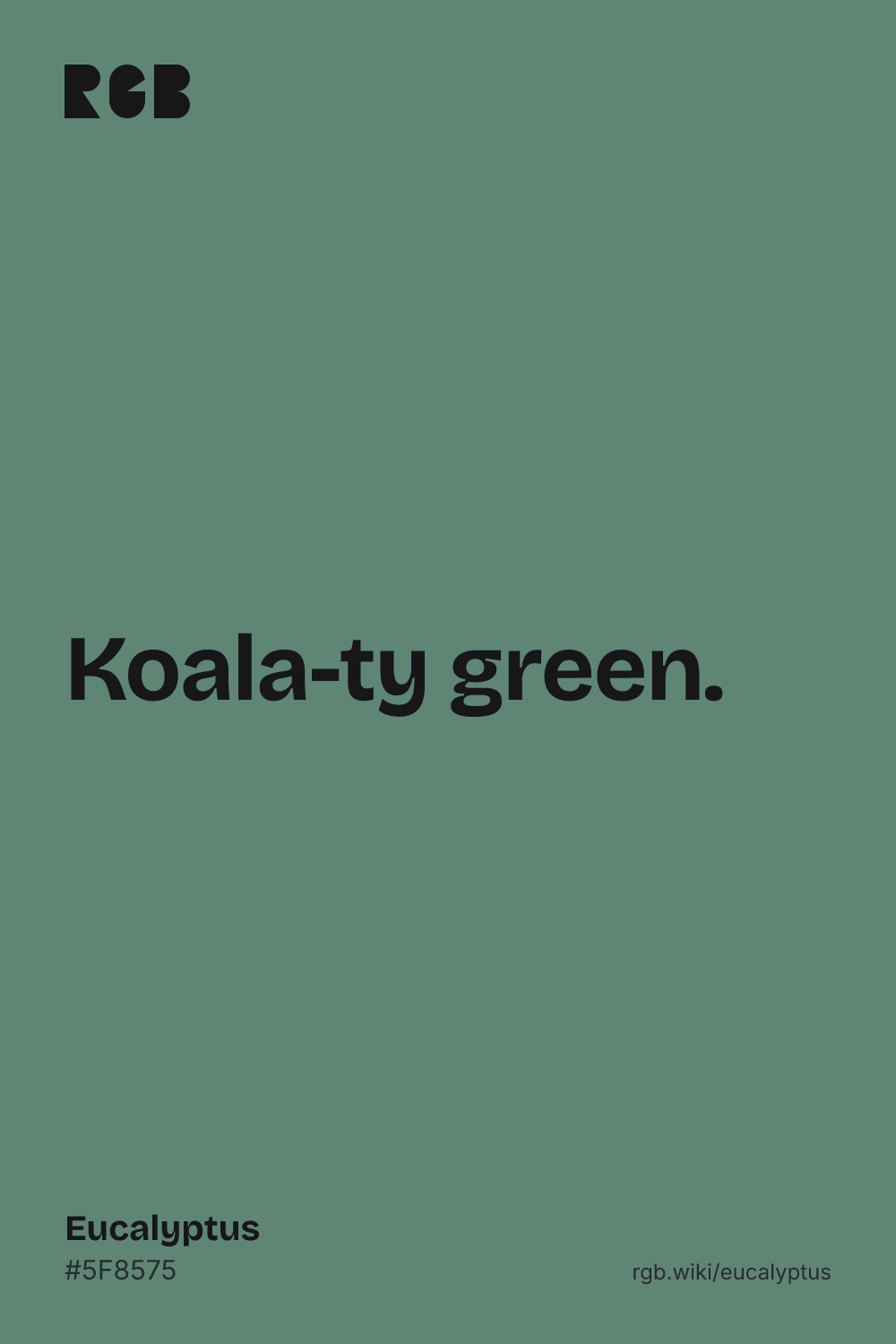
Eucalyptus color card, hex #5F8575: “Koala-ty green”

Eucalyptus on the color map

The dictionary’s grayish yellow green sits well outside the outline, to the left and above: much yellower and a little lighter than the code. Its grayish yellow lies even farther out, a pale khaki. The 1930 eucalyptus green was a dry, yellowish gray-green, while the web code leans blue. The outline is an approximate range, not a measured one.

Shades and tints

Tints with white

Shades with black

Tones with gray

Eucalyptus sits in the middle. Tints add white, shades add black and tones add gray, in 10% steps out from it. Tap any swatch to copy its code.

Light and dark eucalyptus

#CFDAD6
Pale eucalyptusMixed 70% with white. A misty gray-green for walls and backgrounds.
#9FB6AC
Light eucalyptusMixed 40% with white. Close to the powdery blue-gray of waxy young gum leaves.
#5F8575
EucalyptusThe reference color.
#8F9779
Dictionary eucalyptusThe ISCC-NBS grayish yellow green, where the 1955 dictionary files Maerz and Paul’s eucalyptus green. Yellower and drier.
#395046
Dark eucalyptusMixed 40% with black. A deep green-gray for text and shadows.

Colors that go with eucalyptus

Pairings that work in rooms, outfits and interfaces.

Eucalyptus and cream

Soft and calm. Works for bedrooms, bathrooms and quiet brands.

Gum and wattle

Gray-green leaves with golden yellow blossom, the colors of the Australian bush.

Eucalyptus and terracotta

Cool green against warm clay. Earthy and relaxed.

Eucalyptus and charcoal

Muted and modern. Good for interfaces and menswear.

Eucalyptus and blush

Green and soft pink. Fresh and gentle, like a spring bouquet.

Eucalyptus and bark

The colors of a whole gum tree: leaves, peeling bark and pale trunk.

Color-wheel palettes

Pick a palette to see where its colors sit on the color wheel. The caret marks eucalyptus. Tap a band to copy its code.

Similar colors

Mink69%Stone68%EucalyptusViridian81%Hooker's green76%Slate gray73%Light slate gray67%

Lined up by hue around eucalyptus. Hover a color to see how similar it is.The bar under each name shows how similar it is. Similarity comes from the distance between the two colors in OKLab, a model of how we see color.

Eucalyptus vs sage green

Eucalyptus#5F8575 · hue 155°
  • Darker and cooler
  • Leans toward blue
  • Named after gum tree leaves
Sage green#9CAF88 · hue 89°
  • Lighter and softer
  • Leans toward yellow
  • Named after the kitchen herb

Meaning

  • Gum leaves
  • Waxy bloom
  • Weather
  • Blue haze

Eucalyptus brings to mind the Australian bush and the round, silvery leaves of young gum trees. Its blue-gray look has a botanical cause: a coat of wax on the leaves, which is thicker on young growth and can wear away. The trees may even tint the distant hills. Color research hasn’t tested eucalyptus as a color, so the claims here are about the plant.

The blue-gray is a coat of wax

Botanical record

Many eucalypts have a white, waxy bloom on their leaves, buds and fruit. Botanists call such leaves glaucous. Over green leaf tissue, the wax reads as blue-gray. Eucalyptus cinerea takes its name from the Latin cinereus, ashen, for exactly this bloom.1

Young blue gums are bluer than old ones

Botanical record

Eucalypts change their leaves as they grow. Seedlings and young shoots of the Tasmanian blue gum have waxy, blue juvenile leaves with a white-waxy underside. The adult tree grows long, glossy green leaves instead. So one tree can show both ends of the eucalyptus range.2

Rain can wear the bloom away

One lab study

The wax on a blue gum leaf grows as tiny tubes. In a 1986 lab study, droplets of simulated rain broke these tubes, and most of the loss came in the first spell of rain. A leaf that loses its wax looks greener.3

The trees may tint the Blue Mountains

Plausible, untested

The hills west of Sydney have looked blue since the colony’s first years. Distant hills look bluish anywhere, because air scatters blue light. In 1955 a Sydney physics professor suggested that fine droplets of oil from the eucalypts make the effect stronger there, but he called it “merely a guess”, and it has not been tested.4

Sources (4)
  1. Slee, A.V. et al., “Eucalyptus cinerea subsp. cinerea”, EUCLID: Eucalypts of Australia, Centre for Australian National Biodiversity Research.
  2. Slee, A.V. et al., “Eucalyptus globulus subsp. globulus”, EUCLID: Eucalypts of Australia, Centre for Australian National Biodiversity Research.
  3. Baker, E.A. & Hunt, G.M. (1986). “Erosion of waxes from leaf surfaces by simulated rain”. New Phytologist, 102(1), 161–173.
  4. Low, J. “Why are the Blue Mountains blue?”, Blue Mountains City Library, from Pictorial Memories: Blue Mountains (1994), quoting Professor Harry Messel’s letter of 1955.

History

Eucalyptus was a tree long before it was a color. Its story runs from a specimen gathered on Captain Cook’s last voyage to a color dictionary of 1930.

  1. 1777

    David Nelson, a plant collector on Captain Cook’s third voyage, gathers a eucalypt at Adventure Bay on Bruny Island, Tasmania.1

  2. 1788

    In London, the French botanist Charles Louis L’Héritier names the genus Eucalyptus from Nelson’s plant, after the cap that covers the bud.1

  3. 1788

    In the new colony of New South Wales, Governor Phillip names the ranges to the west Carmarthen and Lansdowne. Settlers ignore him and call them the Blue Mountains.4

  4. 1792

    On a French expedition, the naturalist Labillardière collects the Tasmanian blue gum, probably at Recherche Bay. He names it Eucalyptus globulus in 1800, for its ball-shaped fruit.2

  5. 1801

    First known use of the word “eucalyptus” in English.1

  6. 1867

    Eucalyptus cinerea is formally named, from the Latin for ashen, after the white bloom on its leaves.3

  7. 1900

    Lady Audrey Tennyson, crossing the Blue Mountains, writes of hills of “the most gorgeous real sapphire blue” and wonders whether the gum trees cause it.4

  8. 1930

    Maerz and Paul’s A Dictionary of Color includes a eucalyptus green.5

  9. 1955

    The ISCC-NBS dictionary files Maerz and Paul’s eucalyptus as grayish yellow green and grayish yellow, yellower than today’s web code.5

Sources (5)
  1. Merriam-Webster, “Eucalyptus”, etymology note citing L’Héritier, Sertum Anglicum (1788), and Slee et al., EUCLID.
  2. Slee, A.V. et al., “Eucalyptus globulus subsp. globulus”, EUCLID: Eucalypts of Australia.
  3. Slee, A.V. et al., “Eucalyptus cinerea subsp. cinerea”, EUCLID: Eucalypts of Australia.
  4. Low, J. “Why are the Blue Mountains blue?”, Blue Mountains City Library, from Pictorial Memories: Blue Mountains (1994).
  5. Jaffer, A. “Maerz and Paul color names”, with ISCC-NBS centroids from “Color-Name Dictionaries”, MIT CSAIL.

Questions

What color is eucalyptus?

A muted, medium gray-green with a cool, slightly blue cast. The code used here is #5F8575 (RGB 95, 133, 117).

Why do eucalyptus leaves look blue-gray?

Many eucalypts coat their leaves in a fine white wax. Over the green leaf, the wax looks powdery blue-gray. Young leaves often carry more of it than old ones.

What is the difference between eucalyptus and sage green?

Eucalyptus (#5F8575) is darker and leans toward blue. Sage green (#9CAF88) is lighter and leans toward yellow.

Is there an official eucalyptus color code?

No. #5F8575 is the code most web color lists use, but no standard defines it. A 1930 color dictionary had a eucalyptus green that is yellower and closer to sage.

What colors go with eucalyptus?

Cream and soft pink for a gentle look, golden yellow or terracotta for warmth, and charcoal for a modern feel.

Should I use white or black text on eucalyptus?

Black text reads a little better on #5F8575. White text works for headings and other large type.