A tertiary color
Color theoryIn the usual modern definition, a tertiary color is an even mix of a primary and a neighboring secondary color, which gives six of them. On the painter’s wheel, yellow-green is the one between yellow and green.1
The color between yellow and green, once called grass green.
Yellow-green is the color between yellow and green: a fresh, leafy green with a clear yellow lean. Its usual code, #9ACD32, is the CSS color named yellowgreen: strong green, a good deal of red and a little blue. That touch of blue softens it, so it reads as a spring leaf rather than a highlighter.
On the painter’s color wheel, yellow-green is a tertiary color, an even mix of the primary yellow and the secondary green. Albert Munsell made it one of the ten hues of his color system in 1905, under the name green-yellow, and wrote that it was “popularly called grass green”.
The code sits closer to yellow than to green. Its hue is 80°, a third of the way from screen yellow (60°) to screen green (120°). Mix the web colors yellow and green half and half and you get #80C000, with exactly the same hue but more punch. The halfway point between yellow and green light at full strength is chartreuse, brighter and greener.
The web name has a confusing twin. CSS also has greenyellow, #ADFF2F, a far brighter color. Both names come from a 1980s list of colors for Unix computers. People asked to name colors picture yellow green brighter too, at #C0FB2D. In design, #9ACD32 makes a friendly accent: black text reads well on it, white text does not.
| HEX | #9ACD32 | |
|---|---|---|
| RGB | rgb(154, 205, 50) | |
| HSL | hsl(80, 61%, 50%) | |
| HSV | 80°, 76%, 80% | |
| CMYK | 25, 0, 76, 20 | |
| OKLCH | oklch(78.5% 0.184 126.6) |
People’s average yellow green has almost the same hue as the reference but is much lighter and stronger, just above the outline. Their yellowish green sits inside it, a little lighter and yellower. The ISCC-NBS vivid yellow green sits inside too, darker. Chartreuse sits at the top edge on the green side, and greenyellow just above the outline. The outline is an approximate range, not a measured one.
Tints with white
Shades with black
Tones with gray
Pairings that work in rooms, outfits and interfaces.
Opposites on the screen color wheel. Loud and playful, so let one color lead.
Sharp and modern. The green glows against the dark.
Spring in a kitchen or a garden shed. Easy and fresh.
A garden pairing, like leaves and blossoms. Sweet but lively.
Sporty and confident. Navy carries the text.
One hue from pale to deep olive. Calm and natural.
Pick a palette to see where its colors sit on the color wheel. The caret marks yellow-green. Tap a band to copy its code.
Lined up by hue around yellow-green. Hover a color to see how similar it is.The bar under each name shows how similar it is. Similarity comes from the distance between the two colors in OKLab, a model of how we see color.
Yellow-green is a step on the color wheel more than a color with symbols of its own. Studies of color and emotion test basic words like green and yellow, not yellow-green, so there is no measured mood for this code. What research does show is how people and languages divide the stretch between yellow and green.
In the usual modern definition, a tertiary color is an even mix of a primary and a neighboring secondary color, which gives six of them. On the painter’s wheel, yellow-green is the one between yellow and green.1
Albert Munsell’s 1905 color system formed green-yellow from yellow and green and said it was “popularly called grass green”. He set purple opposite it: the two mixed make gray.2
Many languages have a single word for green and blue. A word that joins yellow and green is rare: in a sample of 120 languages from the World Color Survey and related studies, only 3 had one.3
When 57 Japanese speakers named color samples in their own words, matcha (“green tea”) came out as a distinct yellow-green category. American English speakers had a lime category with no Japanese match. Neither ranks as a basic color word.4
Yellow-green’s name comes from color wheels and color systems. Its code comes from a text file of color names written for Unix computers in the 1980s, and it has barely moved since.
Albert Munsell’s A Color Notation makes green-yellow one of ten hues, “popularly called grass green”.1
The ISCC-NBS method of naming colors settles on 17 main hue names. Yellow green and yellowish green are separate ranges, one closer to yellow, one closer to green.2
Jim Gettys checks in the first color name list for the X Window System. Yellow green is 153, 204, 50 (#99CC32). Green yellow is a soft light green, 147, 219, 112.3, 4
Paul Raveling’s retuned list nudges yellow green one step, to 154, 205, 50: today’s #9ACD32. Green yellow becomes a much brighter 173, 255, 47 (#ADFF2F), and olive drab joins the list.3
The list renames the numbered shades of yellow green as OliveDrab1 to OliveDrab4. OliveDrab3 is still identical to yellow green.3
SVG 1.0 adopts the X11 names as color keywords, yellowgreen and greenyellow among them. CSS later takes the same list.5, 6
A study of modern Japanese finds matcha, “green tea”, in use as a yellow-green color word.7
rgb.txt revision history (1985–1994), from the historical source archive kept by Alan Coopersmith. freedesktop.org GitLab.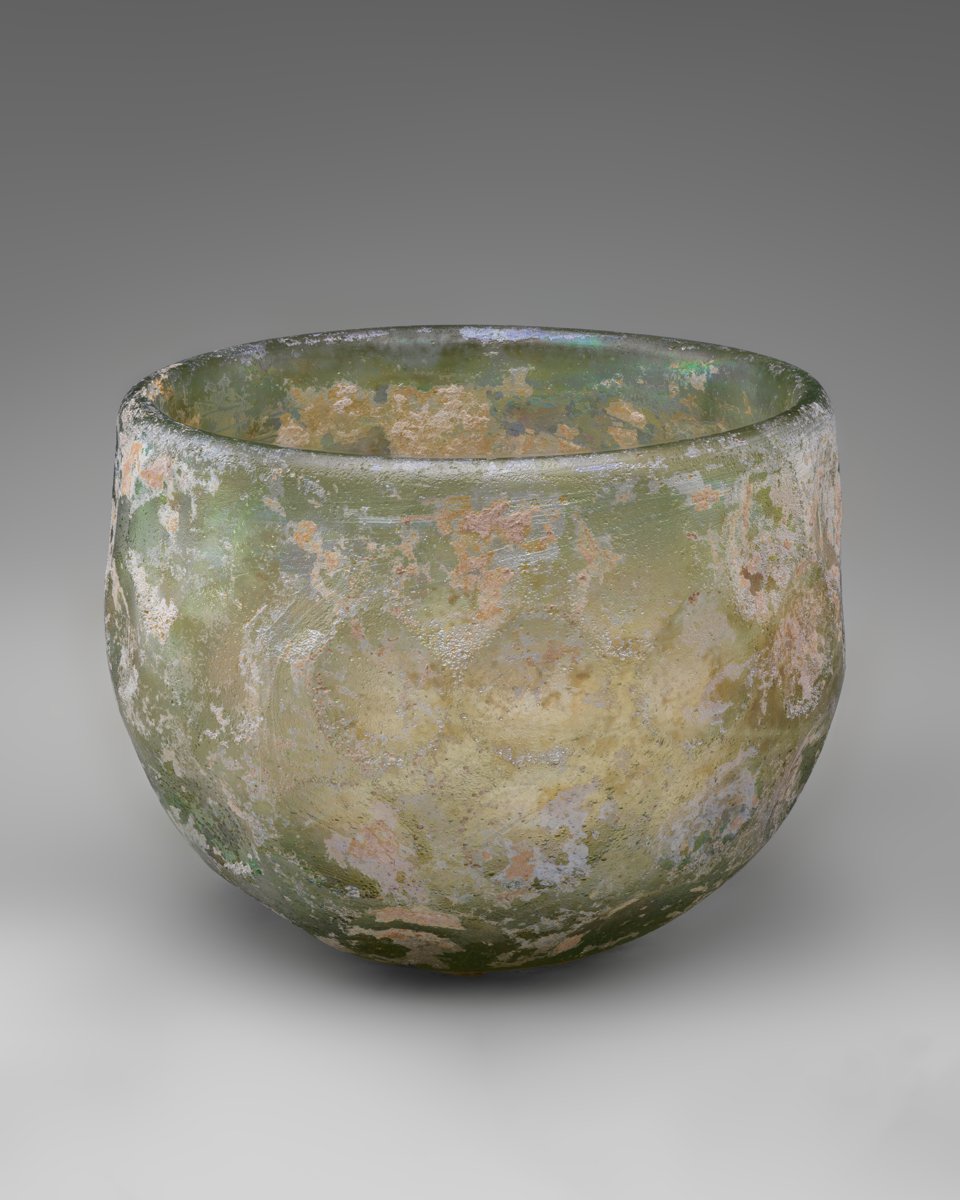
A glass bowl from Sasanian Iran, cut with a honeycomb of shallow round facets, now at the Metropolitan Museum of Art. The museum lists its glass as yellow-green. After some 1,400 years the surface is clouded and flaking, so in the photo it samples as grayish olive, far softer than the web code.
Sampled from the body of the bowl in the Metropolitan Museum of Art’s photograph (59.34), released as CC0 (public domain). The glass color comes from the museum’s record. Colors in a photo shift with the lighting, so read the codes as close, not exact.
Palettes are sampled in-house.
The color between yellow and green. Its usual code is #9ACD32 (RGB 154, 205, 50), the CSS color yellowgreen: a fresh, leafy green that leans toward yellow.
Yes. On the painter’s red-yellow-blue color wheel it is the tertiary color between the primary yellow and the secondary green, one of six tertiary colors.
Both are CSS color names. Yellowgreen (#9ACD32) is a medium, slightly soft yellow-green. Greenyellow (#ADFF2F) is much brighter and lighter, close to a neon yellow-green. The names come from an old Unix color list, not from any rule about word order.
Chartreuse (#7FFF00) is brighter and a little greener, with green at full strength and no blue. Yellow-green (#9ACD32) is softer and darker, with a touch of blue.
In paint, mix yellow with a little green, or yellow with a small amount of blue. On a screen, it is mostly green light with a good share of red and a little blue.
Violet and purple for contrast, navy and charcoal for something crisp, cream for a fresh feel, and pink for a garden look.
On a screen color wheel, the color opposite #9ACD32 is a blue-violet, about #6532CD. In Munsell’s color system, the opposite of green-yellow is purple.