Malachite

A bright web green named after the banded copper stone of Egyptian eye paint and Russian palaces.

Overview

Malachite is a vivid, slightly yellowish green. Its web code, #0BDA51, is almost all green light with a little blue, and it sits very close to lime green. It is named after malachite, a copper mineral whose polished slabs show rings and stripes of light and dark green.

The name goes back through Latin to Greek molochitēs, from molochē, mallow, because the stone’s green reminded people of mallow leaves. In ancient Egypt, ground malachite was a green eye paint, mixed on stone palettes and buried with the dead. Later the stone became a luxury of imperial Russia, where whole rooms and church columns were faced with it.

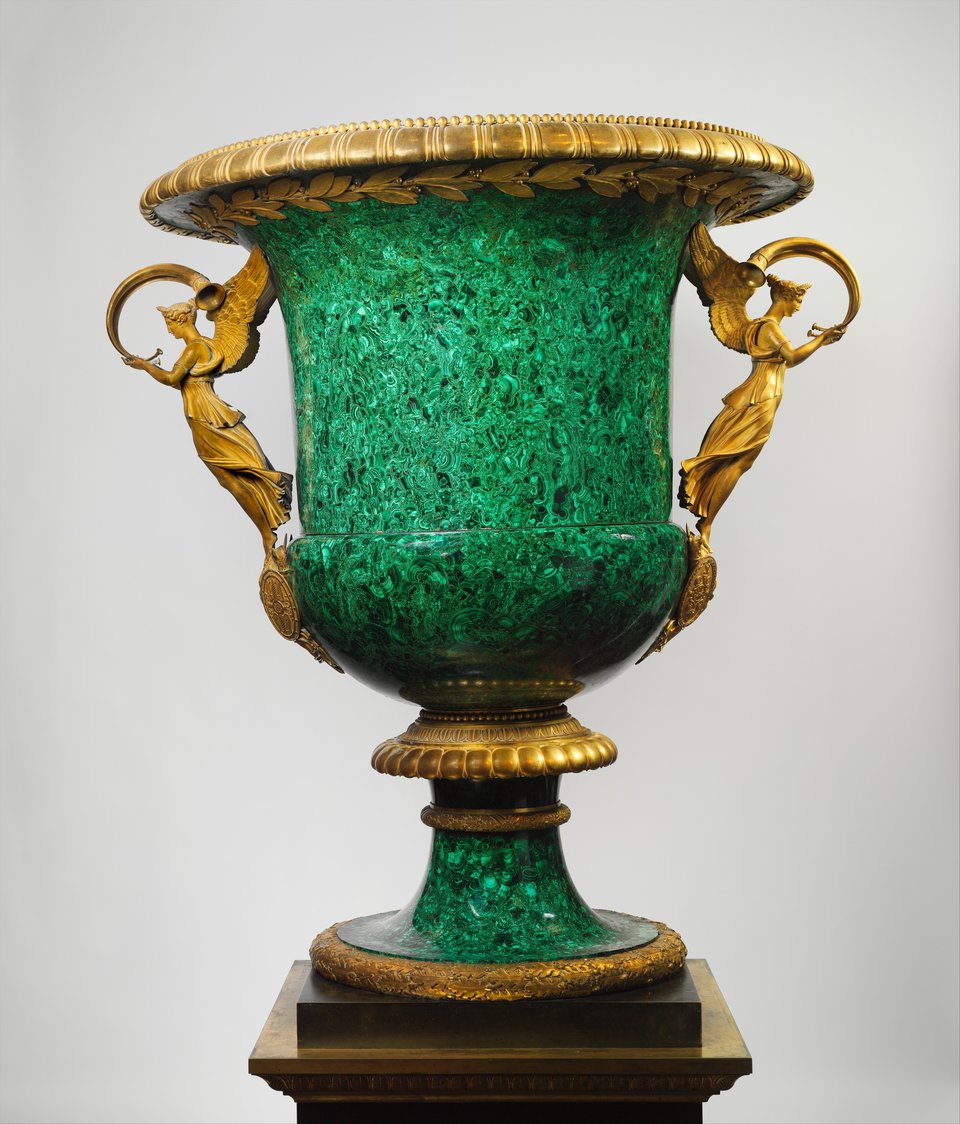
The real stone is much darker and quieter than the code. Polished malachite on a vase at the Metropolitan Museum of Art photographs at about #1D8152, and Maerz and Paul’s 1930 malachite green swatch was filed by the 1955 ISCC-NBS dictionary as a moderate yellowish green, #679267.

#0BDA51 is a light color: white text on it reaches only 1.9:1, so use black or a very dark green (11.2:1 with black). It works as a bright accent or a “success” green, and it looks right beside gilt bronze, deep forest greens and the blue of azurite, its sister copper mineral.

HEX#0BDA51
RGBrgb(11, 218, 81)
HSLhsl(140, 90%, 45%)
HSV140°, 95%, 85%
CMYK95, 0, 63, 15
OKLCHoklch(77.4% 0.229 146.9)
Every code converts from the HEX value #0BDA51. #0BDA51 comes from Wikipedia’s list of shades of green, which says it matches Maerz and Paul’s malachite green (1930, plate 28, sample A9) and calls it vivid yellowish green. The 1955 ISCC-NBS dictionary files that same swatch as moderate yellowish green, #679267, a much grayer green, so the web code is far brighter than the book. No standard defines #0BDA51. CMYK is a screen-based estimate; print results vary.
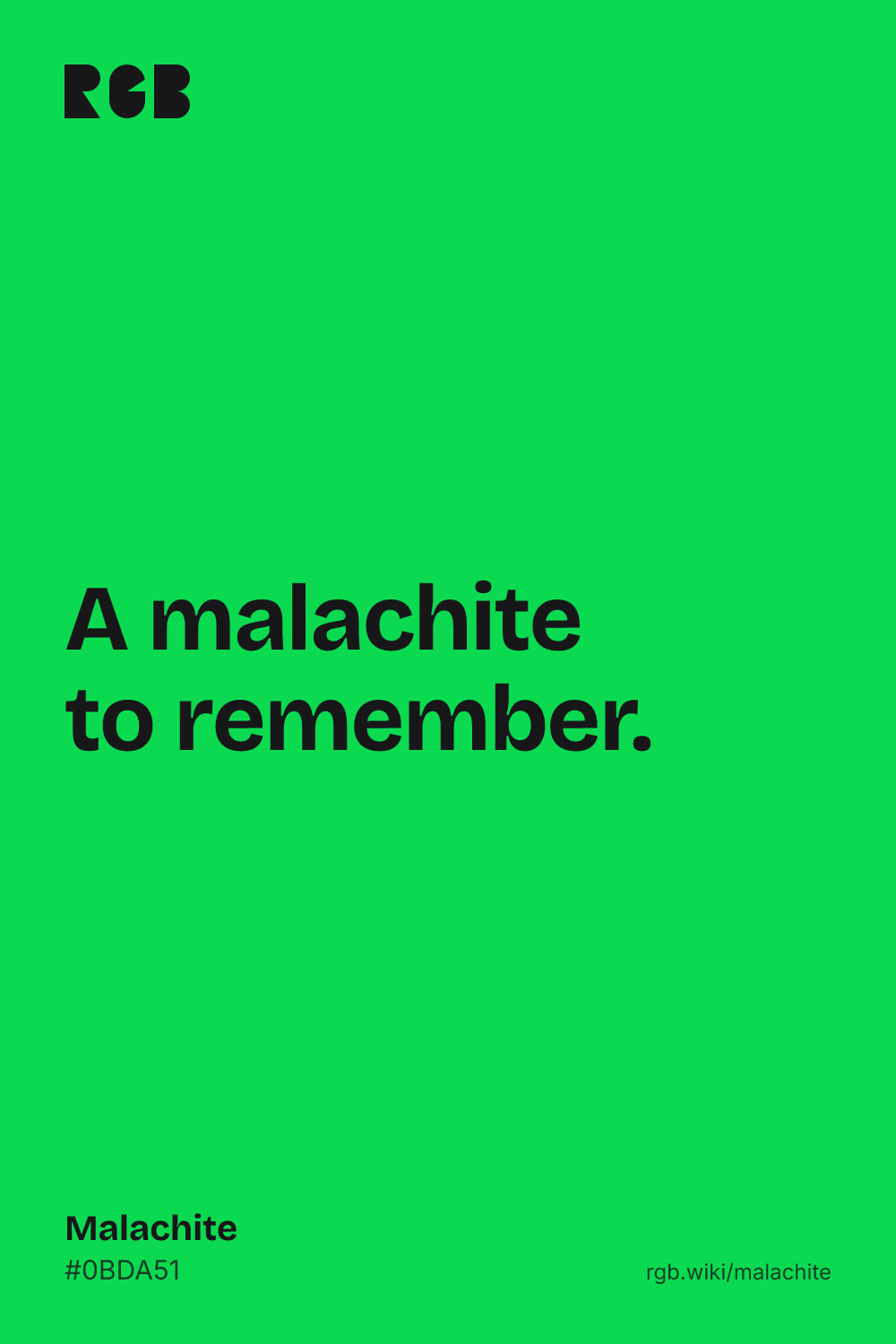
Malachite color card, hex #0BDA51: “A malachite to remember”

Malachite on the color map

Ridgway’s malachite green sits inside the outline at almost the same lightness, a touch to the left (yellower) and much grayer. Maerz and Paul’s swatch, as the dictionary filed it, sits well below the outline: darker and grayer, with nearly the same hue. The polished stone sits far below and a little to the right, toward blue, and the scroll’s green far below and a little to the left. The xkcd survey has no average for malachite. The outline is an approximate range, not a measured one.

Shades and tints

Tints with white

Shades with black

Tones with gray

Malachite sits in the middle. Tints add white, shades add black and tones add gray, in 10% steps out from it. Tap any swatch to copy its code.

Light and dark malachite

#9DF0B9
Pale malachiteMixed 60% with white. A fresh mint for backgrounds.
#6DE997
Light malachiteMixed 40% with white.
#0BDA51
MalachiteThe reference color.
#93C592
Ridgway’s malachite greenLight yellowish green, where the 1955 ISCC-NBS dictionary filed Ridgway’s 1912 malachite green.
#679267
Maerz and Paul’s malachite greenModerate yellowish green, where the same dictionary filed Maerz and Paul’s 1930 swatch.
#1D8152
Polished malachiteSampled from the stone of a Russian malachite vase at the Met. Closer to the real mineral.
#078331
Dark malachiteMixed 40% with black. Like the darkest bands in the stone.

Colors that go with malachite

Pairings that work in rooms, outfits and interfaces.

Malachite and gilt bronze

The Russian palace look: green stone, gold mounts and deep shadow.

Egyptian eye paint

Malachite green and galena black, the two eye paints, on linen with a touch of red ochre.

Malachite and azurite

The two copper minerals that grow side by side. Vivid and earthy.

Banded stone

All the greens of a polished slab, from pale bands to nearly black.

Malachite and coral

A warm accent against bright green. Fresh and playful.

Malachite on charcoal

A dark interface with a bright green for success states and highlights.

Color-wheel palettes

Pick a palette to see where its colors sit on the color wheel. The caret marks malachite. Tap a band to copy its code.

Similar colors

Brat green65%Kiwi59%Kelly green59%Lime green82%Pastel green64%MalachiteEmerald green61%

Lined up by hue around malachite. Hover a color to see how similar it is.The bar under each name shows how similar it is. Similarity comes from the distance between the two colors in OKLab, a model of how we see color.

Malachite vs emerald green

Malachite#0BDA51 · hue 140°
  • Named after an opaque, banded copper mineral
  • Brighter and a little yellower on screen
  • An eye paint and pigment since ancient Egypt
Emerald green#50C878 · hue 140°
  • Named after a clear gemstone, a kind of beryl
  • Softer and a little bluer on screen
  • Also an arsenic paint of the 1800s

Meaning

  • Banded stone
  • Eye paint
  • Rebirth
  • Imperial luxury

Malachite’s meanings come from the stone, not the screen color. In ancient Egypt it was a green eye paint and a sign of new growth and rebirth. In the 1800s it became a mark of Russian imperial luxury. Old charm books also gave it protective powers. Color research tests basic color words such as green, not malachite, so there is no evidence about this code’s effect on mood.

An ancient green eye paint

Museum record

Egyptians ground malachite on stone palettes, often shaped like fish or turtles, to make a green eye paint. Ancient texts describe painting the upper eyelids black with galena and the lower ones green with malachite.1, 2
A green of rebirth in Egypt

Historical record

In Egypt, green (wadj) stood for new life, fertility and resurrection, and one name for the paradise of the afterlife was the “Field of Malachite”. The Cleveland Museum of Art suggests that eye paint ores in graves may have stood for regeneration, a reading the museum gives as a possibility.1, 3

A stone of imperial Russia

Historical record

Russian tsars faced walls, columns and furniture with Ural malachite. The Winter Palace has a whole Malachite Room, the iconostasis of Saint Isaac’s Cathedral is framed by six malachite columns, and under Nicholas I malachite pieces were among the favorite diplomatic gifts.3, 4, 5

Protective powers are folklore

Tradition

Medieval and later writers recommended malachite as a talisman against evil spirits, lightning and disease and as an aid to sleep. These are old beliefs, not tested effects.3

Sources (5)
  1. Cleveland Museum of Art, “Palette in the Form of a Fish”, Egypt, Predynastic, about 3500–2950 BCE (1989.32), museum description.
  2. Wikipedia, “Kohl (cosmetics)”, citing R. J. Forbes, Studies in Ancient Technology, vol. 3.
  3. Wikipedia, “Malachite”, citing J. Hill, “Meaning of green in ancient Egypt” (2010), Ludmila Budrina, Malachite Diplomacy (2020, in Russian), and Thomas and Pavitt, The Book of Talismans, Amulets and Zodiacal Gems (1922).
  4. Wikipedia, “Malachite Room of the Winter Palace”, citing the State Hermitage Museum.
  5. Wikipedia, “Saint Isaac’s Cathedral”.

History

Malachite has been mined, ground and polished for some 6,000 years: first for eye paint and copper, then for painting, and at last as a stone for palaces.

  1. About 4000 BCE

    Malachite is mined near the Isthmus of Suez and in Sinai. It is also one of the first ores smelted for copper.1

  2. About 3650–3300 BCE

    In Predynastic Egypt, stone palettes shaped like fish are used to grind green malachite and black galena into eye paint. One buried in a tomb at Hierakonpolis still carries traces of green pigment.2, 3

  3. About 1473–1458 BCE

    Fragments of malachite are laid in the foundation deposit of the tomb of Senenmut, Hatshepsut’s official, at Deir el-Bahri.4

  4. About 1500–1550

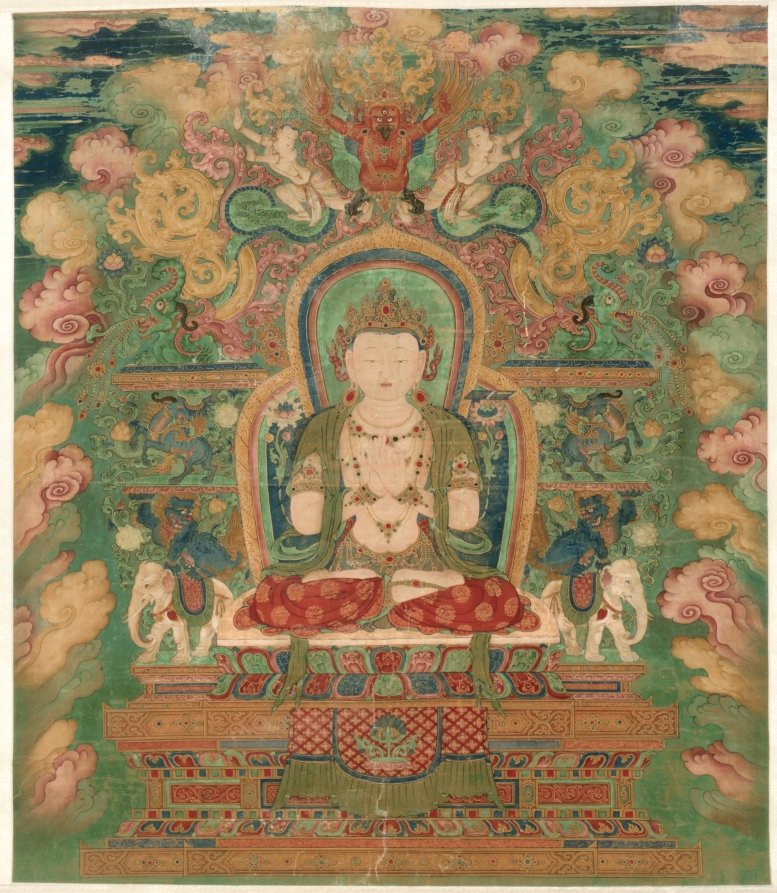
    A Ming dynasty painter fills a hanging scroll of the bodhisattva Manjushri with what the Cleveland Museum of Art calls an abundance of malachite green.5

  5. 1512

    Raphael paints the green drapery at the top of the Sistine Madonna with malachite and orpiment. Malachite was otherwise seldom used in European oil painting, and by about 1800 it had given way to synthetic copper greens.6, 1

  6. 1656

    First known use of the word “malachite” in English, an alteration of the Middle English melochites.7

  7. 1819

    Pierre-Philippe Thomire makes the gilt-bronze mounts for a huge vase veneered with Russian malachite, later in the Demidov family collection and now at the Metropolitan Museum of Art.8, 1

  8. Late 1830s

    After the fire of 1837, Alexander Briullov designs the Malachite Room of the Winter Palace in Saint Petersburg, with malachite columns, fireplace and urn. In 1917 the room was the seat of the Provisional Government.9

  9. 1877

    Chemists first prepare the dye called malachite green. It is a synthetic organic dye, named only for its color, and contains no malachite.10

  10. 1930

    Maerz and Paul’s A Dictionary of Color prints a malachite green swatch (plate 28, A9). The 1955 ISCC-NBS dictionary files it as moderate yellowish green, far grayer than today’s web code.11, 12

Sources (12)
  1. Wikipedia, “Malachite”, citing Susarla, International Journal of Oral and Maxillofacial Surgery (2016), Johnson et al., Journal of Chemical Education (2004), and Gettens and FitzHugh, “Malachite and Green Verditer”, in Artists’ Pigments, vol. 2 (1993).
  2. Metropolitan Museum of Art, “Fish-shaped palette with the remains of green pigment”, Hierakonpolis, Naqada II, about 3650–3300 BCE (35.7.8).
  3. Cleveland Museum of Art, “Palette in the Form of a Fish”, Egypt, Predynastic (1989.32), museum description.
  4. Metropolitan Museum of Art, “Fragments of Malachite”, tomb of Senenmut (TT 353), foundation deposit, about 1473–1458 BCE (27.3.450a–c).
  5. Cleveland Museum of Art, “Manjushri”, China, Ming dynasty, about 1500–1550 (1989.67), museum description.
  6. ColourLex, “Malachite”, history of use and examples.
  7. Merriam-Webster, “malachite”, etymology and first known use.
  8. Metropolitan Museum of Art, “Monumental vase”, Pierre-Philippe Thomire, lapidary work early 1800s, mounts 1819 (44.152a, b).
  9. Wikipedia, “Malachite Room of the Winter Palace”, citing the State Hermitage Museum and The Guardian (1917).
  10. Wikipedia, “Malachite green”.
  11. Wikipedia, “Shades of green”, citing Maerz and Paul, A Dictionary of Color (1930), plate 28.
  12. Kelly, K. L. and Judd, D. B. (1955). The ISCC-NBS Method of Designating Colors and a Dictionary of Color Names, as digitized by Aubrey Jaffer: Maerz and Paul and Ridgway entries.

Malachite in use

All brand colors
A tall urn-shaped vase covered in mottled bright and dark green stone, with gilded winged-figure handles, a gilded rim and a gilded foot, on a dark pedestal
#1D8C56#29AA75#0F4525#B99C5E
StoneMonumental malachite vase, Russia and Paris (mounts 1819)

A vase more than 2.7 meters tall with its pedestal, faced with Russian malachite and mounted in gilt bronze by Pierre-Philippe Thomire. The stone’s swirling bands run from about #29AA75 in the light patches to #0F4525 in the dark ones, averaging #1D8152: real malachite is far deeper than the web code.

#1D8C56#29AA75#0F4525#B99C5E
Source: The Met
A seated pale bodhisattva in a red lower garment on an ornate throne, framed by green and gold scrollwork, white elephants and swirling pink and gold clouds
#5A7854#7E7E57#96603F#CFAB82
PaintingManjushri, Ming dynasty hanging scroll (about 1500–1550)

A Chinese painting on silk of the bodhisattva of wisdom, which the Cleveland Museum of Art describes as dominated by malachite green, set against a red lower garment. Five centuries on, the greens photograph as a soft sage, about #5A7854, near the dictionary’s grayish malachite green rather than the web code.

#5A7854#7E7E57#96603F#CFAB82
Source: Cleveland Museum of Art
#1ED760#000000
BrandingSpotify

Spotify’s green, #1ED760, is a touch softer than this page’s code, at about the same lightness.

#1ED760#000000
Source: Spotify site CSS

Palettes are sampled in-house.

Questions

What color is malachite?

A vivid, slightly yellowish green. The usual code is #0BDA51 (RGB 11, 218, 81). The real stone is darker, with bands from pale to nearly black green.

Where does the code #0BDA51 come from?

From Wikipedia’s list of shades of green, which ties it to Maerz and Paul’s 1930 malachite green swatch. The 1955 ISCC-NBS dictionary filed that swatch as a much grayer green, about #679267, so no standard defines #0BDA51.

Why is malachite green?

Copper. Malachite is a copper carbonate, and the copper ions in it absorb red light, so the stone looks green.

Did Egyptians wear malachite makeup?

Yes. They ground malachite on stone palettes into a green eye paint, often worn on the lower lids, with black galena on the upper lids. Palettes and eye paint were also buried with the dead.

Is the dye called malachite green made from malachite?

No. Malachite green is a synthetic organic dye first made in 1877. It is named for its color and contains no malachite.

What is the Malachite Room?

A reception room in the Winter Palace in Saint Petersburg, now part of the Hermitage Museum. Designed in the late 1830s, it has columns, a fireplace and a large urn of malachite.

What is the difference between malachite and emerald green?

Malachite is an opaque, banded copper stone, and its web code is brighter and slightly yellower. Emerald is a clear beryl gem, and emerald green is softer and a little bluer.

What colors go with malachite?

Gold and gilt bronze for a palace look, azurite blue for the copper-mineral pairing, deep forest greens, and coral or charcoal for a modern accent.