Gray-green

A green softened with gray, whichever word you put first.

Overview

Gray-green is green softened with gray. The code used here, #789B73, is a medium, quiet green: green leads at 61%, while red and blue sit close together not far behind, at 47% and 45%. That small gap between green and the other two channels is what grays it down. It is the color of olive leaves, lichen and dusty hillside scrub rather than fresh grass.

Gray-green is a mix name, not one fixed color. It joins a hue to a neutral, so it covers everything from a gray with a faint green tint to a green with a little gray in it. Everyday speech hardly cares which word comes first. In the xkcd color survey, the colors people called gray green, green gray and grayish green came out almost the same, and #789B73 is exactly the survey’s average gray green.

Color dictionaries are stricter. The 1955 ISCC-NBS system splits the idea in two: a grayish green is a green with some gray, centered on #5E716A, and a greenish gray is a gray with a little green, centered on #7D8984. Both are cooler and bluer than the web code, because ISCC-NBS green leans toward blue. By that system, #789B73 is closest to moderate yellowish green.

In design, gray-green is calm and earthy, a natural partner for cream, terracotta and warm wood. Dark text reads well on it, at 6.7 to 1. White text reaches only 3.1 to 1, which is enough for large type but not for body text, so put white on a deeper shade such as #485D45.
HEX#789B73
RGBrgb(120, 155, 115)
HSLhsl(113, 17%, 53%)
HSV113°, 26%, 61%
CMYK23, 0, 26, 39
OKLCHoklch(65.2% 0.070 141.5)
Every code converts from the HEX value #789B73. No color standard defines gray-green. #789B73 is exactly the average color people named gray green in the 2010 xkcd color survey (CC0 data). The 1955 ISCC-NBS dictionary has no gray green of its own: it files the name, from Plochere’s 1948 color guide, as grayish green, centered on #5E716A, a darker, bluer color. Treat the code as typical, not official. CMYK is a screen-based estimate; print results vary.
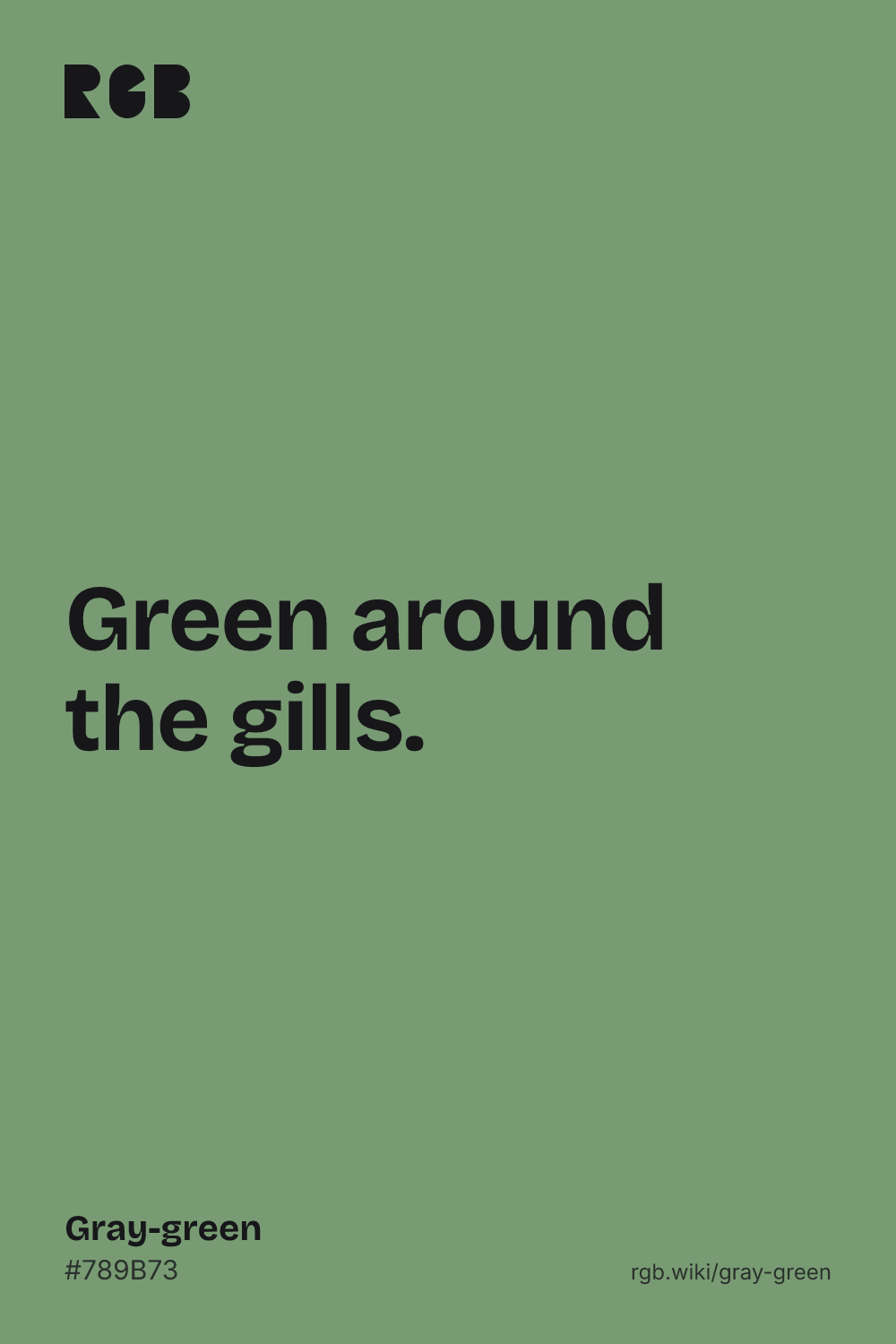
Gray-green color card, hex #789B73: “Green around the gills”

Gray-green on the color map

This view shows hue and lightness, not how gray a color is, so it flatters the grays. The three other survey averages, for green gray, grayish green and greenish gray, all sit inside the outline: green gray a little darker, the other two a little lighter. That shows how little word order matters to people. The ISCC-NBS moderate yellowish green sits just below the reference, and the grayish yellow green sits near the left edge, toward yellow. The ISCC-NBS greenish gray sits just outside on the right, toward blue, and the grayish green sits well outside, to the right and below. The outline is an approximate range, not a measured one.

Shades and tints

Tints with white

Shades with black

Tones with gray

Gray-green sits in the middle. Tints add white, shades add black and tones add gray, in 10% steps out from it. Tap any swatch to copy its code.

Light and dark gray-green

#C9D7C7
Pale gray-greenMixed 60% with white. A soft tint for walls and backgrounds.
#93AF8F
Light gray-greenMixed 20% with white. Close to sage, with dark text.
#789B73
Gray-greenThe reference color.
#7D8984
Greenish grayThe ISCC-NBS center for a gray with a little green (group 155).
#5E716A
Grayish greenThe ISCC-NBS center for a green with some gray (group 150). Cooler and darker.
#485D45
Dark gray-greenMixed 40% with black. Deep enough for white text, at 7.2 to 1.
#4D5D53
FeldgrauField gray, the dark gray-green of German army uniforms. See feldgrau

Colors that go with gray-green

Pairings that work in rooms, outfits and interfaces.

Gray-green and cream

Soft and homely, like herbs drying in a farmhouse kitchen.

Gray-green and terracotta

Warm clay against cool leaves, the look of a Mediterranean garden.

Gray-green and charcoal

Quiet and modern. Charcoal carries the text and the green stays muted.

Gray-green and blush

Gentle and romantic. Popular for weddings, stationery and nurseries.

Gray-green and mustard

A cheerful lift for a calm base. Keep mustard for the small things.

Herb garden

One green in three strengths. Restful, and easy to get right.

Color-wheel palettes

Pick a palette to see where its colors sit on the color wheel. The caret marks gray-green. Tap a band to copy its code.

Similar colors

Stone63%Moss green83%Matcha65%Gray-greenJungle green65%Cadet blue68%Pewter65%

Lined up by hue around gray-green. Hover a color to see how similar it is.The bar under each name shows how similar it is. Similarity comes from the distance between the two colors in OKLab, a model of how we see color.

Gray-green vs sage green

Gray-green#789B73 · hue 112°
  • A plain green with gray mixed in
  • Darker and a little cooler
  • Named for the mix, not a plant
Sage green#9CAF88 · hue 89°
  • Lighter, with more yellow
  • Named after garden sage leaves
  • Reads softer and more pastel

Meaning

  • Dry-country leaves
  • Italian uniforms
  • A mixed name
  • People’s average

Gray-green’s meanings come from plants, uniforms and words rather than from lab tests: color studies use broad terms like green and gray, never gray-green. In nature it is the color of leaves that guard against sun and drought. In Italy it was the color of the army. And as a name, it shows how loosely people mix a hue with a gray.

Gray leaves shade themselves

Plant study

Many plants of dry, sunny places look gray-green because their leaves carry a coat of fine hairs (in eucalyptus it is a wax). In a classic study of the desert brittlebush, Encelia farinosa, its hairy leaves absorbed up to 56% less light than those of a hairless relative from the moist California coast. The hairs change the leaf’s heat balance, at the cost of slower photosynthesis.1

The color of Italy’s soldiers

Historical record

After trials, the Italian army adopted a uniform in grigio-verde, “gray-green”, on 4 December 1908, following the German move to field gray. The color gave its name to a drink as well: in northern Italy, grappa with mint, taken early in the morning by people who worked outdoors, was called grigioverde.2, 3

Word order hardly matters to people

Large online survey

In the xkcd color survey, gray green averaged #789B73, green gray #77926F and grayish green #82A67D, all very close. Even greenish gray, #96AE8D, came out clearly green, only lighter. The survey ran online on uncontrolled screens, so read the averages as a guide.4

Dictionaries split it in two

Color standard

The ISCC-NBS system treats grayish green, a green with some gray, and greenish gray, a gray with a little green, as separate blocks of the color solid. Both centers are bluer and grayer than the web code. When the 1955 dictionary filed stamp collectors’ gray green, it spread across seven groups, from light olive gray to light bluish green.5

Sources (5)
  1. Ehleringer, J., Björkman, O. & Mooney, H. A. (1976). Leaf pubescence: effects on absorptance and photosynthesis in a desert shrub. Science, 192(4237), 376–377. doi:10.1126/science.192.4237.376
  2. Wikipedia, “Feldgrau”, citing G. Franzosi, Il Soldato Italiano dal 1909 al 1945, Rivista Militare, Rome, 1988, pp. 2–3.
  3. Wikipedia (Italian), “Grigioverde”, the grappa and mint drink named after the uniform color.
  4. Munroe, R. (2010). “Color Survey Results” and “The 954 most common RGB monitor colors”, xkcd color survey (CC0).
  5. Kelly, K. L. & Judd, D. B. (1955). The ISCC-NBS Method of Designating Colors and a Dictionary of Color Names. National Bureau of Standards Circular 553, groups 150 and 155 and index. NIST PDF. Centroids from Jaffer, A., “Color-Name Dictionaries”, MIT CSAIL.

History

Gray-green has no single birth date. Its story is the slow work of naming in-between colors: the endings -ish, then hyphenated pairs, then dictionaries that tried to pin the pairs down, and finally a crowd that settled on one code.

  1. 14th century

    Greenish appears in English, one of the first words for a color that is partly green.1

  2. 1562

    Grayish follows, giving English a way to say a color is muted by gray.2

  3. 1908

    On 4 December, after trials, the Italian army adopts grigio-verde, a gray-green field uniform modeled on the German field gray.3

  4. 1912

    Robert Ridgway’s Color Standards and Color Nomenclature names a whole run of gray-greens with modifiers, among them bluish gray-green and dark and deep bluish gray-green.4

  5. 1948

    Plochere’s color guide prints a sample called gray green. The ISCC-NBS dictionary later files it as grayish green, centered on #5E716A.4

  6. 1955

    The ISCC-NBS method gives grayish green and greenish gray their own blocks of the color solid. Its dictionary also shows how loose the everyday name is: stamp collectors’ gray green lands in seven different groups.5

  7. 2010

    The xkcd color survey gathers over five million color names from 222,500 sessions. Its average gray green, #789B73, becomes the usual gray-green code on color lists.6

Sources (6)
  1. Merriam-Webster, “greenish”, first known use.
  2. Merriam-Webster, “grayish”, first known use.
  3. Wikipedia, “Feldgrau”, citing G. Franzosi, Il Soldato Italiano dal 1909 al 1945, Rivista Militare, Rome, 1988, pp. 2–3.
  4. Jaffer, A. “Ridgway color names” and “Plochere color names”, with ISCC-NBS centroids from “Color-Name Dictionaries”, MIT CSAIL.
  5. Kelly, K. L. & Judd, D. B. (1955). The ISCC-NBS Method of Designating Colors and a Dictionary of Color Names. National Bureau of Standards Circular 553, section 4 and index. NIST PDF.
  6. Munroe, R. (2010). “Color Survey Results” and “The 954 most common RGB monitor colors”, xkcd color survey (CC0).

Questions

What color is gray-green?

A soft green muted with gray. The code used here is #789B73 (RGB 120, 155, 115), the average color people named gray green in the xkcd color survey. No color standard defines it.

Is gray-green a green or a gray?

In everyday use, a green: people mean a muted green whichever word comes first. Color naming systems are stricter and treat a grayish green as a green with some gray, and a greenish gray as a gray with only a little green.

Is it gray-green or grey-green?

Both. Gray is the usual American spelling and grey the British one. The color is the same.

What is the difference between gray-green and sage green?

Sage green (#9CAF88) is lighter and leans toward yellow, like the leaves of garden sage. Gray-green (#789B73) is darker, a little cooler and a more even mix of green and gray.

Why do some plants have gray-green leaves?

Often because of a coat of fine hairs, or in some plants a wax. In dry, sunny places it reflects part of the light, which changes the leaf’s heat balance. In one desert shrub, hairy leaves absorbed up to 56% less light than those of a hairless relative.

Does white text work on gray-green?

Only for large type. White on #789B73 reaches about 3.1 to 1. Dark text reads well at 6.7 to 1, or use a deeper shade such as #485D45 behind white text.

What colors go with gray-green?

Cream and blush for something soft, terracotta for warmth, charcoal for a modern look, and mustard as a cheerful accent.