Coral

A warm pinkish orange, named after the red coral of the Mediterranean.

Overview

Coral is a warm color between orange and pink. Its web code is #FF7F50: full red, half green and a little blue, which softens orange toward pink.

The name comes from precious coral, the red skeleton of a sea animal, prized for jewelry and charms since ancient times. Coral has been a color name in English since at least 1513.

Real precious coral is deeper and redder than the web color, and living reefs come in many colors. The web’s coral is a lighter, brighter version that feels like summer.

Coral works as an accent: it pairs naturally with teal, navy and sand, and lighter versions make soft backgrounds.

HEX#FF7F50
RGBrgb(255, 127, 80)
HSLhsl(16, 100%, 66%)
HSV16°, 69%, 100%
CMYK0, 50, 69, 0
OKLCHoklch(73.5% 0.168 40.2)
Every code converts from the HEX value #FF7F50. #FF7F50 is the CSS keyword coral, defined in the CSS Color Module Level 4 and first listed among the web’s color names in SVG 1.0 (2001). CMYK is a screen-based estimate; print results vary.
Coral color card, hex #FF7F50: “The coral of the story”

Coral on the color map

People’s average coral in the xkcd survey is redder than the web code, and coral pink sits beside it, slightly pinker. The outline is an approximate range, not a measured one.

Shades and tints

Tints with white

Shades with black

Tones with gray

Coral sits in the middle. Tints add white, shades add black and tones add gray, in 10% steps out from it. Tap any swatch to copy its code.

Light and dark coral

#F88379
Coral pinkA softer, pinker coral. First recorded as a color name in 1892.
#F08080
Light coralThe CSS keyword lightcoral. Pinker and less orange than coral. See light coral
#FF7F50
CoralThe reference color.
#994C30
Dark coralMixed 40% with black. A warm terracotta brown.

Colors that go with coral

Pairings that work in rooms, outfits and interfaces.

Coral and teal

Near-opposites: warm and cool. Bright and tropical.

Coral and navy

Classic and nautical. Good for summer branding.

Coral and sand

Warm and relaxed, like a beach. Suits interiors.

Coral and mint

Fresh and playful. Good for food and kids’ products.

Coral and gray

Modern and calm. Gray keeps coral from getting loud.

Coral and peach

Tonal and soft, from coral to pale peach.

Color-wheel palettes

Pick a palette to see where its colors sit on the color wheel. The caret marks coral. Tap a band to copy its code.

Similar colors

Salmon81%Tomato73%CoralPapaya85%Hunter orange76%Pumpkin82%Safety orange80%

Lined up by hue around coral. Hover a color to see how similar it is.The bar under each name shows how similar it is. Similarity comes from the distance between the two colors in OKLab, a model of how we see color.

Coral vs salmon

Coral#FF7F50 · hue 16°
  • Leans toward orange
  • Named after sea coral
  • A little brighter
Salmon#FA8072 · hue 6°
  • Leans toward pink
  • Named after the fish’s flesh
  • Softer, with more blue

Meaning

  • Reefs
  • Summer
  • Jewelry
  • Protection
  • Warmth

Coral feels warm, sunny and friendly, with the energy of orange and the softness of pink. Its older meanings come from the material: precious coral was worn as jewelry and as a charm to protect children. Today the name also brings up reefs, and their loss in warming seas. As with most named colors, mood research tests broad hues, not coral itself.

Worn to protect children

Historical record

Pliny the Elder wrote in the first century that branches of coral hung at a baby’s neck were thought to keep it from harm. The belief lasted: in colonial Boston, a silver teething toy with a coral stick was made as a christening present, around 1722.1, 2
Reefs lose their color in heat

Well established

Corals get their color from tiny algae living in their tissues. When the water is too warm, corals expel the algae and turn completely white. This is called coral bleaching.3

Closer to orange than pink

Calculated

The web code’s main wavelength works out to about 595 nm, in the orange part of the spectrum. Dictionaries still describe coral as a deep pink, and people use the name for both.4, 5

Sources (5)
  1. Pliny the Elder, Natural History, Book 32, chapter 11, translated by J. Bostock and H. T. Riley (1855). Perseus Digital Library.
  2. Art Institute of Chicago, “Whistle and Bells with Coral”, Thomas Edwards, Boston, about 1722 (1943.1064).
  3. NOAA National Ocean Service, “What is coral bleaching?”.
  4. CIE (1931) standard observer color matching functions, data from the Colour & Vision Research Laboratory, University College London. The wavelength is our own calculation from the sRGB code, against a D65 white.
  5. Merriam-Webster, “coral”, sense 3b: “a deep pink”.

History

Coral was a treasure long before it was a color. The color name is five centuries old, and the material has been worn for luck for two thousand years.

  1. 1st century

    Pliny the Elder records that coral hung at a baby’s neck is thought to protect it, and that coral is prized in India.1

  2. 1300s

    The word “coral” enters English, from Latin corallium and Greek korallion.2

  3. 1513

    First recorded use of “coral” as a color name in English.3

  4. About 1722

    Boston silversmith Thomas Edwards makes a whistle with bells and a coral teething stick, probably as a christening gift.4

  5. 1892

    First recorded use of “coral pink” as a color name.3

  6. 2001

    The SVG standard adds “coral” to the web’s color names, as #FF7F50.5

Sources (5)
  1. Pliny the Elder, Natural History, Book 32, chapter 11, translated by J. Bostock and H. T. Riley (1855). Perseus Digital Library.
  2. Merriam-Webster, “coral”, etymology and first known use.
  3. Wikipedia, “Coral (color)”, citing Maerz and Paul’s A Dictionary of Color (1930).
  4. Art Institute of Chicago, “Whistle and Bells with Coral”, Thomas Edwards, Boston, about 1722 (1943.1064).
  5. W3C (2001). Scalable Vector Graphics (SVG) 1.0, recognized color keyword names.

Coral in use

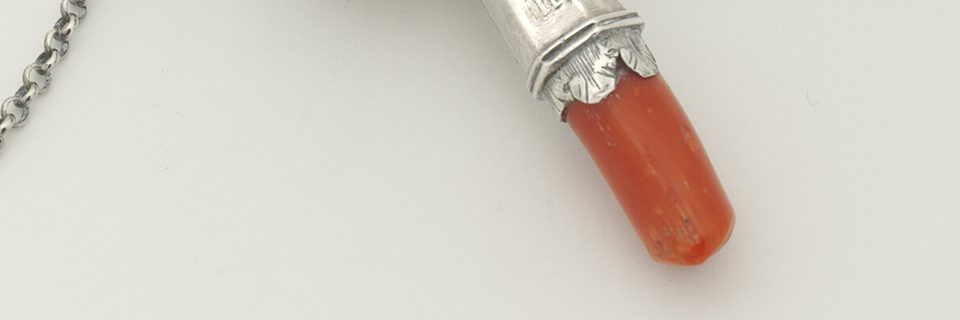
Detail of a silver baby’s whistle: the red-orange coral teething stick at its end, beside part of its silver chain
#AD5037#DDDDD4#9B9689#6A6458
Decorative artWhistle and bells with coral (about 1722)

A silver teething toy by the Boston silversmith Thomas Edwards, at the Art Institute of Chicago. Coral was thought to protect children. The coral stick is darker and redder than the web code, closer to real precious coral.

#AD5037#DDDDD4#9B9689#6A6458
Source: Art Institute of Chicago

Palettes are sampled in-house.

Questions

What color is coral?

A warm pinkish orange. The web code is #FF7F50 (RGB 255, 127, 80).

Is coral pink or orange?

Both names get used. By wavelength the web code is closer to orange, at about 595 nm. Dictionaries call coral a deep pink, and coral pink (#F88379) is a pinker version.

What is the difference between coral and salmon?

Coral (#FF7F50) leans orange and is a little brighter. Salmon (#FA8072) has more blue, so it leans pink and looks softer.

What colors go with coral?

Teal and navy for contrast, sand and peach for a warm tonal look, and mint or gray for something fresh and modern.

Why is it called coral?

After precious coral, the red skeleton of a sea animal used for jewelry. Coral has been a color name in English since 1513.

What is coral bleaching?

When the sea gets too warm, corals expel the algae that live in their tissues and give them their color, and they turn white. Bleached corals are not dead, but they are stressed and can die if it lasts.