Once part of mourning dress
Historical recordIn the last stage of Victorian mourning, called half-mourning, widows could wear muted colors such as gray, purple and lilac. The sources name purple and lilac rather than mauve itself.1
A pale purple named after the mallow flower, made famous by the first commercial synthetic dye.
Mauve is a pale, soft purple, the color of mallow flowers. Its classic code is #E0B0FF: strong red, softer green and full blue, which gives a light lilac-purple.
The name is French for mallow. It became famous in 1856, when 18-year-old William Henry Perkin tried to make the malaria drug quinine and made a purple dye instead. Sold as “mauve” from 1859, it was the first synthetic dye to become a commercial hit, and fashion went mad for it.
Today the word has drifted. Many people use mauve for a dusty pinkish purple, much grayer and pinker than the dictionary sample. In the xkcd color survey, the average “mauve” was #AE7181, closer to dusty rose than to lilac.
Both versions work as soft, quiet colors. The pale purple suits fresh, airy designs; the dusty version sits well with sage, cream and warm grays.
| HEX | #E0B0FF | |
|---|---|---|
| RGB | rgb(224, 176, 255) | |
| HSL | hsl(276, 100%, 85%) | |
| HSV | 276°, 31%, 100% | |
| CMYK | 12, 31, 0, 0 | |
| OKLCH | oklch(82.7% 0.119 311.6) |
Mauve has moved. The dictionary sample is a pale purple, while people’s average “mauve” in the xkcd survey (#AE7181) is a dusty pink just beyond the right edge of this view. The outline is an approximate range, not a measured one.
Tints with white
Shades with black
Tones with gray
Pairings that work in rooms, outfits and interfaces.
Soft and natural. A favorite for weddings and interiors.
Modern and calm. Good for beauty and fashion.
The two mauves side by side: pale purple and dusty pink.
Light and romantic. Suits stationery and soft branding.
Near-opposites that both feel muted. Earthy and grown-up.
Tonal and rich. Good for evening and autumn designs.
Pick a palette to see where its colors sit on the color wheel. The caret marks mauve. Tap a band to copy its code.
Lined up by hue around mauve. Hover a color to see how similar it is.The bar under each name shows how similar it is. Similarity comes from the distance between the two colors in OKLab, a model of how we see color.
Mauve feels soft, nostalgic and gentle. It sits between the romance of pink and the calm of lavender, which is why it turns up on wedding invitations, in makeup and in vintage-style rooms. It also carries Victorian history: a fashion craze in the 1860s, and the muted purples allowed late in mourning. As with most named colors, the research tests broad words like “purple” and “pink”, not mauve.
In the last stage of Victorian mourning, called half-mourning, widows could wear muted colors such as gray, purple and lilac. The sources name purple and lilac rather than mauve itself.1
In a study of children aged 7 months to 5 years, girls began to prefer pink at about two and a half, while boys began to avoid it. That timing suggests the link is learned, and it is the same link that makes dusty mauves read as feminine.2
In a 1994 study with color chips, purple and red-purple were among the most pleasant hues, and lighter colors were rated more pleasant than darker ones. Mauve, a light purple, fits both, but it was not tested by name.3
Mauve is the rare color with a birthday. A teenage chemist’s accident in 1856 turned a flower name into a fashion craze and started the synthetic dye industry.
William Henry Perkin, 18, tries to make the malaria drug quinine and instead makes a purple dye. He patents it that August.1, 2
Perkin opens a factory at Greenford Green, near London, to make the dye.1
The dye is sold as “mauve”, and the word enters English as a color name. Punch jokes about an outbreak of “mauve measles”.3, 4
Mauve fades easily, and newer synthetic dyes have replaced it.4
The decade is later called the “Mauve Decade”, after a 1926 book by Thomas Beer.4
Perkin is knighted on the 50th anniversary of his discovery, and the Perkin Medal is created in his honor.2
Chemists analyze 14 historic samples from museum collections and find that Perkin’s mauve is a mix of at least 13 related compounds.5
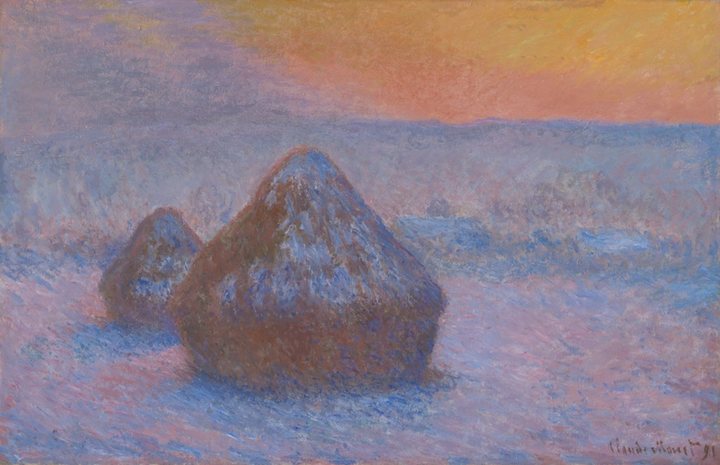
Claude Monet painted these stacks of wheat beside his house at Giverny, here at sunset in snow, in soft mauves, lilacs and rose. The canvas is at the Art Institute of Chicago.
Sampled from the Art Institute of Chicago’s photograph (1922.431), released as CC0 (public domain). Colors in a photo shift with the lighting, so read the codes as close, not exact.
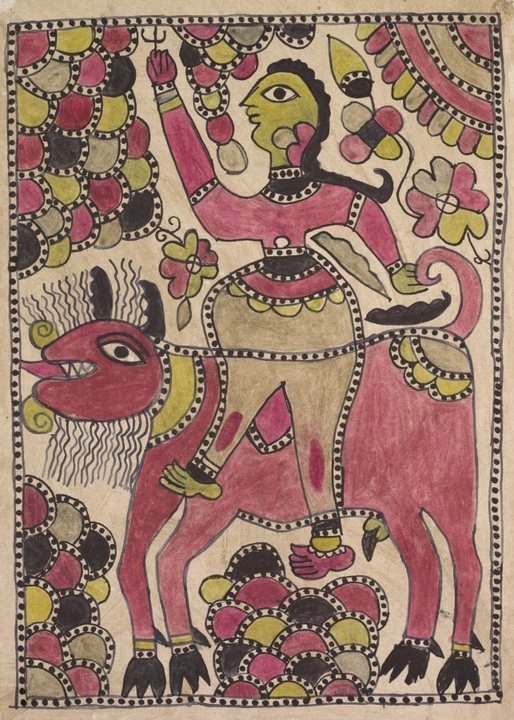
A Madhubani painting from Bihar, India, at the Cleveland Museum of Art. The museum’s own title calls its pink mauve: a dusty rose, far from the dictionary’s pale purple and close to what many people picture today.
Sampled from the Cleveland Museum of Art’s photograph (2005.83), released as CC0 (public domain). Its full title is “Rider and four-legged bovine creature in mauve, chartreuse and black palette”. Colors in a photo shift with the lighting, so read the codes as close, not exact.
Palettes are sampled in-house.
A pale purple, named after the mallow flower. The classic code is #E0B0FF (RGB 224, 176, 255). In everyday use, many people mean a dustier pinkish purple.
Both, depending on who you ask. The dictionary color and the original dye are purples. Fashion and makeup often use mauve for a grayish pink-purple, and survey data shows many people now picture it that way.
Classic mauve (#E0B0FF) is lighter and clearer and leans toward blue. Lilac (#C8A2C8) is grayer, with equal parts red and blue. When people use mauve for dusty pinks, the two drift further apart.
Sage green, cream and charcoal are the safest. Dusty rose makes a soft tonal pair, and deep plum adds richness.
Usually “mohv”, rhyming with “grove”. Some speakers say “mawv”.
The color name is older, but the famous mauve dye was discovered by the chemist William Henry Perkin in 1856, when he was 18. It was the first synthetic dye to be produced commercially.