Army green

A dark olive named after soldiers’ uniforms, in a code no army ever set.

Overview

Army green is a dark, dull olive green with a brownish cast. The code most color lists use, #4B5320, has red and green at about a third of full strength and very little blue. Merriam-Webster defines it as US Army green, a dark yellowish green, and dates the name to 1915.

No army set that code. The earliest place we found it is a Wikipedia article from November 2007, which cited a color posted on a color-sharing website, and it has been copied from list to list since. Even so, it is close to what people mean: in the xkcd color survey, people’s average army green was #4B5D16, just a little greener. CSS has no army green. Its nearest keyword is darkolivegreen, #556B2F, which is lighter and a little greener.

The US Army itself has worn many greens. Its olive drab of 1902 was a field color. From 1954 to 2015, soldiers wore a gray-green service uniform in a shade called Army Green 44. Since 2020, the Army Green Service Uniform has brought back the officers’ “pinks and greens” of World War II. Its coat shade, heritage green 564, is far darker and browner than the web code, about #3A332A on screen.

Army green is practical and outdoorsy. It carries white text easily, and it pairs well with khaki, cream, tan leather, brass and black.
HEX#4B5320
RGBrgb(75, 83, 32)
HSLhsl(69, 44%, 23%)
HSV69°, 61%, 33%
CMYK10, 0, 61, 67
OKLCHoklch(42.3% 0.074 117.1)
Every code converts from the HEX value #4B5320. No color standard defines army green. #4B5320 is the code most color lists use, and the earliest place we found it is a 2007 Wikipedia article that cited a color-sharing website; the US Army sets its own greens with physical cloth standards, such as heritage green 564 for today’s service coat. CMYK is a screen-based estimate; print results vary.
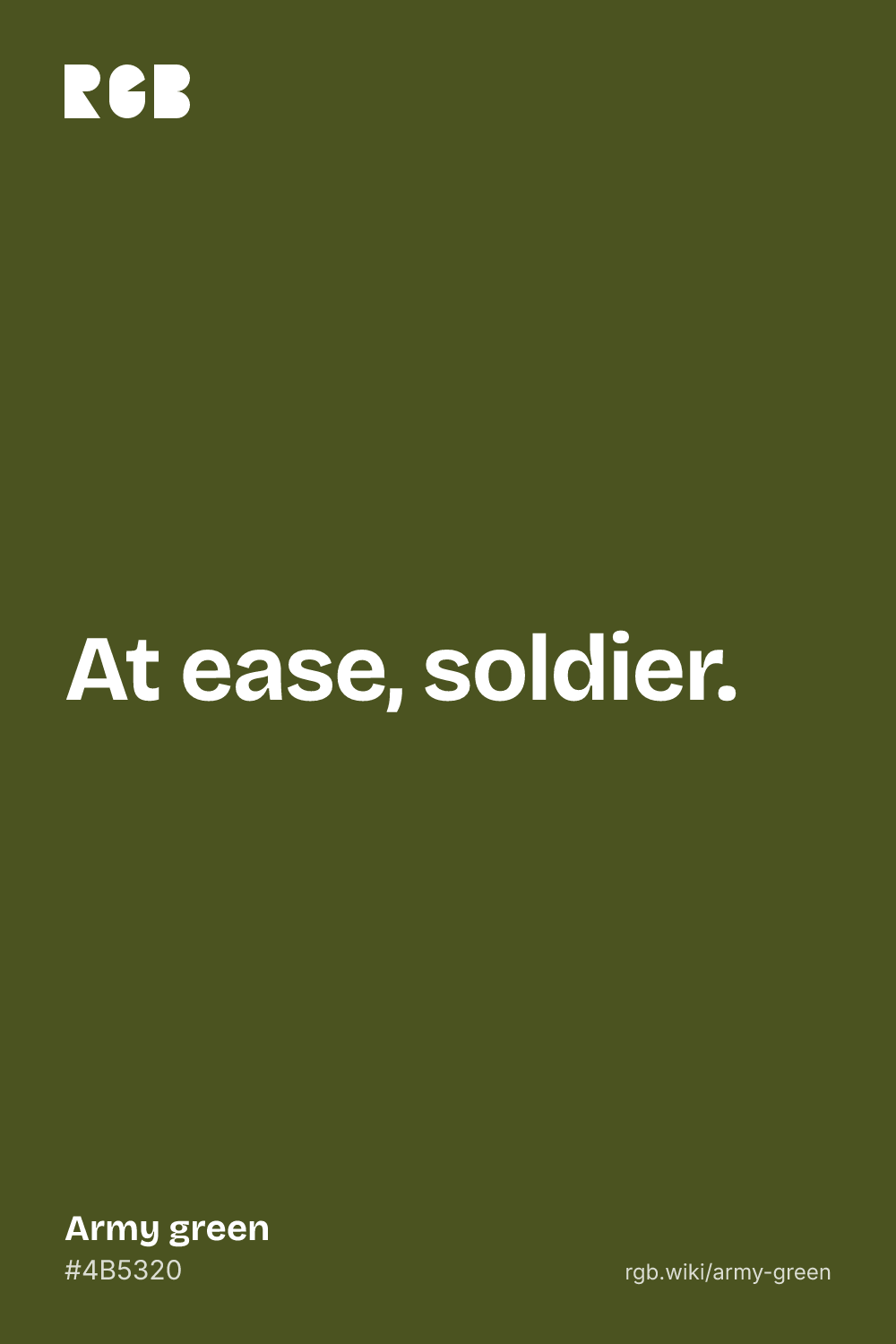
Army green color card, hex #4B5320: “At ease, soldier”

Army green on the color map

People’s average army green in the xkcd survey sits just to the right of the code, a little greener and lighter, and the ISCC-NBS moderate olive green sits beside it. Both are inside the outline. Heritage green 564, the Army’s own coat shade, lies far to the left at the bottom edge: much darker, browner and grayer. The outline is an approximate range, not a measured one.

Shades and tints

Tints with white

Shades with black

Tones with gray

Army green sits in the middle. Tints add white, shades add black and tones add gray, in 10% steps out from it. Tap any swatch to copy its code.

Light and dark army green

#B7BAA6
Pale army greenMixed 60% with white. A soft gray-green for backgrounds.
#818763
Light army greenMixed 30% with white. A muted sage olive.
#4B5320
Army greenThe reference color.
#4B5D16
Everyday army greenPeople’s average army green in the xkcd survey. A little greener and more vivid.
#3A332A
Heritage greenAbout the coat shade of today’s Army Green Service Uniform, heritage green 564. A very dark olive brown.
#262A10
Dark army greenMixed 50% with black. Nearly black, with an olive glow.

Colors that go with army green

Pairings that work in rooms, outfits and interfaces.

Army green and khaki

The classic field pairing. Practical and outdoorsy.

Pinks and greens

After the World War II officers’ uniform: olive coat, pinkish taupe trousers, russet shoes.

Army green and cream

Soft and calm. Good for homes, cafés and outdoor brands.

Army green and brass

Like brass buttons on a service coat. Formal and confident.

Army green and blaze orange

A safety-orange accent on a field color. Bold and easy to spot.

Army green and black

Plain and tough. Strong for outdoor gear and tools.

Color-wheel palettes

Pick a palette to see where its colors sit on the color wheel. The caret marks army green. Tap a band to copy its code.

Similar colors

Dark brown68%Army greenEbony66%Lincoln green66%Hunter green79%Feldgrau66%Spruce69%

Lined up by hue around army green. Hover a color to see how similar it is.The bar under each name shows how similar it is. Similarity comes from the distance between the two colors in OKLab, a model of how we see color.

Army green vs olive drab

Army green#4B5320 · hue 69°
  • Darker and duller
  • No standard; the code most lists use
  • Named after US Army uniforms
Olive drab#6B8E23 · hue 80°
  • Lighter and brighter
  • The CSS keyword olivedrab
  • Much greener than real olive drab cloth

Meaning

  • Uniforms
  • Service dress
  • Prestige
  • World War II

Army green says soldier, but mostly the soldier in service dress, at the office or at an official meeting, rather than in the field. The US Army picked its greens with care: in 1954 a gray-green meant to look military and restore prestige, and in 2018 a return to the uniform of World War II, meant to build pride. Mood research tests basic words such as green, not army green, so this section sticks to the record.

Picked to look military

Historical record

After World War II, surplus olive drab uniforms were everywhere. Laborers wore them as cheap work clothes, and prisons dressed inmates in them. An Army officer wrote in 1954 that soldiers’ prestige and morale had suffered as a result. Its answer, in 1954, was a new service uniform in a gray-green, Army Green shade 44, chosen to look distinctly military.1, 2, 3

A link to World War II

Army’s stated aim

In 2018 the Army revived the officers’ service uniform of World War II, a dark olive drab coat worn with lighter drab trousers nicknamed pinks. It said polling showed overwhelming support, and that the uniform would instill pride and connect soldiers with the public.1, 4

Blue came first

Historical record

Through the 1800s, regular US soldiers wore dark blue coats. Olive drab became the field color only in 1902, and the traditional blue was kept for dress. From 2015 to 2020, a blue uniform was the Army’s only service uniform, and it remains the formal dress uniform today.5, 3

Sources (5)
  1. Decuers, L. (2017). “Pinks and Greens”. The National WWII Museum, citing The Quartermaster Review (1954).
  2. Jahner, K. (2015). “The end of the Green Service Uniform: 1954–2015”. Army Times, October 1, 2015.
  3. Wikipedia, “Army Service Uniform”, history, citing Kamp, “Prestige of the Soldier”, The Quartermaster Review (1954), and Cole, Survey of U.S. Army Uniforms, Weapons and Accoutrements (US Army, 2007).
  4. US Army, “Army Greens Uniform”, STAND-TO!, December 11, 2018.
  5. Wikipedia, “Uniforms of the United States Army”.

History

“Army green” was in print by 1915, while the US Army still called its uniform cloth olive drab. In 1954 the Army put the name on a new uniform shade, Army Green 44, and its greens have kept changing since.

  1. 1915

    First known use of “Army green” as a color name.1

  2. World War II

    Army officers wear a dark olive drab coat with lighter drab trousers, a pairing nicknamed pinks and greens. Enlisted soldiers wear a medium olive drab.2

  3. 1954

    The Army introduces a service uniform for all ranks in Army Green shade 44, a gray-green, after surplus olive drab became common work clothing.2, 3

  4. 1964

    A lighter-weight polyester and wool version of the green uniform follows, in Army Green shade 344.3

  5. 2007

    A new Wikipedia article gives army green as #4B5320, citing a color posted on a color-sharing website. Color lists still use the code.4

  6. 2015

    The green service uniform is retired after 61 years, leaving the blue Army Service Uniform as the only one.5, 3

  7. 2018

    On Veterans Day, the Army announces the Army Green Service Uniform, based on the pinks and greens of World War II.6

  8. 2020

    Fielding begins in July. The coat is heritage green 564, a very dark olive brown, worn with heritage taupe trousers and a heritage tan shirt.7, 8, 9

  9. 2027

    October 1 is the deadline for every soldier to own the Army Green Service Uniform.7

Sources (9)
  1. Merriam-Webster, “Army green”, first known use, and “U.S. Army green”.
  2. Decuers, L. (2017). “Pinks and Greens”. The National WWII Museum.
  3. Wikipedia, “Army Service Uniform”, history, citing The Quartermaster Review (1954) and Cole, Survey of U.S. Army Uniforms, Weapons and Accoutrements (US Army, 2007).
  4. Wikipedia, “Army green”, first revision, November 7, 2007.
  5. Jahner, K. (2015). “The end of the Green Service Uniform: 1954–2015”. Army Times.
  6. US Army (2018). “U.S. Army to roll out new Army Greens uniform”. army.mil, November 11, 2018.
  7. Program Executive Office Soldier, “Army Green Service Uniform”, US Army.
  8. Department of the Army (2021). DA Pamphlet 670-1: Guide to the Wear and Appearance of Army Uniforms and Insignia, paragraphs 14-4 and 14-7.
  9. Defense Logistics Agency (2022). Shade tolerance sheet, heritage green 564 (CIELAB L* 21.70, a* 1.18, b* 7.06; “numbers are for reference only”). Converted to #3A332A by RGB.wiki, assuming daylight (D65).

Questions

What color is army green?

A dark, dull olive green with a brownish cast. The usual code is #4B5320 (RGB 75, 83, 32).

Is there an official army green hex code?

No. No standard defines #4B5320. The earliest place we found it is a 2007 Wikipedia article that cited a color-sharing website. The US Army sets its uniform colors with physical cloth standards, not hex codes.

Is army green the same as olive drab?

They are close, and people often use the names loosely. Olive drab is the older name, used by the US Army for its field uniforms from 1902. On the web, the CSS keyword olivedrab (#6B8E23) is much lighter and brighter than army green.

What is the difference between army green and olive green?

Army green (#4B5320) is darker and duller, closer to brown. Olive green (#708238) is lighter and a little greener.

What color is the Army Green Service Uniform?

The coat is heritage green, a very dark olive brown, worn with heritage taupe trousers, a heritage tan shirt and brown oxford shoes. It is based on the pinks and greens worn by officers in World War II.

When did the Army stop wearing green?

The green service uniform introduced in 1954 was retired in 2015, leaving the blue Army Service Uniform. Green came back in 2020 with the Army Green Service Uniform, which every soldier must own by October 1, 2027.

What colors go with army green?

Khaki, cream and tan for an outdoor look, brass or gold for a formal one, and black or blaze orange for contrast.