Light brown

A soft, warm brown with no official code, better known by names such as tan, camel and mocha.

Overview

Light brown is a soft, warm brown, the color of milky coffee, cardboard and a paper bag. Its code is #AD8150: red at 68%, green at 51% and blue at 31%. Its hue, 32°, is the hue of orange. Brown is what orange looks like with less light in it, and light brown is the stretch where the orange starts to show again.

Light brown has no official code. It isn’t a CSS keyword: the web’s color list has tan, burlywood, peru and sandy brown, but no light brown, and its plain brown, #A52A2A, is a dark red. The code used here is the average of what people called light brown in Randall Munroe’s 2010 xkcd color survey, where it was one of the most used names of all. For once a dictionary agrees: the 1955 ISCC-NBS system’s light brown is centered around #A67B5B, almost the same color.

Most light browns go by other names. Tan and camel are lighter, caramel is more golden, mocha and taupe are grayer, and beige is paler than all of them. Light brown is the plain description they share. Some color lists use a stronger code: Wikipedia’s shades of brown shows #B5651D, which is deeper and far more orange.

On screens, light brown takes dark text: black on it has a contrast of about 6:1. White reaches only about 3.5:1, enough for large headings but not for body text. It pairs well with cream and dark brown, with sage green and dusty blue, and with terracotta.

HEX#AD8150
RGBrgb(173, 129, 80)
HSLhsl(32, 37%, 50%)
HSV32°, 54%, 68%
CMYK0, 25, 54, 32
OKLCHoklch(63.5% 0.085 68.3)
Every code converts from the HEX value #AD8150. #AD8150 is the average of the colors people called “light brown” in Randall Munroe’s 2010 xkcd color survey, from the survey’s results list (CC0). No color standard defines light brown, and it isn’t a CSS keyword. The 1955 ISCC-NBS system’s light brown is centered around #A67B5B, close to it. Wikipedia’s shades of brown shows #B5651D, a deeper and more orange color. CMYK is a screen-based estimate; print results vary.
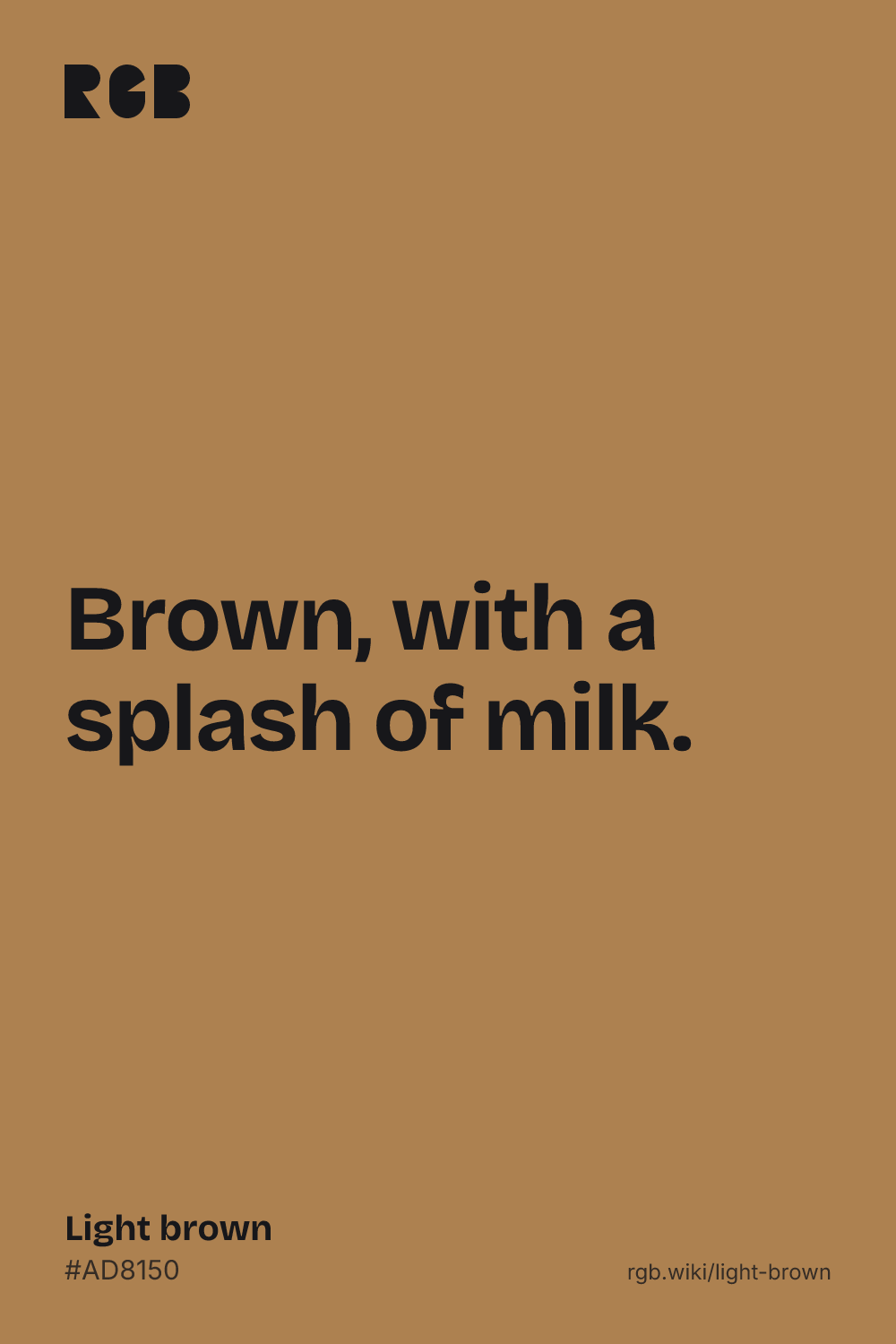
Light brown color card, hex #AD8150: “Brown, with a splash of milk”

Light brown on the color map

The dictionary’s light brown sits inside the outline, a little to the left of the code: slightly redder. Wikipedia’s light brown sits further left and lower: redder and darker. CSS peru is to the left and a little higher, and CSS tan sits above the outline: almost the same hue, but lighter. The outline is an approximate range, not a measured one.

Shades and tints

Tints with white

Shades with black

Tones with gray

Light brown sits in the middle. Tints add white, shades add black and tones add gray, in 10% steps out from it. Tap any swatch to copy its code.

Versions of light brown

#D2B48C
TanThe web’s tan: lighter and paler. See tan
#C19A6B
CamelA step lighter and a touch yellower. See camel
#AD8150
Light brownThe reference color: the survey’s average for the name.
#A67B5B
Dictionary light brownThe center of the ISCC-NBS group light brown (1955): a little redder and grayer.
#A38068
MochaGrayer and cooler. See mocha
#B5651D
Wikipedia’s light brownDeeper and far more orange.

How to mix light brown

Light brown is brown with white in it, kept warm with a little extra yellow. In paint, mix a brown first, then lighten it.

From red, yellow and blue

Yellowcadmium yellow, the most
Bluecobalt blue, some
Redcadmium red, a little less
Whitetitanium white, to lighten
Modeled mix#AC834E

Red, yellow and blue together make brown, and white lifts it. The extra yellow keeps the mix from turning pink.

With a brown paint

Reddish brownsienna, mostly
Whitetitanium white, some
Blacklamp black, a touch
Modeled mix#B28058

A reddish brown, lightened with white and quieted with a little black. The modeled mix comes out slightly redder than the code.

Lighter
More white heads toward tan and then beige.
Darker
More brown, or a touch of blue, heads toward dark brown.
Warmer
A touch of yellow or orange gives camel and caramel.
Grayer
A touch of gray or blue gives mocha and taupe.

On a screen

Red lightat 68%
Green lightat 51%
Blue lightat 31%
Light brown#AD8150

A screen makes light brown from red, green and blue light: rgb(173, 129, 80). In print, a starting point is C 0, M 25, Y 54, K 32, worked out from the screen color; inks and paper shift it, so check a proof.

Paint swatches are worked out with a pigment model, not measured from real paint. Tube colors differ in strength from brand to brand, so add the darker color a little at a time.

Colors that go with light brown

Pairings that work in rooms, outfits and interfaces.

Light brown and cream

Soft and natural, with a dark brown for text.

Light brown and dark brown

Tonal, like wood and leather. The dark brown carries text and buttons.

Light brown and sage green

Earthy and calm, for interiors and packaging.

Light brown and dusty blue

Blue is the opposite of orange, so a soft blue makes light brown look warmer.

Light brown and terracotta

A warm pair in the same family, lifted with cream.

Light brown and black

A dark theme where light brown works for headings, links and buttons.

Color-wheel palettes

Pick a palette to see where its colors sit on the color wheel. The caret marks light brown. Tap a band to copy its code.

Similar colors

Mocha83%Copper81%Bronze71%Peru71%Light brownDark goldenrod72%Dark yellow75%

Lined up by hue around light brown. Hover a color to see how similar it is.The bar under each name shows how similar it is. Similarity comes from the distance between the two colors in OKLab, a model of how we see color.

Light brown vs tan

Light brown#AD8150 · hue 32°
  • Darker and stronger
  • A survey average, no standard
  • A plain description
Tan#D2B48C · hue 34°
  • Lighter and paler
  • A CSS keyword
  • Named after tanned leather

Meaning

  • A survey average
  • Matches the dictionary
  • No CSS keyword
  • Warm and plain

Light brown reads as warm, plain and natural: the color of wood, leather, paper and sand. No study has tested light brown by name; research on color and feeling works with brown as a whole. What can be measured is how people use the name, and here, unusually, the survey and the dictionary agree.

One of the most used color names

Online survey

In Randall Munroe’s 2010 color survey, people typed their own names for colors shown on their screens: more than five million colors over 222,500 sessions. On the results page, which lists the 954 most common names starting with purple, green and blue, light brown comes 38th, behind tan (22nd) and beige (32nd) and ahead of khaki (68th), taupe (74th) and dark brown (75th). Its average color is #AD8150.1

The dictionary agrees

Calculated

The ISCC-NBS system of 1955 sorts all colors into 267 named groups. One is called light brown, centered around #A67B5B, and it is the group the survey’s light brown falls nearest to. The next group toward yellow, light yellowish brown, is centered on #C19A6B, the color this site lists as camel.2

An orange in the shade

Well established

Light brown’s hue, 32°, is an orange’s. Brown is not a hue of its own: it is how orange, and the reds and yellows beside it, look when they are dimmer than their surroundings. The same patch can look orange on a dark ground and brown on a bright one. The 1955 dictionary works the same way: it has no group called dark orange and uses brown in its place.3, 2

Missing from the web’s list

Specification

The X Window System’s color list, the source of most web color names, has had a brown, a tan and a sandy brown since its first version, and its 1989 revision added peru, burlywood, rosy brown and saddle brown. No version has a light brown. In CSS the nearest keywords are dark goldenrod (#B8860B), which is yellower and stronger, and peru (#CD853F), which is brighter and more orange.4, 5

A violet in the printing standard

Printed value, our reading

The Printer Working Group’s 2013 names for paper colors include a light brown. The value printed in its table, 0x9966FF, is a violet. It looks like a slip for 996600, a dark golden brown, which is how Wikipedia’s copy of the table reads it. The standard adds that its color values are not binding.6, 7

Brown is rarely a favorite

Two lab studies

A 2010 study at Berkeley, in which 48 people rated 32 colors, concluded that people like colors linked with things they like, such as blues with clear skies, and dislike colors linked with things they dislike, such as browns with rotten food. A 1994 lab study found lighter colors more pleasant than darker ones. Neither tested light brown by name.8, 9
Sources (9)
  1. Randall Munroe (2010), “Color Survey Results”, and “The 954 most common RGB monitor colors” (light brown #ad8150, tan #d1b26f, beige #e6daa6), xkcd color survey, CC0.
  2. Kelly, K. L. & Judd, D. B. (1955). The ISCC-NBS Method of Designating Colors and a Dictionary of Color Names, NBS Circular 553. Group centers as sRGB, converted by John Foster, in Aubrey Jaffer’s “Color-Name Dictionaries”, MIT CSAIL (light brown, light yellowish brown), with the note in nbs-iscc.txt that “brown” stands in for “dark orange”.
  3. Wikipedia, “Brown”, optics, citing The Feynman Lectures on Physics (1964) and Johnson & Fairchild in the CRC Digital Color Imaging Handbook (2003).
  4. W3C, CSS Color Module Level 4, named colors: brown #a52a2a, tan #d2b48c, peru #cd853f, darkgoldenrod #b8860b, burlywood #deb887 and sandybrown #f4a460, and no lightbrown.
  5. The X Window System’s color lists, hosted by Aubrey Jaffer, MIT CSAIL: the first list (1986–88), old-rgb.txt, and Paul Raveling’s 1989 revision, raveling.txt (brown 165 42 42, tan and sandy brown in the first; peru, burlywood, rosy brown and saddle brown added in the second).
  6. Printer Working Group (2013). PWG Media Standardized Names 2.0 (MSN2), PWG 5101.1-2013, Table 2, Color Names (light-brown 0x9966FFFF), and section 1.1 on the color values.
  7. Wikipedia, “X11 color names”, derived lists: the table of PWG 5101.1 media color names (light brown 153, 102, 0).
  8. Palmer, S. E. & Schloss, K. B. (2010). An ecological valence theory of human color preference. Proceedings of the National Academy of Sciences, 107(19), 8877–8882. doi:10.1073/pnas.0906172107
  9. Valdez, P. & Mehrabian, A. (1994). Effects of color on emotions. Journal of Experimental Psychology: General, 123(4), 394–409. doi:10.1037/0096-3445.123.4.394

History

Light brown has no first use to record: it is a description, not a coined name. Its history is a short list of the times someone had to pin the description to one color, or chose not to.

  1. 1955

    The ISCC-NBS dictionary of color names sorts all colors into 267 named groups. One is light brown; its center works out to about #A67B5B.1

  2. 1986

    The X Window System’s first color list has brown, tan, sandy brown and sienna. Its brown, 165 42 42, is a dark red, and there is no light brown.2

  3. 1989

    Paul Raveling’s revised list adds peru, burlywood, rosy brown and saddle brown. Still no light brown.2

  4. 2010

    In the xkcd color survey, light brown is one of the most used names, and people’s average for it is #AD8150, the code this page uses.3

  5. 2013

    The Printer Working Group’s standard names for print media list a light brown paper color. The value printed for it, 0x9966FF, is a violet.4

Sources (4)
  1. Kelly, K. L. & Judd, D. B. (1955). The ISCC-NBS Method of Designating Colors and a Dictionary of Color Names, NBS Circular 553. Group centers as sRGB, converted by John Foster, in Aubrey Jaffer’s “Color-Name Dictionaries”, MIT CSAIL (light brown, light yellowish brown), with the note in nbs-iscc.txt that “brown” stands in for “dark orange”.
  2. The X Window System’s color lists, hosted by Aubrey Jaffer, MIT CSAIL: the first list (1986–88), old-rgb.txt, and Paul Raveling’s 1989 revision, raveling.txt (brown 165 42 42 in both; peru 205 133 63 and burlywood 222 184 135 in the second).
  3. Randall Munroe (2010), “Color Survey Results”, and “The 954 most common RGB monitor colors” (light brown #ad8150, tan #d1b26f, beige #e6daa6), xkcd color survey, CC0.
  4. Printer Working Group (2013). PWG Media Standardized Names 2.0 (MSN2), PWG 5101.1-2013, Table 2, Color Names (light-brown 0x9966FFFF).

Questions

What color is light brown?

A soft, warm brown. The code used here is #AD8150 (RGB 173, 129, 80): an orange hue at about two thirds of full brightness, with a good share of gray in it.

What is the hex code for light brown?

There is no standard one. This page uses #AD8150, the average of what people called light brown in the xkcd color survey. The 1955 color dictionary’s light brown is a close #A67B5B, and Wikipedia shows a more orange #B5651D.

What is light brown called?

Usually tan, camel, fawn or mocha. A very pale light brown is beige, a golden one is caramel, and a grayish one is taupe or khaki.

Is light brown the same as tan?

Close. By the usual codes, tan (#D2B48C) is lighter and paler, and light brown (#AD8150) is darker and stronger. In everyday speech the two names overlap.

Is light brown a CSS color?

No. CSS has no lightbrown keyword, so it has to be written as a code. The nearest keywords are darkgoldenrod (#B8860B), which is yellower and stronger, and peru (#CD853F), which is brighter and more orange. Tan (#D2B48C) is paler.

What colors make light brown?

With paint, mix red, yellow and blue into brown, or orange and blue, then lighten it with white and a little extra yellow. On a screen, light brown is red at 68%, green at 51% and blue at 31%.

What colors go with light brown?

Cream and dark brown for a natural, tonal look, sage green for an earthy one, dusty blue for contrast, and terracotta for warmth.

What text color works on light brown?

Dark text. Black on light brown has a contrast of about 6:1. White reaches only about 3.5:1, enough for large headings but too low for body text.