A light yellowish brown named after camel hair, the cloth of the classic winter coat.
Overview
Camel is a light, warm yellowish brown, the color of camel-hair cloth. Its code, #C19A6B, has red at about three quarters strength, green at 60% and blue at about 40%, which gives a soft golden brown. It is a shade darker than tan.
The name comes from the cloth more than the animal. Camel hair is the fine undercoat of the two-humped Bactrian camel, gathered when the animals shed in late spring. Its natural color is golden tan, and coats made of it became a classic in the 1920s. Camel has been a color name in English since 1916.
The code comes from a dictionary of everyday trade and fashion colors. When the 1955 ISCC-NBS dictionary indexed the camel of a 1950 dictionary of color names, it filed it first as a light yellowish brown, and the center of that group is #C19A6B. The older A Dictionary of Color (1930) had printed camel as a brownish gray, the very same sample it also called mushroom and beaver.
Camel is a warm neutral. It pairs naturally with the colors it is worn with: navy, black, white and burgundy. Use dark text on it, since white text is hard to read.
HEX
#C19A6B
RGB
rgb(193, 154, 107)
HSL
hsl(33, 41%, 59%)
HSV
33°, 45%, 76%
CMYK
0, 20, 45, 24
OKLCH
oklch(71.1% 0.078 71.2)
Every code converts from the HEX value #C19A6B. #C19A6B is the center of the ISCC-NBS color group light yellowish brown, the code Wikipedia gives for camel. The 1955 ISCC-NBS dictionary lists that group first for the camel of the 1950 Descriptive Color Names Dictionary, but files the camel of Maerz and Paul’s A Dictionary of Color (1930) as a brownish gray. CMYK is a screen-based estimate; print results vary.
Camel on the color map
LighterDarker
People’s average camel in the xkcd survey is a little more golden than the code, inside the outline to the right. Maerz and Paul’s camel’s hair is the same hue but darker and grayer, below the outline. The clay camel from the 500s is darker and redder, below it and to the left. Maerz and Paul’s plain camel, a brownish gray (#5B504F), is too dark and gray to fit in this view. The outline is an approximate range, not a measured one.
Shades and tints
Tintswith white
Shadeswith black
Toneswith gray
Camel sits in the middle. Tints add white, shades add black and tones add gray, in 10% steps out from it. Tap any swatch to copy its code.
Light and dark camel
#ECE1D3
Pale camelMixed 70% with white. A warm off-white for backgrounds.
#DAC2A6
Light camelMixed 40% with white. A soft biscuit color.
#D2B48C
TanLighter and paler, the CSS keyword tan. See tan
#C19A6B
CamelThe reference color.
#745C40
Dark camelMixed 40% with black. A deep brown for text and borders.
#5B504F
Dictionary camelThe ISCC-NBS brownish gray, where the 1955 dictionary files Maerz and Paul’s camel of 1930. Their book used the same sample for mushroom and beaver.
Colors that go with camel
Pairings that work in rooms, outfits and interfaces.
Camel and navy
The classic camel coat over navy. Smart and warm.
Camel and black
Simple and sharp. The black makes camel look richer.
Camel and winter white
Soft and light, like a camel coat over a cream sweater.
Camel and burgundy
Warm and traditional. Good for autumn and the holidays.
Camel and forest green
Country colors: tweed, leather and woods.
Camel and charcoal
Quiet and modern. The gray cools the warm brown.
Color-wheel palettes
Pick a palette to see where its colors sit on the color wheel. The caret marks camel. Tap a band to copy its code.
Lined up by hue around camel. Hover a color to see how similar it is.The bar under each name shows how similar it is. Similarity comes from the distance between the two colors in OKLab, a model of how we see color.
Camel vs tan
Camel#C19A6B · hue 33°
A shade darker and richer
Named after camel-hair cloth
The classic coat color
Tan#D2B48C · hue 34°
Lighter and paler
Named after leather tanning
A CSS color keyword
Meaning
Camel coats
Natural fiber
Deserts
Campus style
Camel suggests soft winter coats, desert caravans and quiet, lasting style. Its meanings come from the cloth more than the animal: camel hair is warm and light, and it is usually left its natural color, so the color became the color of a good coat. Color research tests broad words like brown, not camel, so the claims here are about the fiber and the coat.
Left its natural color
Well established
Camel hair comes from the fine, soft undercoat of the two-humped Bactrian camel. The animals shed from late spring to early summer, and the fallen clumps are still often gathered by hand. The fiber’s natural color is golden tan. It takes dye as well as wool does, but most camel hair is left undyed.1, 2
A coat from the polo field
Museum account
The camel hair polo coat began as a heavy wrap that British polo players wore between periods of play. After British teams began visiting the United States in the 1920s, the coat was adapted, with a double-breasted cut, patch pockets and a half-belt, and became a favorite on elite college campuses.3
An old desert cloth
Historical record
Camel hair cloth is far older than the color name. In the Gospel of Matthew, John the Baptist wears “raiment of camel’s hair, and a leathern girdle about his loins”. Where camels were kept, the coarser hair was long woven into tents, carpets and cloaks.4, 2
Camel hair was a cloth long before camel was a color. The color name arrived in the 1900s with the camel coat, and the color dictionaries never quite agreed on it.
Before the 1100s
The word camel is in use in English, from Latin camelus and Greek kamēlos, a word of Semitic origin.1
Mid-to-late 500s
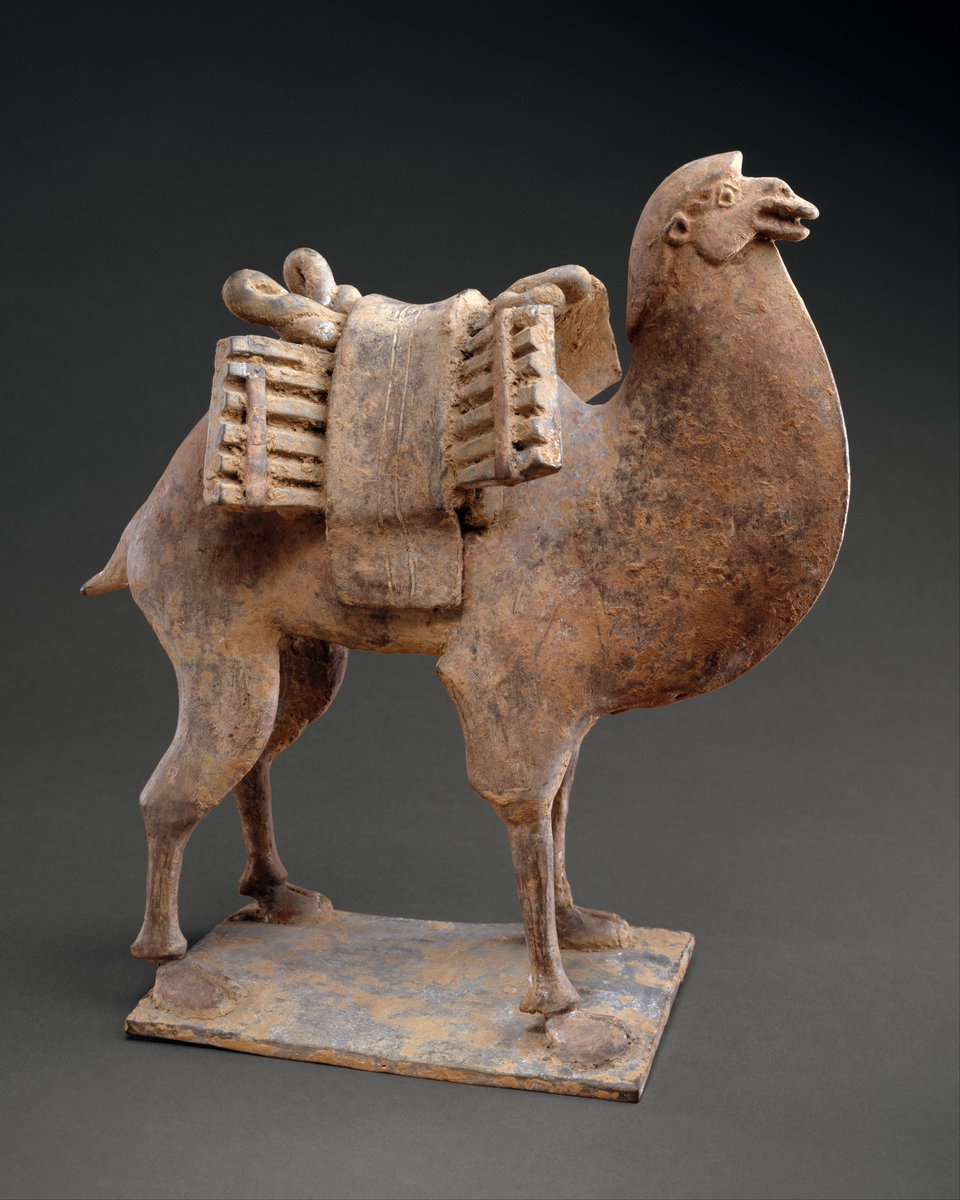
In China, under the Northern dynasties, a potter models a two-humped camel carrying packs, in earthenware with traces of paint.2
First recorded use of camel as a color name in English.4
1920s
British polo teams visit the United States, and their camel hair wait coats become the polo coats of American college campuses.5
1930
Maerz and Paul’s A Dictionary of Color prints camel as plate 15, sample A6, the same sample it also calls mushroom and beaver.4, 6
1937
The American designer Vera Maxwell makes a camel hair coat for fall and winter 1937–38. It is now in the Metropolitan Museum of Art.7
1955
The ISCC-NBS dictionary files Maerz and Paul’s camel as a brownish gray. For the camel of the 1950 Descriptive Color Names Dictionary it lists light yellowish brown first, and the center of that group, #C19A6B, is today’s camel code.6, 8
Sources (8)
Merriam-Webster, “camel”, definitions, etymology and first known use.
Metropolitan Museum of Art, “Camel”, China, Northern Wei to Northern Qi dynasty, mid-to-late 6th century (28.121).
Merriam-Webster, “camel hair”, definitions and first known use.
Wikipedia, “Camel (color)”, citing Maerz and Paul, A Dictionary of Color (1930), p. 191 and plate 15, sample A6.
The Museum at FIT, “Polo coat”, Ivy Style exhibition (2012–13).
A two-humped Bactrian camel with packs on its back, modeled in earthenware under China’s Northern dynasties. The clay body reads about #87624A in the photo, darker and redder than the camel of a coat, with paler patches where the light catches it.
#A07F6A#87624A#684835#4A2B1C
Source: The Met
Source
Sampled from the body of the figure in the Metropolitan Museum of Art’s photograph (28.121), released as CC0 (public domain). The museum dates it to the Northern Wei to Northern Qi dynasties and lists it as earthenware with traces of pigment. Colors in a photo shift with the lighting, so read the codes as close, not exact.
Palettes are sampled in-house.
Questions
What color is camel?
A light, warm yellowish brown, the natural color of camel-hair cloth. The code used here is #C19A6B (RGB 193, 154, 107).
What is the difference between camel and tan?
Camel (#C19A6B) is a shade darker and richer. Tan (#D2B48C) is lighter and paler. The two have almost the same hue, so camel looks like a deeper tan.
Is camel the same as beige?
No. Beige (#F5F5DC) is much paler, close to an off-white. Camel is a true mid-tone brown.
What is the difference between camel and fawn?
Fawn (#E5AA70) is lighter and more orange. Camel (#C19A6B) is darker and more muted, closer to a soft brown.
Why is it called camel?
After camel hair, the soft undercoat of the Bactrian camel. Its natural color is golden tan, and camel-hair coats made the color a fashion classic in the 1920s.
What colors go with camel?
Navy, black and white for a classic look, burgundy or forest green for warmth, and charcoal gray for a quiet, modern feel.
Is camel a neutral color?
Yes, a warm neutral. It sits between tan and brown and goes with most colors, especially deep blues, grays and black.