Copper

A warm reddish brown named after the first metal people worked.

Overview

Copper is a warm, reddish orange-brown. The code used here, #B87333, is strong in red, medium in green and low in blue, which gives it a brown, slightly orange tone. It is the copper code most color lists use.

The color is named after the metal. The word comes from Old English coper, from the Latin Cyprium aes, “metal of Cyprus”. It has named a color in English since at least 1594.

Freshly cut copper is a brighter, pinker orange than this code. Most metals reflect every color of light about equally, so they look silver or gray. Copper soaks up more of the green and blue and sends back mostly red and yellow, which is why it glows warm. Outdoors it doesn’t stay that way: air and rain darken it to brown, then cover it in a blue-green crust like verdigris.

One flat code can’t show the shine, so a plain copper swatch reads as brown. For a metallic look on screen, run a gradient from a pale peach highlight such as #D4AB85 through the base color to a deep brown such as #6E451F. Black text is readable on copper; white text works only at large sizes.

HEX#B87333
RGBrgb(184, 115, 51)
HSLhsl(29, 57%, 46%)
HSV29°, 72%, 72%
CMYK0, 38, 72, 28
OKLCHoklch(61.8% 0.117 60.4)
Every code converts from the HEX value #B87333. #B87333 is the copper most color lists use. Wikipedia gives it as a match for the copper sample in Maerz and Paul’s A Dictionary of Color (1930), but the 1955 ISCC-NBS dictionary files that sample as a grayish reddish orange, so treat the code as typical, not official. CMYK is a screen-based estimate; print results vary.
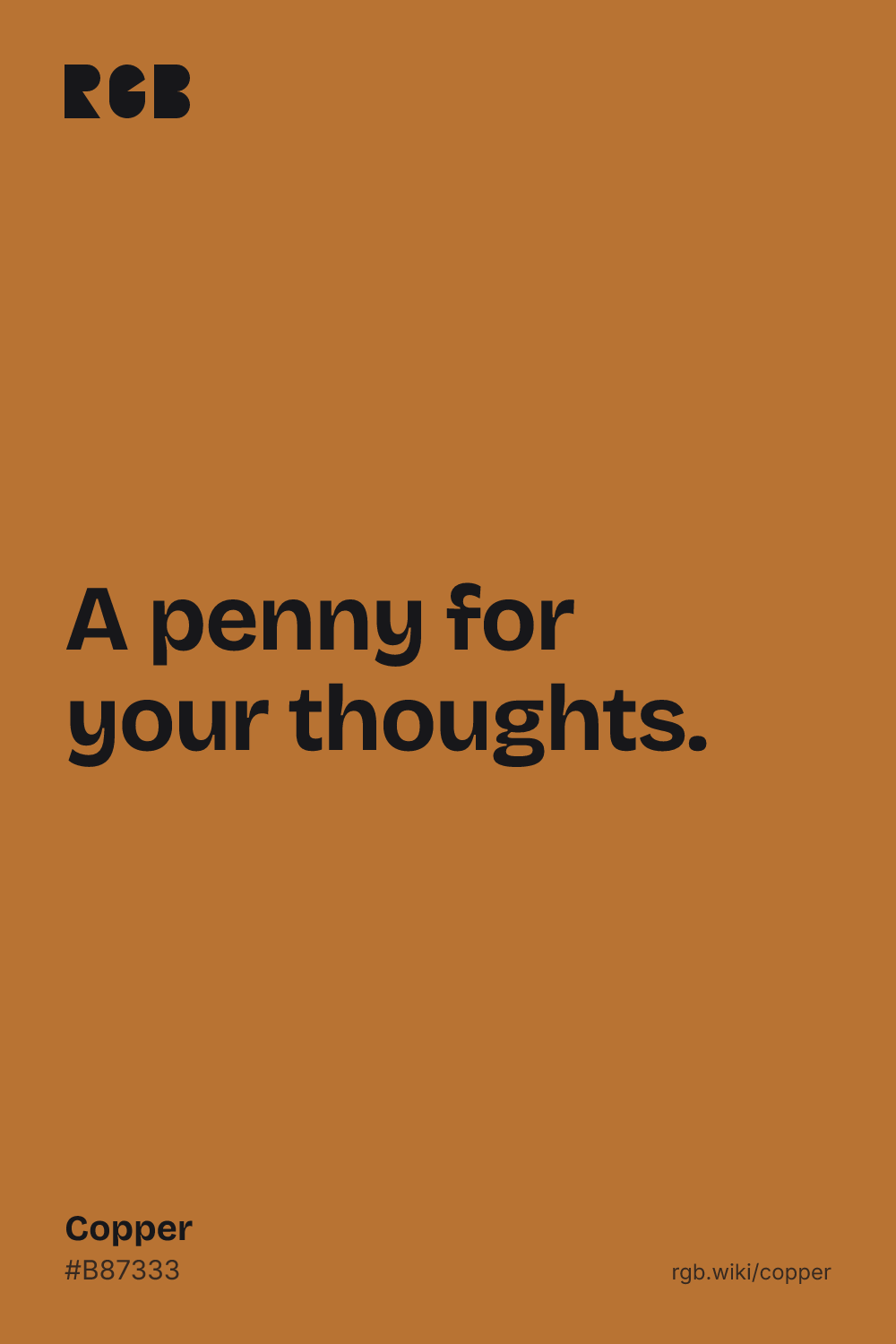
Copper color card, hex #B87333: “A penny for your thoughts”

Copper on the color map

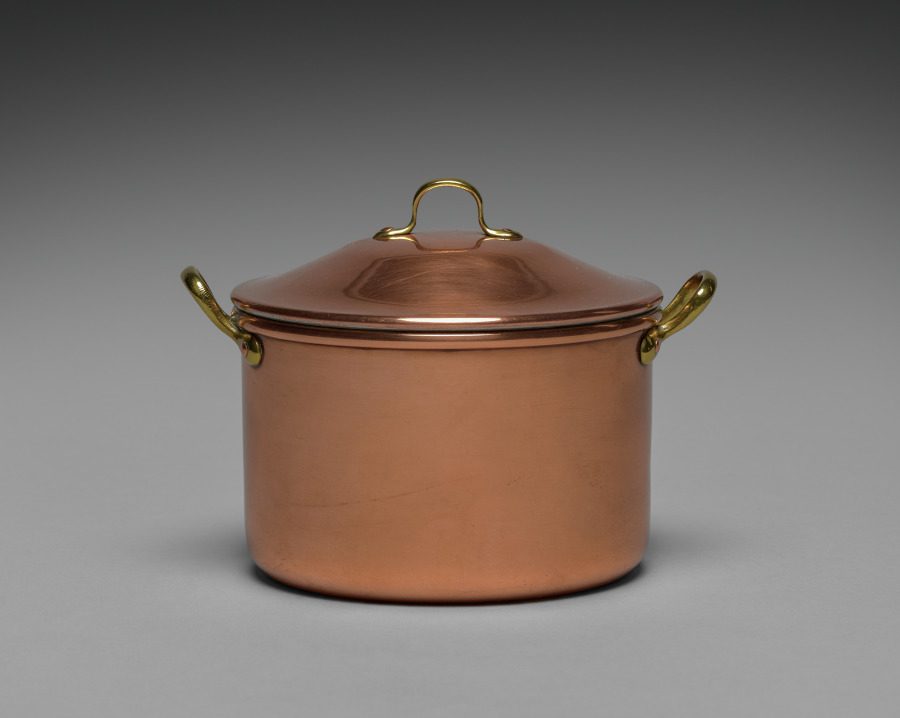
People’s average copper in the xkcd survey is a little darker and redder than the code, inside the outline below and to the left. The ISCC-NBS grayish reddish orange is duller and pinker and sits near the left edge. The polished pot in the museum photo is darker and duller still. The outline is an approximate range, not a measured one.

Shades and tints

Tints with white

Shades with black

Tones with gray

Copper sits in the middle. Tints add white, shades add black and tones add gray, in 10% steps out from it. Tap any swatch to copy its code.

Light and dark copper

#D4AB85
Light copperMixed 40% with white. A soft peach for the highlight in a copper gradient.
#B87333
CopperThe reference color.
#B4745E
Dictionary copperThe ISCC-NBS grayish reddish orange, where the 1955 dictionary files Maerz and Paul’s copper. Pinker and duller.
#9F694B
Polished potSampled from a museum photo of a Fabergé copper pot from 1914. Real copper under gallery light.
#6E451F
Dark copperMixed 40% with black. A deep brown for shadows, and for text on light backgrounds.

Colors that go with copper

Pairings that work in rooms, outfits and interfaces.

Copper and verdigris

The metal and its own patina: warm orange-brown against cool blue-green.

Copper and navy

Warm metal on deep blue. Smart and confident.

Copper and cream

Soft and cozy, like copper pans in a farmhouse kitchen.

Copper and charcoal

Industrial and modern. Suits bars, lighting and tech.

Copper and sage

Earthy and calm. Good for homes and gardens.

Copper and blush

Two warm tones together. Gentle and romantic.

Color-wheel palettes

Pick a palette to see where its colors sit on the color wheel. The caret marks copper. Tap a band to copy its code.

Similar colors

Clay78%Cinnamon76%Ochre80%CopperBronze75%Ginger79%Dark goldenrod70%

Lined up by hue around copper. Hover a color to see how similar it is.The bar under each name shows how similar it is. Similarity comes from the distance between the two colors in OKLab, a model of how we see color.

Copper vs bronze

Copper#B87333 · hue 29°
  • Darker and a little duller
  • Named after the pure metal
  • The real metal is pinker than the code
Bronze#CD7F32 · hue 30°
  • Lighter and brighter
  • Named after an alloy of copper and tin
  • The color of third place

Meaning

  • Wiring
  • Coins
  • Cookware
  • Statue of Liberty

Copper brings to mind pots and pans, pipes, pennies and old roofs. Its meanings come from the metal itself: an easy metal to shape, which carries heat and electricity well. Color research tests broad words like orange and brown, not copper, so the claims here are about the metal and its history.

Reddish because of how it reflects light

Well established

Most metals reflect all visible colors about equally, so they look silver or gray. Copper reflects less of the short, blue end of the spectrum and more of the red and yellow. Freshly exposed copper is pinkish orange, and copper is one of only a few metals with a color of its own.1, 2
The Statue of Liberty was once penny brown

Historical record

The statue’s skin is copper about 2.5 mm thick, as thick as two American pennies. When it was finished in 1886, it was a brown like a penny. It took about thirty years to oxidize fully and turn green.3

The first metal people worked

Historical record

Copper beads found in northern Iraq are more than ten thousand years old. Hardened with a little tin, copper became bronze, which gave the Bronze Age its name.4

Sources (4)
  1. WebExhibits, “Gold”, Causes of Color.
  2. Wikipedia, “Copper”, section Physical, citing Chambers’s Information for the People and Ramachandran, “Why is copper red?” (IIT Madras, 2007).
  3. National Park Service, “Frequently Asked Questions”, Statue of Liberty National Monument.
  4. Royal Society of Chemistry, “Copper”, Periodic Table.

History

Copper was a metal for thousands of years before it was a color word. Its story runs from the first worked metal to a green statue in New York Harbor.

  1. Over 10,000 years ago

    Copper beads are made in what is now northern Iraq, probably from nuggets of native copper.1

  2. About 3000 BCE

    People in Egypt, Mesopotamia and the Indus Valley start using bronze, copper hardened with about 5% tin.2

  3. About 1500–1000 BCE

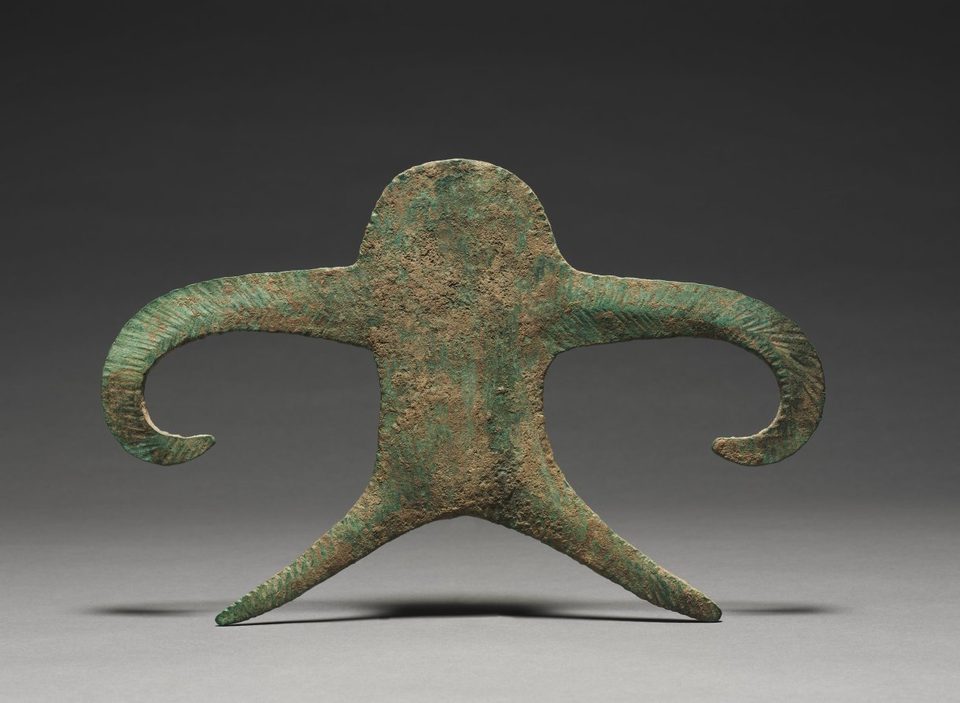
    Bronze Age India makes flat copper figures now called anthropomorphs. What they meant is still a mystery.3

  4. 1594

    First recorded use of “copper” as a color name in English.4

  5. 1886

    The Statue of Liberty is finished in copper, brown like a penny. It takes about thirty years to turn fully green.5

  6. 1914

    As Russia enters the First World War, the Fabergé firm makes munitions from brass and copper, and copper soup pots that are sent to the front filled with provisions.6

  7. 1930

    Maerz and Paul’s A Dictionary of Color prints a copper sample, the one Wikipedia matches to #B87333.4

  8. 1955

    The ISCC-NBS dictionary files Maerz and Paul’s copper as a grayish reddish orange.7

Sources (7)
  1. Royal Society of Chemistry, “Copper”, Periodic Table.
  2. Royal Society of Chemistry, “Tin”, Periodic Table.
  3. Cleveland Museum of Art, “Anthropomorph, c. 1500–1000 BCE” (2004.31).
  4. Wikipedia, “Copper (color)”, citing Maerz and Paul, A Dictionary of Color (1930), p. 193 and plate 4.
  5. National Park Service, “Frequently Asked Questions”, Statue of Liberty National Monument.
  6. Cleveland Museum of Art, “Covered Pot, 1914”, Firm of Peter Carl Fabergé (1966.511).
  7. Jaffer, A. “Maerz and Paul color names”, with ISCC-NBS centroids from “Color-Name Dictionaries”, MIT CSAIL.

Copper in use

A small polished copper pot with a domed lid and curved brass handles, on a gray background
#9F694B#845A43#654130#381F14
MetalworkCovered Pot by the Fabergé firm (1914)

A small copper soup pot with brass handles, made in St. Petersburg in the first year of the First World War and sent to the front filled with provisions. The polished copper reads about #9F694B in the photo: darker than the web code, with a pale glint where the light hits the lid.

#9F694B#845A43#654130#381F14
Source: Cleveland Museum of Art
An ancient flat copper figure shaped like a person with arms curling down and two pointed legs, its surface mottled brown and green
#7A7256#68654A#585740#45422E
ArchaeologyAnthropomorph, Bronze Age India (about 1500–1000 BCE)

A flat copper figure with curled arms, from the plains of the Ganges and Yamuna rivers. What it was for is still a mystery. Three thousand years on, its surface is brown and olive, flecked with green, nothing like the orange of new copper.

#7A7256#68654A#585740#45422E
Source: Cleveland Museum of Art

Palettes are sampled in-house.

Questions

What color is copper?

A warm, reddish orange-brown. The code used here is #B87333 (RGB 184, 115, 51).

Why is copper reddish when most metals look silver?

Most metals reflect all colors of light about equally. Copper reflects less blue and green light and more red and yellow, so freshly cut copper looks pinkish orange.

Why does copper turn green?

Outdoors, copper slowly reacts with air and water. It darkens to brown first, then grows a blue-green patina. The Statue of Liberty took about thirty years to turn fully green.

What is the difference between copper and bronze?

Copper (#B87333) is darker and a little duller. Bronze (#CD7F32) is lighter and brighter. The metal bronze is mostly copper with some tin added.

What colors go with copper?

Teal or verdigris green for contrast, navy or charcoal for a modern look, and cream or sage for a warm, earthy room.

How do I make copper look metallic on a screen?

Use a gradient instead of one flat color: a pale peach such as #D4AB85 for the highlight, #B87333 in the middle, and a deep brown such as #6E451F in the shadows.