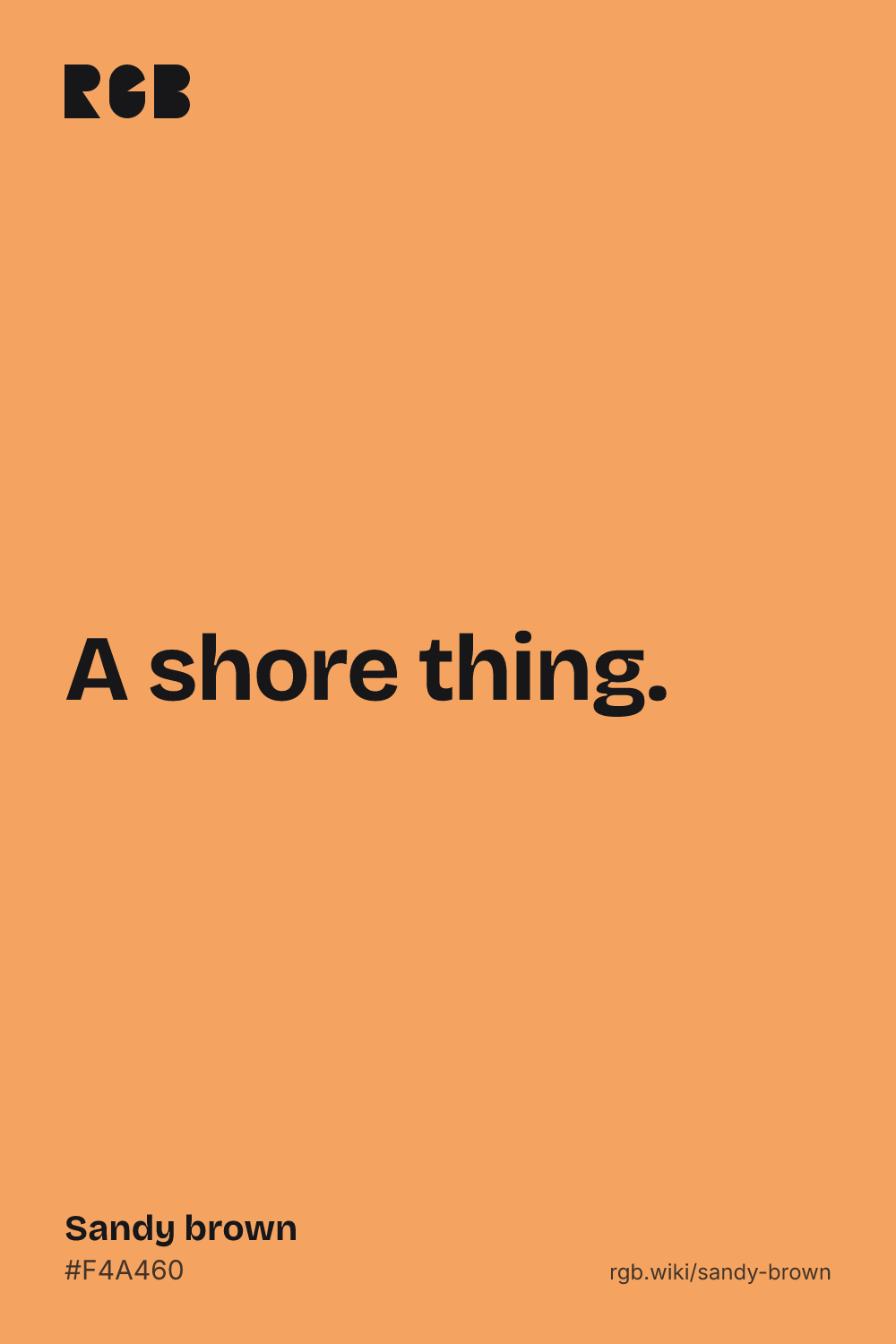
Sandy brown is a light, warm orange brown, like a dune in late afternoon sun or the crust of a fresh loaf. Its code is #F4A460: red almost at full strength, green about two thirds as strong and blue low. Its hue, 28°, is really orange, and it is light and bright for a brown. Its nearest neighbor is fawn, #E5AA70, which is a touch duller; light salmon, #FFA07A, is pinker.
The name is the CSS keyword sandybrown. It was not in the X Window System’s first color list of 1986, nor in X11’s first release in 1987: it arrived in X11 Release 3 in October 1988, together with plain brown. In 1989 John Thomas at Tektronix retuned the list to a box of crayons and made sandy brown a duller #B28F56, but Paul Raveling kept the 1988 value in his revision, which became the X11 standard and then, in 2001, the web’s. No note says who chose the name or why.
The name promises more sand than the color delivers. Merriam-Webster defines sand as a color as “a yellowish-gray color”, and Maerz and Paul’s 1930 A Dictionary of Color has no sandy brown at all. When people named colors in the 2010 xkcd survey, their average sandy brown was #C4A661, an olive tan far less orange than the code. Most sand is pale quartz; orange sands, such as the dunes of the Namib, get their color from iron. See sand for the grayer colors the word usually means.
On screens, sandy brown needs dark text: black on it has a contrast of about 10.3:1, white only about 2.0:1, too low even for large headings. It pairs well with navy, sea teal, cream, deep brown and dusty purple.