Burly wood

A light sandy brown named after knotty tree burls, which come in far more colors than this one.

Overview

Burly wood is a light, warm sandy brown, like freshly sanded pale wood or a new cardboard box. Its code is #DEB887: red at about 87%, green at 72% and blue at 53%, which gives a soft brown with a hue of 34°, between orange and yellow. It is light enough to read as a neutral rather than a strong color.

The name is the CSS keyword burlywood. It is not in the X Window System’s first color list of 1986. Paul Raveling added it in his 1989 revision, as 222 184 135, between peru and wheat, with four numbered steps from a bright burlywood1, #FFD39B, to a dark burlywood4, #8B7355. It sits in his section of spectrum colors, not among the light colors he copied from a paint maker’s samples, and his notes don’t explain the name. The web adopted the list in 2001.

A burl is a rounded outgrowth on a tree trunk or branch, packed with small knots from dormant buds, and prized for its swirling figured wood. The word first meant a knot or lump in thread or cloth. Real burl wood has no single color: maple is nearly white to cream, walnut pale to dark chocolate brown, redwood pinkish to reddish brown. Burly wood matches the pale end, without the knotty figure. Maerz and Paul’s 1930 A Dictionary of Color has a burlwood too, filed by the later ISCC-NBS dictionary as a grayer, darker light grayish brown, around #AE9B82 to #958070.

Its closest look-alike is tan, #D2B48C, on the same hue and only a shade grayer. Wheat is paler and peru deeper and more orange. On screens, burly wood needs dark text: black on it has a contrast of about 11.3:1, white only about 1.9:1. It pairs well with navy, forest green, deep brown and cream.
HEX#DEB887
RGBrgb(222, 184, 135)
HSLhsl(34, 57%, 70%)
HSV34°, 39%, 87%
CMYK0, 17, 39, 13
OKLCHoklch(80.5% 0.078 73.4)
Every code converts from the HEX value #DEB887. #DEB887 is the CSS keyword burlywood, rgb(222, 184, 135), defined in the CSS Color Module Level 4 and first listed among the web’s color names in SVG 1.0 (2001). It comes from Paul Raveling’s 1989 revision of the X Window System’s color list (raveling.txt, 222 184 135), merged into X11 Release 4. No color dictionary defines this exact value: the ISCC-NBS dictionary files Maerz and Paul’s 1930 burlwood as a grayer light grayish brown. CMYK is a screen-based estimate; print results vary.
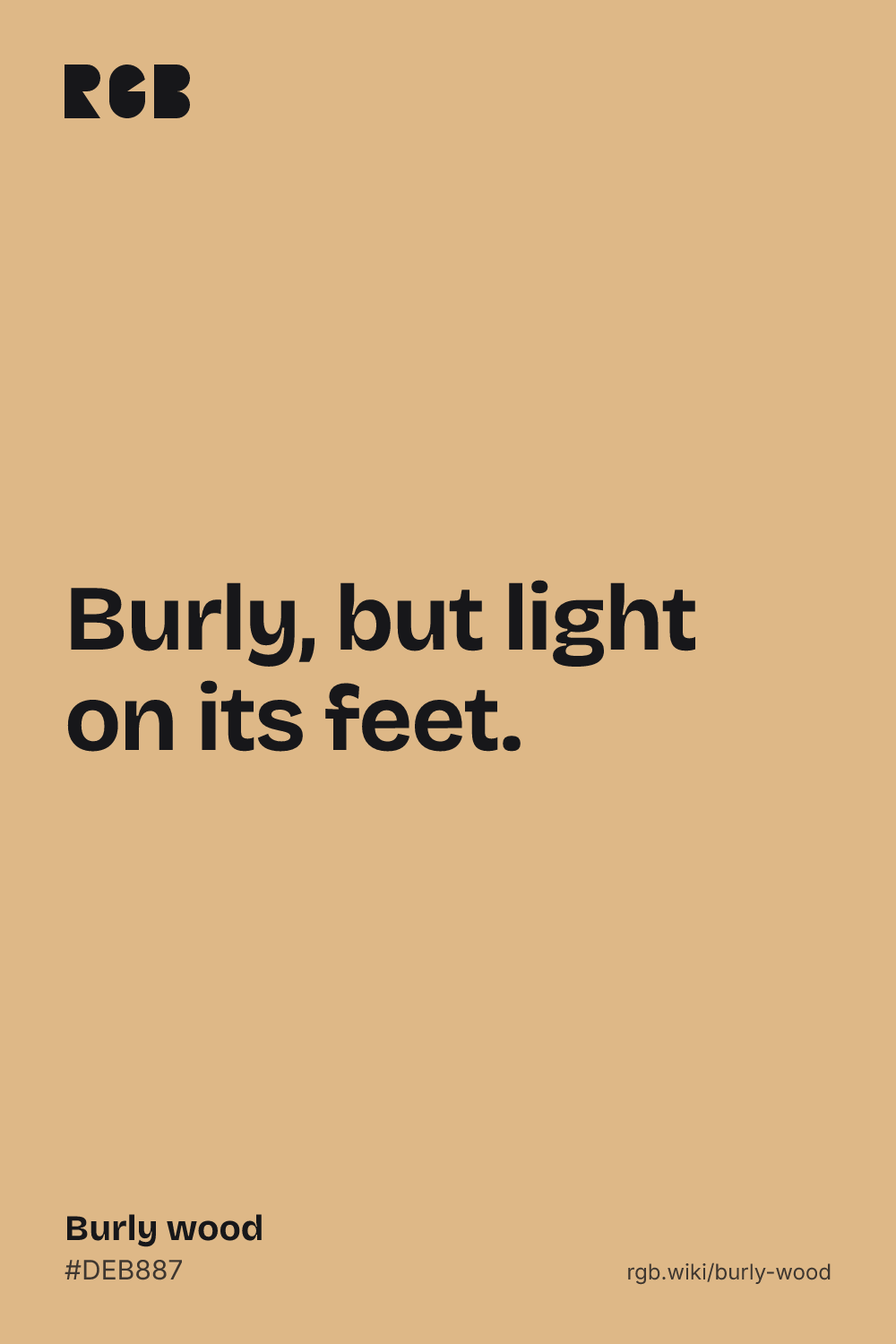
Burly wood color card, hex #DEB887: “Burly, but light on its feet”

Burly wood on the color map

No survey measures burly wood itself, and the xkcd color survey has no entry for it. Both dots for the 1930 burlwood sit below the code, darker and much grayer. The yellowish brown dot is on the same hue; the light grayish brown dot is a little redder and lies near the bottom of the outline. The outline is an approximate range, not a measured one.

Shades and tints

Tints with white

Shades with black

Tones with gray

Burly wood sits in the middle. Tints add white, shades add black and tones add gray, in 10% steps out from it. Tap any swatch to copy its code.

Light and dark burly wood

#EBD4B7
Light burly woodMixed 40% with white: a pale oatmeal.
#FFD39B
Burlywood1The brightest of the four numbered steps in the 1989 X11 list, 255 211 155.
#DEB887
Burly woodThe reference color, the CSS keyword burlywood.
#D2B48C
TanThe CSS keyword tan, set in the same 1989 X11 release: same hue, a shade grayer. See tan
#B2936C
Deep burly woodMixed 20% with black.
#8B7355
Burlywood4The darkest numbered step in the X11 list, 139 115 85: a grayish walnut brown.

Colors that go with burly wood

Pairings that work in rooms, outfits and interfaces.

Burly wood and navy

Warm against cool. Navy text and buttons stay crisp next to the sandy brown.

Woodshop

Burly wood with its own darker steps and a deep brown, like boards of one tree from sapwood to heart.

Burly wood and forest

Wood and leaves. Deep green calms the warm brown for an outdoorsy look.

Burly wood and lake

Fresh and Nordic. A misty blue-gray background with deep teal and a pale wood accent.

Raveling’s browns

Burly wood with wheat, sandy brown and saddle brown, three neighbors from the same 1989 X11 list.

Burly wood on espresso

A dark theme where burly wood glows like lamplit oak. Good for headings and buttons.

Color-wheel palettes

Pick a palette to see where its colors sit on the color wheel. The caret marks burly wood. Tap a band to copy its code.

Similar colors

Nude87%Fawn82%Burly woodTan88%Khaki75%Putty81%Ecru76%

Lined up by hue around burly wood. Hover a color to see how similar it is.The bar under each name shows how similar it is. Similarity comes from the distance between the two colors in OKLab, a model of how we see color.

Burly wood vs tan

Burly wood#DEB887 · hue 34°
  • A little lighter and warmer
  • Added to the X11 list in 1989
  • Named after tree burls
Tan#D2B48C · hue 34°
  • A shade grayer and darker
  • In the X lists since 1986, reset in 1989
  • Named after leather tanning

Meaning

  • Named for tree burls
  • CSS keyword
  • Older burlwood is grayer
  • Near twin of tan

No study has looked at what burly wood means to people. Color research tests broad words such as brown, never burly wood, so the claims below are about the name, the wood behind it and how the code came about.

Real burls vary widely

Dictionary and wood references

A burl is a tree growth whose grain has grown in a deformed way, usually a rounded knob full of small knots from dormant buds, and burl wood is sliced into veneer for furniture, trim and turned bowls. Its color depends on the tree. The Wood Database describes bigleaf maple as nearly white to cream, claro walnut as pale to dark chocolate brown and redwood heartwood as light pinkish to deep reddish brown, and shows or notes burls in all three. Burly wood matches only the pale end.1, 2, 3

No one wrote down why

Historical record

Burlywood first appears in Paul Raveling’s 1989 list, in his spectrum section rather than among the light colors he copied from paint samples, and his notes say nothing about the name. Wiktionary marks its etymology as unknown. Burly usually means strongly and heavily built, but Wiktionary also records a rare sense, “full of burls; knotty”, which would fit. That reading is a guess, not a record.4, 5, 6, 7

The 1930 burlwood is grayer

Color dictionary

Maerz and Paul’s 1930 A Dictionary of Color lists burlwood, spelled without the y. The 1955 ISCC-NBS dictionary files that sample as light grayish yellowish brown or light grayish brown, centered around #AE9B82 and #958070: darker and much grayer than the web code. No record shows Raveling used the book.8

Tan became its twin in 1989

Historical record

Raveling’s draft gave tan an orange 225 146 70. The merged list shipped with X11 Release 4 in December 1989 kept his burlywood but set tan to 210 180 140 instead. That put the two on the same hue, 34°, with a contrast between them of only about 1.06:1, too close for most people to tell apart side by side.4

No survey entry, close to tan

Online survey

Randall Munroe’s 2010 color survey has no burlywood. The nearest common names are tan, averaged at #D1B26F, and fawn, at #CFAF7B; both are a little darker and more golden than the code.9

Sources (9)
  1. Merriam-Webster, “burl”, definitions, etymology and first known use.
  2. Wikipedia, “Burl”, description and uses, citing Kevin T. Smith (2012), “The biology of burls”.
  3. The Wood Database: “Bigleaf maple”, “Claro walnut” and “Coast redwood”, color and appearance.
  4. The X Window System’s color lists, hosted by Aubrey Jaffer, MIT CSAIL: the first list, old-rgb.txt, and Paul Raveling’s raveling.txt (burlywood 222 184 135, tan 225 146 70); the merged mit/rgb/rgb.txt (7 December 1989, tan 210 180 140) in the X11 Release 4 archive.
  5. Aubrey Jaffer, “Color-Name Dictionaries”, MIT CSAIL, quoting the X11 README and Paul Raveling’s notes.
  6. Wiktionary, “burlywood” (etymology requested) and “burly”, etymology 2: “full of burls or knots; knotty”.
  7. Merriam-Webster, “burly”: “strongly and heavily built”.
  8. Kelly, K. L. & Judd, D. B. (1955). The ISCC-NBS Method of Designating Colors and a Dictionary of Color Names, NBS Circular 553, tabulated in Jaffer’s “Maerz and Paul color names” (burlwood: groups 60 and 79).
  9. Randall Munroe (2010), “Color Survey Results”, and the survey’s 954 most common color names (tan #d1b26f, fawn #cfaf7b), CC0.

History

The burl is an old word; burlywood is a young one. The story runs from a knot in cloth to a 1930 color book, a 1989 computer list where tan was quietly moved next door, and the web standards.

  1. 15th century

    First known use of burl in English, for a knot or lump in thread or cloth, from an Anglo-French word for a tuft of wool. Merriam-Webster also defines it as a hard woody outgrowth on a tree and as veneer made from burls.1

  2. 1930

    Maerz and Paul’s A Dictionary of Color includes burlwood. The 1955 ISCC-NBS dictionary files it as a light grayish brown, around #958070 to #AE9B82.2

  3. 1986

    The X Window System’s first color list, shipped with X10 Release 3, has tan and wheat but no burlywood. The list stays nearly the same through X11 Release 3 in 1988.3

  4. 1989

    Paul Raveling, at USC’s Information Sciences Institute, retunes the list on his HP monitor and adds burlywood at 222 184 135, with burlywood1 to burlywood4.3, 4

  5. December 1989

    The merged list for X11 Release 4, dated December 7, keeps Raveling’s burlywood but sets tan to 210 180 140 instead of his orange 225 146 70, making the two near twins.3

  6. 2001

    SVG 1.0 lists “burlywood”, rgb(222, 184, 135), among the web’s color keywords.5

  7. 2011

    CSS Color Module Level 3 becomes a W3C Recommendation on June 7 and makes burlywood, #deb887, an official CSS keyword. Level 4 keeps it.6, 7

Sources (7)
  1. Merriam-Webster, “burl”, definitions, etymology and first known use.
  2. Kelly, K. L. & Judd, D. B. (1955). The ISCC-NBS Method of Designating Colors and a Dictionary of Color Names, NBS Circular 553, tabulated in Jaffer’s “Maerz and Paul color names” (burlwood: groups 60 and 79).
  3. The X Window System’s color lists, hosted by Aubrey Jaffer, MIT CSAIL: old-rgb.txt and raveling.txt; the 1986 list in the X10 Release 3 archive (with X11R1 and X11R3); and the merged mit/rgb/rgb.txt (7 December 1989) in the X11 Release 4 archive.
  4. Aubrey Jaffer, “Color-Name Dictionaries”, MIT CSAIL, quoting Paul Raveling’s notes; Wikipedia, “X Window System”, release history.
  5. W3C (2001). Scalable Vector Graphics (SVG) 1.0, recognized color keyword names.
  6. W3C (2011). CSS Color Module Level 3, extended color keywords, W3C Recommendation, June 7, 2011.
  7. W3C, CSS Color Module Level 4, named colors: burlywood, #deb887, 222 184 135.

Questions

What color is burly wood?

A light, warm sandy brown. Its code is #DEB887 (RGB 222, 184, 135), the CSS keyword burlywood. It looks like freshly sanded pale wood.

Why is it called burlywood?

Nobody recorded why. Paul Raveling added burlywood to the X Window System’s color list in 1989, and his notes don’t explain the name. It most likely refers to burls, the knotty growths on trees prized for figured wood, but that is a reading of the word, not a documented fact.

Is burlywood the color of real burl wood?

Only of some. Burl wood takes the color of its tree: maple burl is pale cream, walnut burl light to dark chocolate brown, redwood burl pinkish to reddish brown. Burlywood matches the pale end, without the swirling knots that make burls prized.

Is burlywood a CSS color?

Yes. burlywood is one of the CSS named colors. burlywood, #DEB887 and rgb(222, 184, 135) all give exactly the same color.

What is the difference between burlywood and tan?

Very little. Both have a hue of 34°. Burlywood (#DEB887) is a little lighter and warmer; tan (#D2B48C) is a shade grayer. They became near twins in 1989, when the X11 Release 4 list set tan right next to the new burlywood.

Is burlywood the same as wheat?

No. Wheat (#F5DEB3) is much paler, close to a cream. Burlywood is a deeper, browner neighbor; the two sit next to each other in the 1989 X11 list.

What text color works on burlywood?

Dark text. Black on burlywood has a contrast of about 11.3:1, while white manages only about 1.9:1, too low even for large headings.

What colors go with burlywood?

Navy and deep teal for contrast, forest green for a natural look, dark espresso brown for a warm dark theme, and neighbors such as wheat, sandy brown and saddle brown for a tonal palette.