Mocha

A soft, milky brown named after the Red Sea port that shipped the world’s coffee.

Overview

Mocha is a soft, medium brown with a milky, slightly rosy cast. The code most color lists use, #A38068, has red at about 64%, green at 50% and blue at 41%, so it reads as a warm, muted brown, like coffee with milk.

The name comes from Mocha, a port on the Red Sea coast of Yemen. From the 1500s to the 1700s it shipped much of the world’s coffee, and its name stuck to the beans, then to a drink of coffee and chocolate, a glove leather and a stone.

The color has grown lighter along the way. Merriam-Webster defines mocha as a dark chocolate brown, and the 1955 ISCC-NBS dictionary files the mocha of Maerz and Paul’s A Dictionary of Color (1930) as a dark olive brown. Today’s code is the color of the café drink instead: almost the same as café au lait, and close to people’s average mocha in the xkcd survey.

Mocha is a cozy, grown-up neutral. It suits interiors, knitwear and food brands, and pairs well with cream, blush, sage and chocolate brown. Dark text reads best on it; white text works only at large sizes.
HEX#A38068
RGBrgb(163, 128, 104)
HSLhsl(24, 24%, 52%)
HSV24°, 36%, 64%
CMYK0, 21, 36, 36
OKLCHoklch(62.7% 0.056 55.9)
Every code converts from the HEX value #A38068. No color standard defines mocha. #A38068 is the code most color lists use. It sits very close to the ISCC-NBS light brown, about #A67B5B, which Wikipedia gives as café au lait, while the 1955 ISCC-NBS dictionary files the mocha of Maerz and Paul’s A Dictionary of Color (1930) as a dark olive brown, about #3B3121. CMYK is a screen-based estimate; print results vary.
Mocha color card, hex #A38068: “Mocha ado about nothing”

Mocha on the color map

Café au lait sits almost on top of the reference value. People’s average mocha in the xkcd survey is a little darker and more golden, inside the outline to the right. Maerz and Paul’s mocha bisque, a moderate brown, sits straight below the outline. Their plain mocha, a dark olive brown (#3B3121), and the mocha agate of the snuff box below are too dark to fit in this view. The outline is an approximate range, not a measured one.

Shades and tints

Tints with white

Shades with black

Tones with gray

Mocha sits in the middle. Tints add white, shades add black and tones add gray, in 10% steps out from it. Tap any swatch to copy its code.

Light and dark mocha

#E3D9D2
Pale mochaMixed 70% with white. A warm, milky off-white.
#C8B3A4
Light mochaMixed 40% with white. A soft, rosy beige.
#A38068
MochaThe reference color.
#6F4E37
CoffeeThe ISCC-NBS moderate brown, the web’s coffee and Maerz and Paul’s mocha bisque. See coffee
#624D3E
Dark mochaMixed 40% with black. A deep, soft brown for text and borders.
#3B3121
Dictionary mochaThe ISCC-NBS dark olive brown, where the 1955 dictionary files Maerz and Paul’s mocha. Much darker, in line with Merriam-Webster’s definition of mocha as a dark chocolate brown.

Colors that go with mocha

Pairings that work in rooms, outfits and interfaces.

Mocha and cream

Coffee and milk. Warm, soft and easy to live with.

Mocha and blush

Gentle and romantic. The pink brings out mocha’s rosy side.

Mocha and sage

Earthy and calm. Good for living rooms and bedrooms.

Mocha and chocolate

Light and dark brown together, like a layered dessert.

Mocha and navy

A soft brown against deep blue. Smart and relaxed.

Café

Coffee shades from espresso to foam.

Color-wheel palettes

Pick a palette to see where its colors sit on the color wheel. The caret marks mocha. Tap a band to copy its code.

Similar colors

Rose gold66%Dusty rose69%Clay71%MochaCopper69%Mink75%Stone77%

Lined up by hue around mocha. Hover a color to see how similar it is.The bar under each name shows how similar it is. Similarity comes from the distance between the two colors in OKLab, a model of how we see color.

Mocha vs taupe

Mocha#A38068 · hue 24°
  • A medium, milky brown
  • Named after a coffee port
  • Warmer, with a rosy cast
Taupe#483C32 · hue 27°
  • A dark brown-gray
  • Named after the mole
  • Often used for lighter grayish browns too

Meaning

  • Red Sea port
  • Coffee
  • Café drinks
  • Mocha stone

Mocha suggests coffeehouses, chocolate and warm, milky drinks. Its meanings come from a place: the Red Sea port of Mocha in Yemen, which lent its name to a coffee, a drink, a leather and a stone before it named a color. Color research tests broad words like brown, not mocha, so the claims here are about the port and the word.

The port that named a coffee

Historical record

After the Ottomans occupied Yemen in the late 1530s, they turned Mocha from a fishing village into a coffee port. The coffee did not grow in the town: it came from the Yemeni highlands and from Ethiopia. In the 1600s the English and Dutch East India companies set up there and labeled all the beans they shipped from the port as Mocha coffee. By the 1720s coffee was grown in Java and the Caribbean, and Mocha’s trade began to fade.1, 2

One word, many things

Dictionary

Merriam-Webster lists mocha as Yemeni coffee beans, in English since 1773; as a flavoring of coffee or of coffee and chocolate; as a soft, suede-finished glove leather made from African sheepskins; and as a dark chocolate-brown color.3

Mocha stone and mocha ware

Historical record

Moss agate, a stone with dark, branching markings, was known in Britain as mocha stone because it arrived through the port. From the late 1700s, potters copied its tree-like markings on cheap slip-decorated earthenware known as mocha ware. The earliest dated piece is a mug from 1799.4, 5

Sources (5)
  1. The New York Times, “Why Mokha, historic port that shaped the coffee trade, is a prize in Yemen’s war”, republished by Oman Observer (13 September 2026), quoting the historian Nancy Um.
  2. Wikipedia, “Mokha”, history, citing Um, N., “Mocha: Maritime Architecture on Yemen’s Red Sea Coast” (2017) and Macro, E., “The Topography of Mocha” (1980).
  3. Merriam-Webster, “mocha”, definitions, etymology and first known use.
  4. Wikipedia, “Mocha decorated pottery”, citing Rickard, J., Mocha and Related Dipped Wares, 1770–1939 (2006).
  5. Wikipedia, “Moss agate”.

History

Mocha was a port, then a coffee, then a drink, a leather and a stone. The color name came last, and it has drifted from the dark bean to the milky cup.

  1. Late 1530s

    The Ottoman Turks occupy Yemen and develop Mocha, then a small fishing village, into a port near the Bab el-Mandeb Strait.1, 2

  2. 1600s

    The English and Dutch East India companies open trading posts at Mocha and sell the coffee they ship from it as Mocha coffee.1

  3. 1720s

    Coffee now grows in Java and the Caribbean, and Mocha’s central role in the trade begins to fade.1

  4. 1773

    First known use of mocha in English, for coffee from Yemen.3

  5. 1799

    The earliest dated piece of mocha ware, a mug now at Christchurch Mansion in Ipswich, England, copies the branching markings of mocha stone.4

  6. About 1840

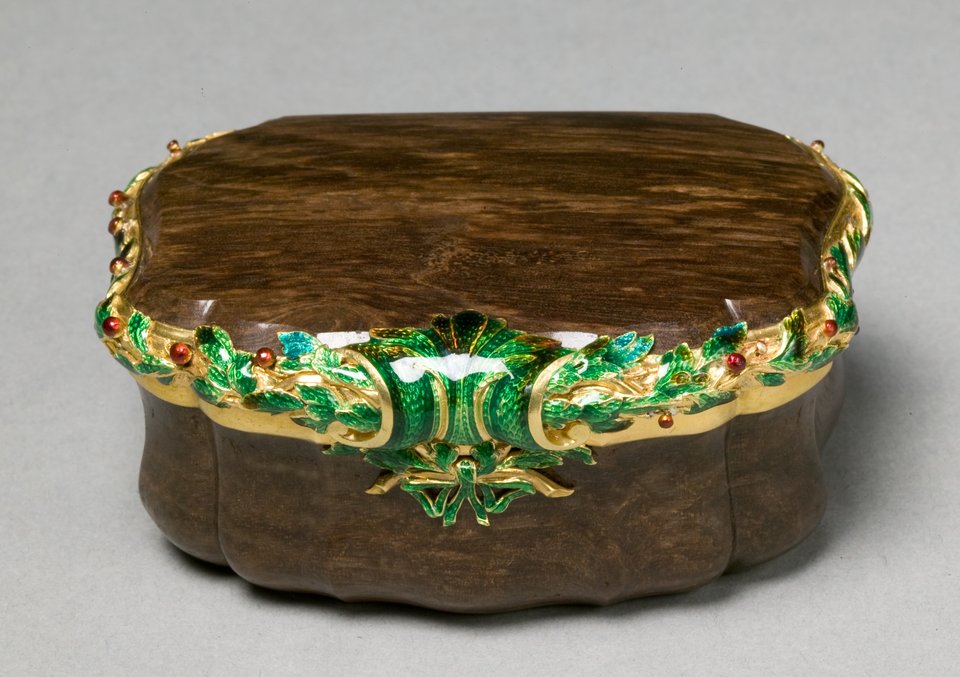
    In Germany, a small snuff box cut from mocha agate is mounted in gold.5

  7. 1955

    The ISCC-NBS dictionary files Maerz and Paul’s mocha (1930) as a dark olive brown, and their mocha bisque as a moderate brown.6, 7

Sources (7)
  1. The New York Times, “Why Mokha, historic port that shaped the coffee trade, is a prize in Yemen’s war”, republished by Oman Observer (13 September 2026).
  2. Wikipedia, “Mokha”, history.
  3. Merriam-Webster, “mocha”, etymology and first known use.
  4. Wikipedia, “Mocha decorated pottery”.
  5. Cleveland Museum of Art, “Snuff Box”, Germany, about 1840, mocha agate with 18-karat gold mounts (2009.43).
  6. Kelly, K. L. & Judd, D. B. (1955). The ISCC-NBS Method of Designating Colors and a Dictionary of Color Names. NBS Circular 553. Entries “Mocha (same as Bark)” and “Mocha Bisque”.
  7. Jaffer, A. “Maerz and Paul color names”, with ISCC-NBS centroids from “Color-Name Dictionaries”, MIT CSAIL.

Mocha in use

A small rounded box of streaky dark brown stone with a gold rim decorated with green leaves and small red beads
#704E27#492F10#392307#433625
Decorative artSnuff box of mocha agate, Germany (about 1840)

A small box cut from mocha agate, the stone named after the port, in gold mounts decorated with green leaves. The stone reads about #492F10 on the lid and #433625 on the sides: a dark olive brown much like the dictionary’s mocha, far darker than a mocha drink.

#704E27#492F10#392307#433625
Source: Cleveland Museum of Art

Palettes are sampled in-house.

Questions

What color is mocha?

A soft, medium brown with a milky cast, like coffee with milk. The code most color lists use is #A38068 (RGB 163, 128, 104).

Why is it called mocha?

After Mocha, a port in Yemen that shipped much of the world’s coffee from the 1500s to the 1700s. The name passed to the beans, then to a drink of coffee and chocolate, and then to the color.

Is mocha a dark or a light brown?

It depends on the source. Dictionaries describe mocha as a dark chocolate brown, but the code most sites use is a medium, milky brown, like a café mocha.

What is the difference between mocha and taupe?

Mocha (#A38068) is a warm, milky brown. Taupe in its dictionary form (#483C32) is a much darker brown-gray, though paint and fashion often use taupe for lighter grayish browns.

What is the difference between mocha and camel?

Camel (#C19A6B) is lighter and more golden. Mocha (#A38068) is darker, grayer and a little rosier.

What colors go with mocha?

Cream and blush for a soft look, sage or olive for an earthy one, and chocolate brown or navy for depth.

Is mocha warm or cool?

Warm. Its red is stronger than its green and blue, but the gray in it keeps it soft.