Spotted to hide
Well establishedWhite-tailed deer fawns are born reddish brown with white spots, a coat that helps them blend into their surroundings. They lose the spots at three to four months of age, when they grow their first winter coat.1, 2
A light, warm brown named after the young deer, and a coat color in dogs.
Fawn is a light, warm brown with an orange glow. The code most color lists use, #E5AA70, has red near full strength, green at two thirds and blue under half. That makes it the lightest and brightest of the mid browns, close to the CSS color sandy brown.
The name comes from the young deer. White-tailed deer fawns are reddish brown with white spots, and fawn has been a color name in English since 1789. Dog breeders use the word too: Boxers, Pugs, Great Danes and French Bulldogs all come in fawn.
Dictionaries describe a much quieter color. Merriam-Webster defines fawn as a light grayish brown, and the 1955 ISCC-NBS dictionary spreads the fawn of Maerz and Paul’s A Dictionary of Color (1930) across four grayish and moderate browns. The web code is brighter and more orange than any of them, and people’s average fawn in the xkcd survey is duller and more yellow. Breed standards stretch the word further, from light tan to mahogany.
Fawn is a soft, sunny neutral. It needs dark text, and it pairs well with chocolate brown, cream, sage and dusty blue.
| HEX | #E5AA70 | |
|---|---|---|
| RGB | rgb(229, 170, 112) | |
| HSL | hsl(30, 69%, 67%) | |
| HSV | 30°, 51%, 90% | |
| CMYK | 0, 26, 51, 10 | |
| OKLCH | oklch(78.1% 0.102 64.9) |
People’s average fawn in the xkcd survey is a little darker and more yellow, inside the outline to the right. Sandy brown, the nearest CSS keyword, sits just to the left at the same lightness, a little brighter. The dictionary’s light grayish brown and the painted fawns are much darker, below the outline: the painted coat a little to the right, the dictionary color a little to the left and far grayer. The outline is an approximate range, not a measured one.
Tints with white
Shades with black
Tones with gray
Pairings that work in rooms, outfits and interfaces.
Light and dark brown together. Warm, cozy and natural.
A meadow in early summer. Soft and calm.
Warm and cool in balance. Good for nurseries and weddings.
Gentle and sunny, with a deeper brown for text.
Fawn against deep forest green, like a deer at the edge of the trees.
A dark theme where fawn glows as the accent.
Pick a palette to see where its colors sit on the color wheel. The caret marks fawn. Tap a band to copy its code.
Lined up by hue around fawn. Hover a color to see how similar it is.The bar under each name shows how similar it is. Similarity comes from the distance between the two colors in OKLab, a model of how we see color.
Fawn suggests softness, youth and gentleness: a newborn deer lying still in the grass. As a color word it also has a long, practical life in dog breeding, where it names one of the most common coat colors. Color research tests broad words like brown and orange, not fawn, so the claims here are about deer, dogs and the word itself.
White-tailed deer fawns are born reddish brown with white spots, a coat that helps them blend into their surroundings. They lose the spots at three to four months of age, when they grow their first winter coat.1, 2
In dogs, a yellow-tan coat with some dark hairs, called fawn or sable, is linked to one version of the agouti gene. A 2005 study across 37 breeds found it in 41 fawn or sable dogs from 22 breeds, and in none of 16 black-and-tan or tricolor dogs.3
Breed standards use fawn loosely. The American Kennel Club’s Boxer standard says fawn shades vary from light tan to mahogany. Its Great Dane standard asks for yellow gold, and its French Bulldog standard runs from light fawn to red fawn.4, 5, 6
The noun fawn comes from an Anglo-French word for the young of an animal, which goes back to the Latin fetus, offspring. It is unrelated to the verb to fawn, which comes from an Old English word for rejoicing. As a color name, fawn dates from 1789.7, 8
Fawn named a young deer for centuries before it named a color. Since then the word has meant a grayish brown to dictionaries, a pale buff to printers and anything from light tan to mahogany to dog breeders.
First known use of fawn in English for a young deer, from the Anglo-French word for the young of an animal.1
First recorded use of fawn as a color name in English.2
Arthur Fitzwilliam Tait paints Maternal Solicitude: a doe with two spotted fawns in the snow, one of them dying, as a raven approaches.3
Henri de Toulouse-Lautrec draws a cover for Les Courtes Joies. When it is printed in 1925, the drawing goes over a fawn tint from a second stone.4
Maerz and Paul’s A Dictionary of Color prints a fawn sample, plate 14, sample A7.2
The ISCC-NBS dictionary files Maerz and Paul’s fawn under four colors: light grayish reddish brown, moderate brown, light grayish brown and grayish brown.5, 6
Geneticists link the fawn or sable coat in dogs to one version of the agouti gene, and the American Kennel Club’s new Boxer standard describes fawn as anything from light tan to mahogany.7, 8
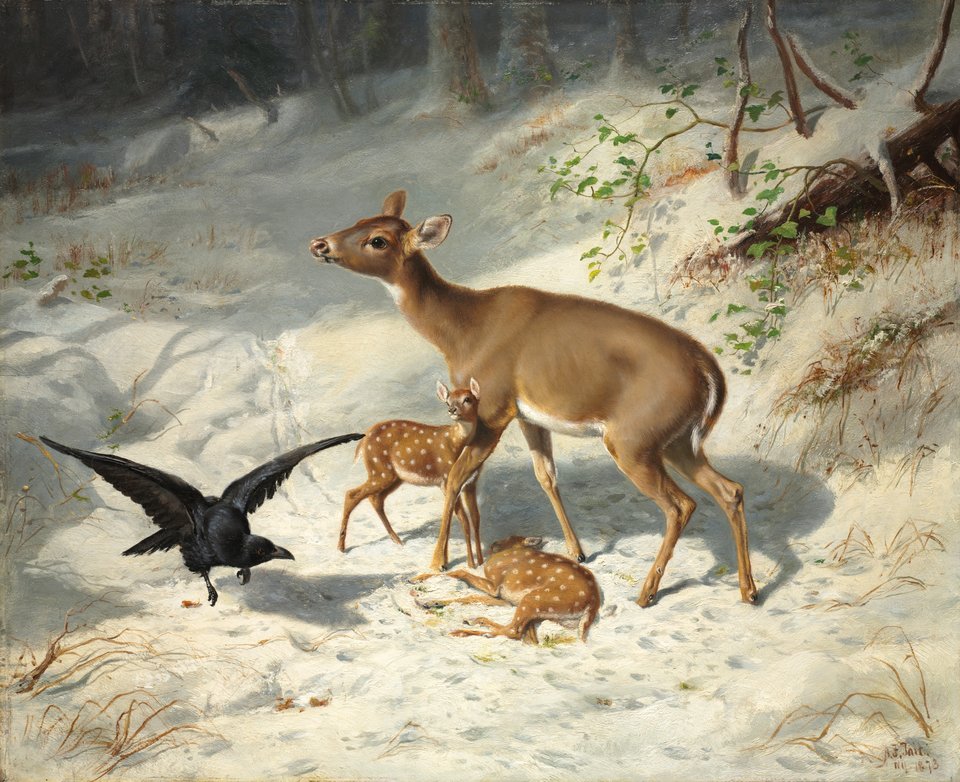
A doe stands over her two spotted fawns in the snow, one of them dying, as a raven approaches. The fawns’ coats read about #A7763F in the photo: a reddish golden brown, much darker than the web’s fawn, with cream spots near #DEC69E.
Sampled from the coat of the lying fawn in the Cleveland Museum of Art’s photograph (1915.693), released as CC0 (public domain). The museum’s description gives the subject. Colors in a photo shift with the lighting, so read the codes as close, not exact.
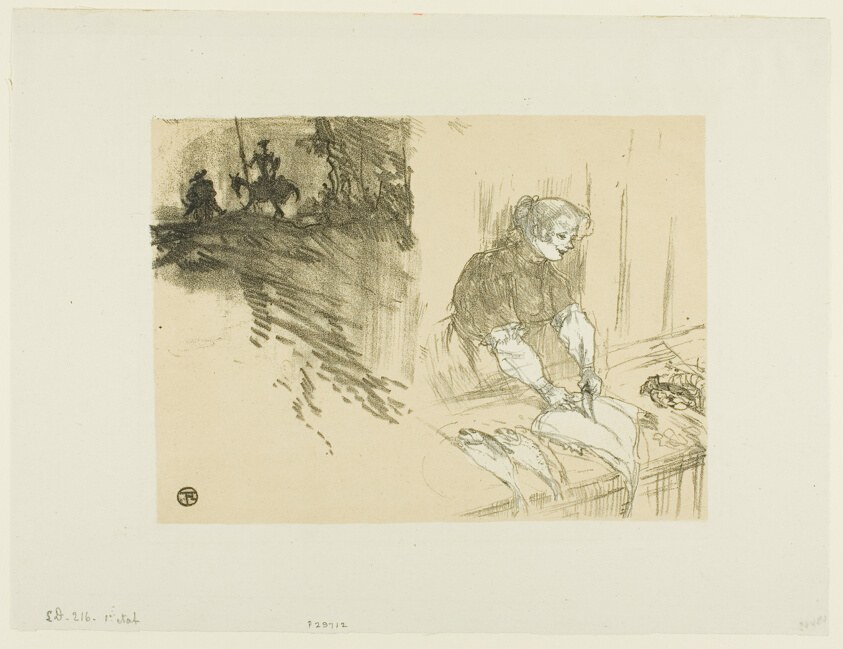
The Art Institute of Chicago catalogs this lithograph as printed “over a fawn tint from a second stone”. The tint reads about #E2D6B5 in the photo: a pale buff under the gray crayon lines, far lighter and grayer than the web code.
Sampled from the tinted image area in the Art Institute of Chicago’s photograph (1943.510), released as CC0 (public domain). The medium description, “lithograph over a fawn tint from a second stone”, is the museum’s. Colors in a photo shift with the lighting, so read the codes as close, not exact.
Palettes are sampled in-house.
A light, warm brown with an orange glow. The code most color lists use is #E5AA70 (RGB 229, 170, 112). Dictionaries describe fawn as a duller, light grayish brown.
Fawn (#E5AA70) is brighter and more orange. Tan (#D2B48C) is softer and grayer. Both are light, warm browns.
Camel (#C19A6B) is darker and more muted, the color of a camel-hair coat. Fawn (#E5AA70) is lighter and brighter.
A yellow-tan to reddish coat, often with a black mask. Breed standards vary: the AKC’s Boxer standard allows light tan to mahogany, and its Great Dane standard asks for yellow gold.
No. Beige (#F5F5DC) is much paler, close to an off-white. Fawn is a real light brown with a lot of orange in it.
Chocolate brown and cream for a warm look, sage or forest green for a woodland feel, and dusty blue or charcoal for contrast.