Lamp black

A soft, neutral black named after soot scraped from oil lamps, one of the oldest blacks in ink and paint.

Overview

Lamp black is a black pigment made from soot, the fine carbon that collects above a smoky oil flame. Its web code, #1F1F1F, is a neutral near-black: red, green and blue all at about 12 percent, with no tint at all. It sits between two other named blacks, a little lighter than eigengrau and clearly darker than jet black.

The recipe has hardly changed in two thousand years. Burn oil or resin with too little air, let the smoke settle on a cool surface, and sweep it off. Around 1400 the Italian painter Cennino Cennini held a dish over a lamp of linseed oil and noted that the soot needed no grinding, because it was already a very fine powder. Chinese inkmakers did the same on a large scale, and an encyclopedia of 1637 describes one worker tending 200 lamps at once. Mixed with glue, the soot became the ink stick; mixed with varnish, the printer’s ink.

No color standard defines #1F1F1F, but it is close to the books. The 1955 ISCC-NBS dictionary files the “lamp black” of a 1950 color dictionary under plain black, centered on #222222, almost the same. Real lampblack is seldom so flat. Laid on thin, it lets the paper glow through: in a tiny lampblack drawing from the 1880s the darkest passages photograph near #383532, a warm gray-brown. Chinese ink lore even calls oil-soot ink a warm black and pine-soot ink a bluish one.

On screens, #1F1F1F works as a soft black for dark themes and large backgrounds. White text on it has a contrast of about 16.5 to 1, a little gentler than on pure black. It pairs with the colors it has always lived beside: paper whites, cinnabar seal red, brass and old gold.
HEX#1F1F1F
RGBrgb(31, 31, 31)
HSLhsl(0, 0%, 12%)
HSV0°, 0%, 12%
CMYK0, 0, 0, 88
OKLCHoklch(23.9% 0.000 89.9)
Every code converts from the HEX value #1F1F1F. No color standard defines #1F1F1F for lamp black, and we could not trace it to a published source. The closest standard value is in the ISCC-NBS dictionary (1955), which files Taylor, Knoche and Granville’s “lamp black” (1950) under black, centered on #222222. CMYK is a screen-based estimate; print results vary.
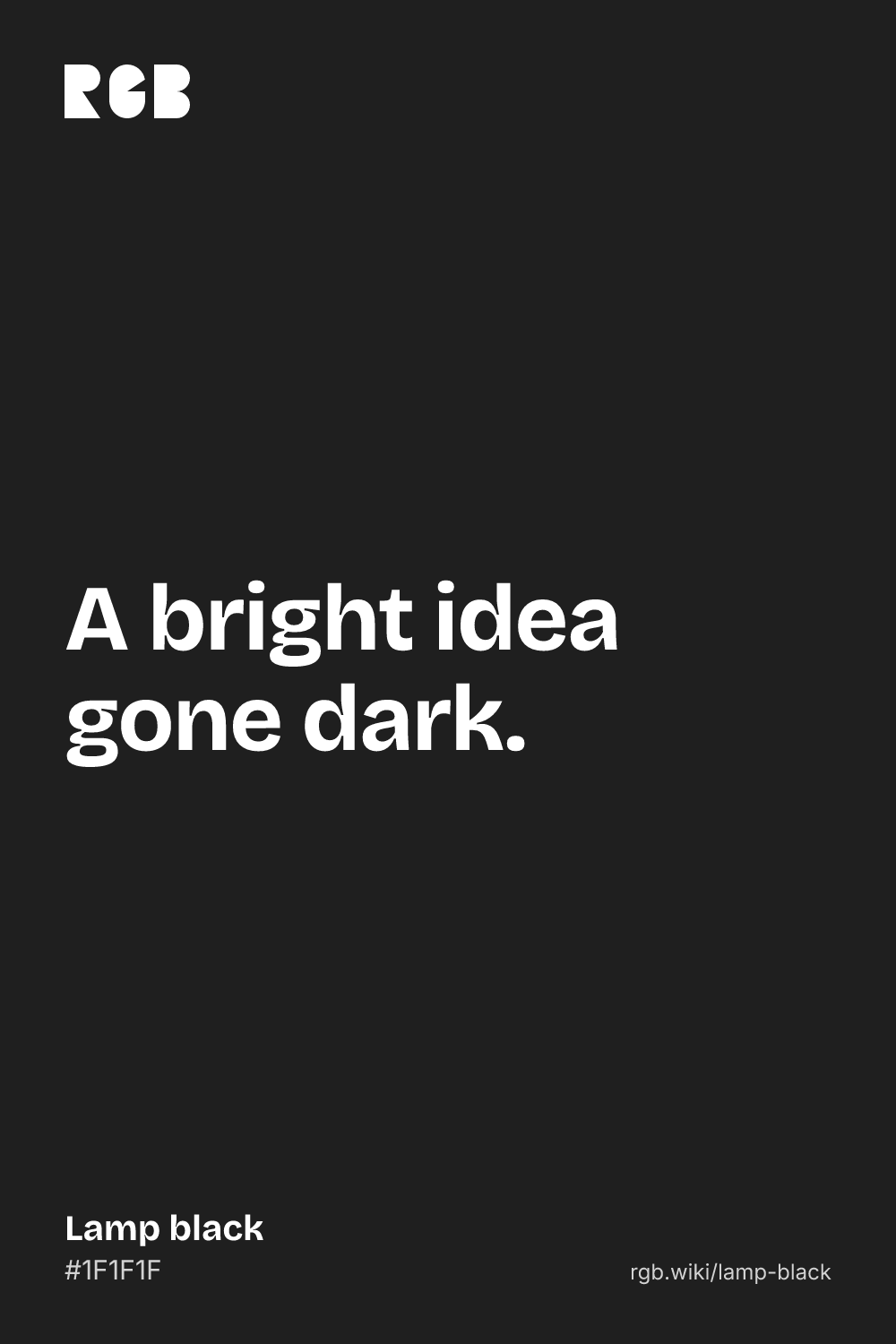
Lamp black color card, hex #1F1F1F: “A bright idea gone dark”

Lamp black on the color map

The dictionary’s black is neutral like the reference, so it sits on the center line just above the reference dot, a hair lighter. The drawing’s lampblack sits above the outline, lighter, and nudged a little toward warm brown. The outline is an approximate range, not a measured one.

Shades and tints

Tints with white

Shades with black

Tones with gray

Lamp black sits in the middle. Tints add white, shades add black and tones add gray, in 10% steps out from it. Tap any swatch to copy its code.

Light and dark lamp black

#D2D2D2
Pale lamp blackMixed 80% with white. A light silver gray.
#797979
Lamp black washMixed 40% with white. A middle gray, like a diluted ink wash.
#4C4C4C
Light lamp blackMixed 20% with white. A dark slate gray.
#343434
Jet blackThe usual code for jet black, a step lighter than lamp black. See jet black
#222222
ISCC-NBS blackWhere the 1955 color dictionary files the lamp black of Taylor, Knoche and Granville (1950).
#1F1F1F
Lamp blackThe reference color.
#131313
Deep lamp blackMixed 40% with black. Nearly pure black.

Colors that go with lamp black

Pairings that work in rooms, outfits and interfaces.

Ink and rice paper

Black ink, gray wash and a red seal on warm paper, as in East Asian calligraphy.

Printer’s ink

An early printed page: black type, red headings and cream paper. Good for long reading.

Palm leaf

Lampblack lines on golden palm leaf, with turmeric yellow and dark brown. Warm and earthy.

Lamp and brass

Black, brass and a flame of yellow. Warm and low-lit, for evening themes.

Soft dark mode

Lamp black as the page, a slightly lighter surface and one clear blue for links and buttons.

Grisaille

Black, two grays and white: the painter’s study in tones only. Calm and neutral.

Color-wheel palettes

Pick a palette to see where its colors sit on the color wheel. The caret marks lamp black. Tap a band to copy its code.

A gray has no hue, so turning it around the wheel only gives the same gray back. Monochrome is the one wheel palette that works for it.

Similar colors

Phthalo green61%Lamp blackDark green63%Obsidian68%Gunmetal60%Oxford blue59%Eigengrau81%

Lined up by hue around lamp black. Hover a color to see how similar it is.The bar under each name shows how similar it is. Similarity comes from the distance between the two colors in OKLab, a model of how we see color.

Lamp black vs jet black

Lamp black#1F1F1F · hue 0°
  • Darker: white text reaches about 16.5:1
  • Named for soot from oil lamps
  • A pigment for ink and paint since antiquity
Jet black#343434 · hue 0°
  • Lighter, a soft charcoal: about 12.4:1
  • Named for jet, a fossilized wood
  • A gem black, polished for jewelry

Meaning

  • Soot from flames
  • Ink
  • Painters’ black
  • Never fades

Lamp black means what it is: soot. For more than two thousand years it gave scribes, printers and painters a black that does not fade. The claims below rest on dictionaries, old recipes and conservation references. No study has tested how the color lamp black, or the code #1F1F1F, makes people feel; studies of color and emotion test the basic word black.

The name tells how it was made

Word history

Merriam-Webster defines lampblack as a finely powdered black soot from incomplete burning, used chiefly as a pigment in paints, enamels and printing inks, and dates the word to 1598. Painters named their other carbon blacks the same way: ivory black from charred bone or ivory, vine black from burnt vine shoots.1, 2

A black that does not fade

Reference works

Soot is almost pure carbon. Conservation references call lampblack very stable, absolutely lightfast and compatible with all other pigments. Carbon ink does not fade in sunlight or even with bleach, though it can smudge in damp air and wash off a surface.3, 4

Warm or bluish, by ink lore

Craft tradition

Chinese inkmakers sort soot by its source. Oil-soot ink, the lampblack kind, is said to give a warm black, and pine-soot ink a bluish one; a fine ink stick should be “black like lacquer.” These are craft judgments, passed on in the trade, not measurements.5

The dust, not the color, is the worry

Health classification

The International Agency for Research on Cancer rates carbon black as possibly carcinogenic to humans (Group 2B), a category for limited evidence, and its dust can irritate the airways. Carbon black from plants is approved in the European Union as food color E153 but not in the United States. A color on a screen carries none of this.2

Sources (5)
  1. Merriam-Webster, “lampblack”, definition and first known use.
  2. Wikipedia, “Carbon black”, citing Winter and FitzHugh, “Pigments Based on Carbon,” in Artists’ Pigments, vol. 4 (2007), and Kuempel and Sorahan, IARC Technical Publication No. 42 (2010).
  3. ColourLex, “Lampblack”, composition, properties and history of use.
  4. Wikipedia, “Ink”, section on carbon inks.
  5. Wikipedia, “Inkstick”, sections on production and types.

History

Lampblack has been made since prehistoric times, and many ages have written down how to make it. Its story runs from Roman soot chambers and Chinese ink workshops to the first printed books.

  1. 1st century BCE

    The Roman architect Vitruvius describes a polished chamber where smoke from burning resin settles on the walls. The soot is mixed with gum to make ink for scribes, and with size to paint walls.1

  2. 77 CE

    Pliny the Elder writes that black is made from the soot of burnt resin or pitch, in workshops built so the smoke cannot escape, and that the best comes from torch-pine. His 1855 English translators gloss it as “our lamp-black.”2

  3. Late 1000s

    Troubled by the loss of China’s pine forests, the Song official Shen Kuo looks for an ink soot other than pine and tries the soot of burning petroleum. From the Song dynasty on, lampblack from oil lamps becomes a favored soot for Chinese ink.3

  4. About 1400

    Cennino Cennini’s painter’s handbook gives the recipe: hang a clean baking dish two or three fingers above a lamp of linseed oil, sweep off the soot, and refill the lamp as often as needed.4

  5. 1450s

    Johannes Gutenberg prints with an oil-based ink made from lampblack, varnish and egg white, according to the historian Martyn Lyons.5

  6. 1598

    The word “lampblack” is first recorded in English.6

  7. 1637

    Song Yingxing’s encyclopedia Tiangong Kaiwu says a tenth of China’s ink soot comes from burning tung oil, vegetable oils or lard. One skilled worker can tend 200 lamps, and a catty of oil (about half a kilogram) yields more than an ounce of fine soot.3

  8. 1700s

    In Odisha, eastern India, artists illustrate a palm-leaf manuscript of a popular romance with gum tempera and lampblack. A leaf is now at the Cleveland Museum of Art.7

  9. 1738

    An English translation of Jean-Baptiste Du Halde’s account of China describes inkmakers setting five or six wicks in a bowl of oil under an iron funnel, then brushing the soot off with a goose feather.3

  10. About 1880–85

    The French artist Frédéric Juncker paints tiny landscapes, some under 5 cm wide, in lampblack, turpentine and wax on waxed paper. Two are now at the Metropolitan Museum of Art.8

Sources (8)
  1. Vitruvius, On Architecture, Book VII, chapter 10, translated by Joseph Gwilt (1826), LacusCurtius.
  2. Pliny the Elder, The Natural History, Book 35, chapter 25, “Atramentum”, translated by John Bostock and H. T. Riley (1855), Perseus Digital Library.
  3. Wikipedia, “India ink”, citing Needham, Science and Civilisation in China, vol. 5, part 1 (1985), Sivin (1995), and Sung, Sun and Sun’s translation of Tiangong Kaiwu.
  4. Cennino Cennini, The Book of the Art of Cennino Cennini, chapter 37, translated by Christiana J. Herringham (1899; 1922 printing), Internet Archive.
  5. Wikipedia, “Ink”, citing Lyons, Books: A Living History (2011).
  6. Merriam-Webster, “lampblack”, first known use.
  7. Cleveland Museum of Art, “A Prince Performs Austerities” (2018.175.a), collection record.
  8. Metropolitan Museum of Art, “Industrial Landscape” (2025.516) and “Landscape” (2025.517), collection records.

Lamp black in use

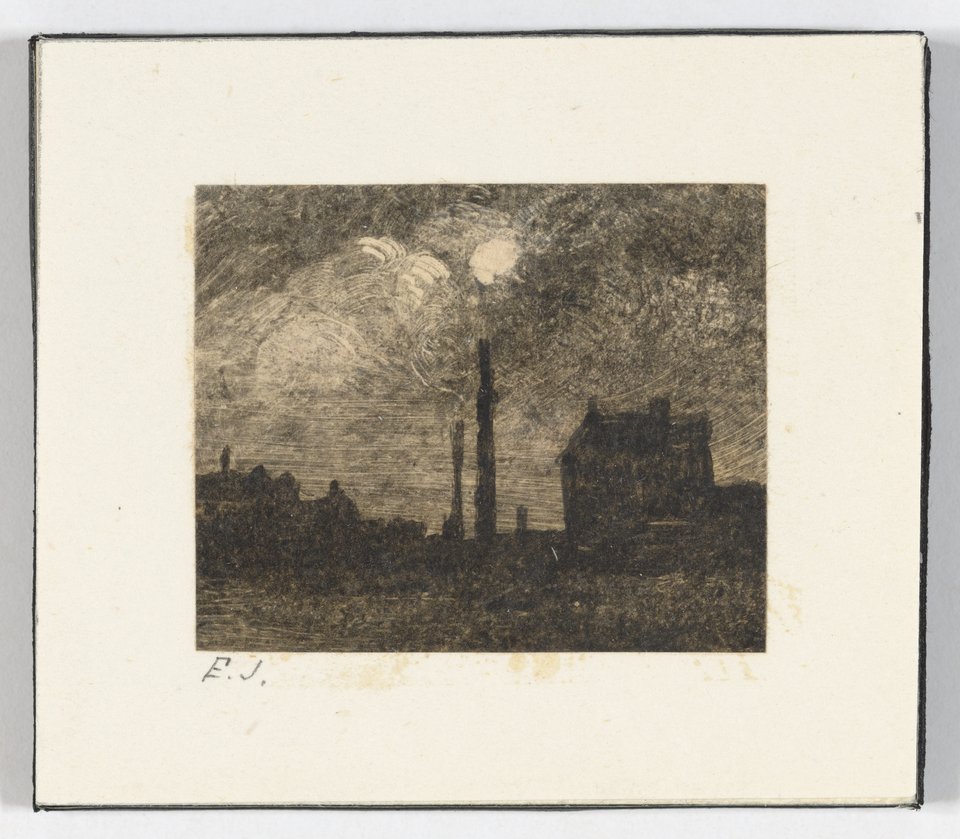
A tiny dark brown-black drawing on a cream mount: a tall factory chimney and low buildings in silhouette under a smoky sky with a pale glowing moon
#383532#45403A#7D715C#BDAC8F
DrawingFrédéric Juncker, Industrial Landscape (about 1880–85)

A smoking factory chimney under a smoky sky, painted in soot: brush and lampblack, turpentine and wax on waxed paper, wiped and scraped for the lights. The sheet is only 3.8 × 4.8 cm. Even the darkest buildings sample near #383532, a warm gray-brown, because thin lampblack lets the paper show through.

#383532#45403A#7D715C#BDAC8F
Source: The Met
A long, narrow golden-brown palm leaf painted with fine black lines and touches of yellow and red: seated figures, a shrine, flowering trees, a bird and small fires
#B18757#D3A849#513D2C#7A5B3E
ManuscriptPalm-leaf manuscript, Odisha (1700s)

A leaf from a romance by the poet Upendra Bhanja, showing a prince doing penance before a Shiva linga, among trees and fires. The museum lists gum tempera and lampblack on palm leaf. The leaf itself samples as golden brown, and the fine black lines darken it toward #513D2C.

#B18757#D3A849#513D2C#7A5B3E
Source: Cleveland Museum of Art

Palettes are sampled in-house.

Questions

What color is lamp black?

A soft, neutral near-black. The usual web code is #1F1F1F (RGB 31, 31, 31): red, green and blue all at about 12 percent. It is named after the soot pigment made from oil lamps.

What is lamp black made of?

Soot. Oil, resin or fat is burned with too little air, and the smoke settles as a fine powder of almost pure carbon on a cool surface, where it is swept off. It needs no grinding.

Is lamp black the same as ivory black?

No. Both are carbon blacks, but ivory black (or bone black) is made by charring bones or ivory, and vine black by burning vine shoots. Lamp black is soot from a flame.

Is lamp black the same as carbon black?

Lamp black is one kind of carbon black. Today most carbon black is made in furnaces from petroleum, and most of it goes into tires and rubber, not paint.

Is Chinese ink made from lamp black?

Often. Ink sticks are soot pressed with animal glue. Some use soot from burnt oils such as tung oil, the lampblack kind, and others soot from pine wood.

Is lamp black toxic?

The pigment is very stable, but its dust is rated possibly carcinogenic (IARC Group 2B) and can irritate the airways, so avoid breathing it. The color on a screen is just a code and is harmless.

Is #1F1F1F good for dark mode?

Yes. It is softer than pure black, and white text on it reaches a contrast of about 16.5 to 1, well above the 4.5 to 1 needed for body text.

What colors go with lamp black?

Warm paper whites, seal red, brass and old gold, as in ink, print and lamplight. For a cool modern look, pair it with light grays and one bright blue.
