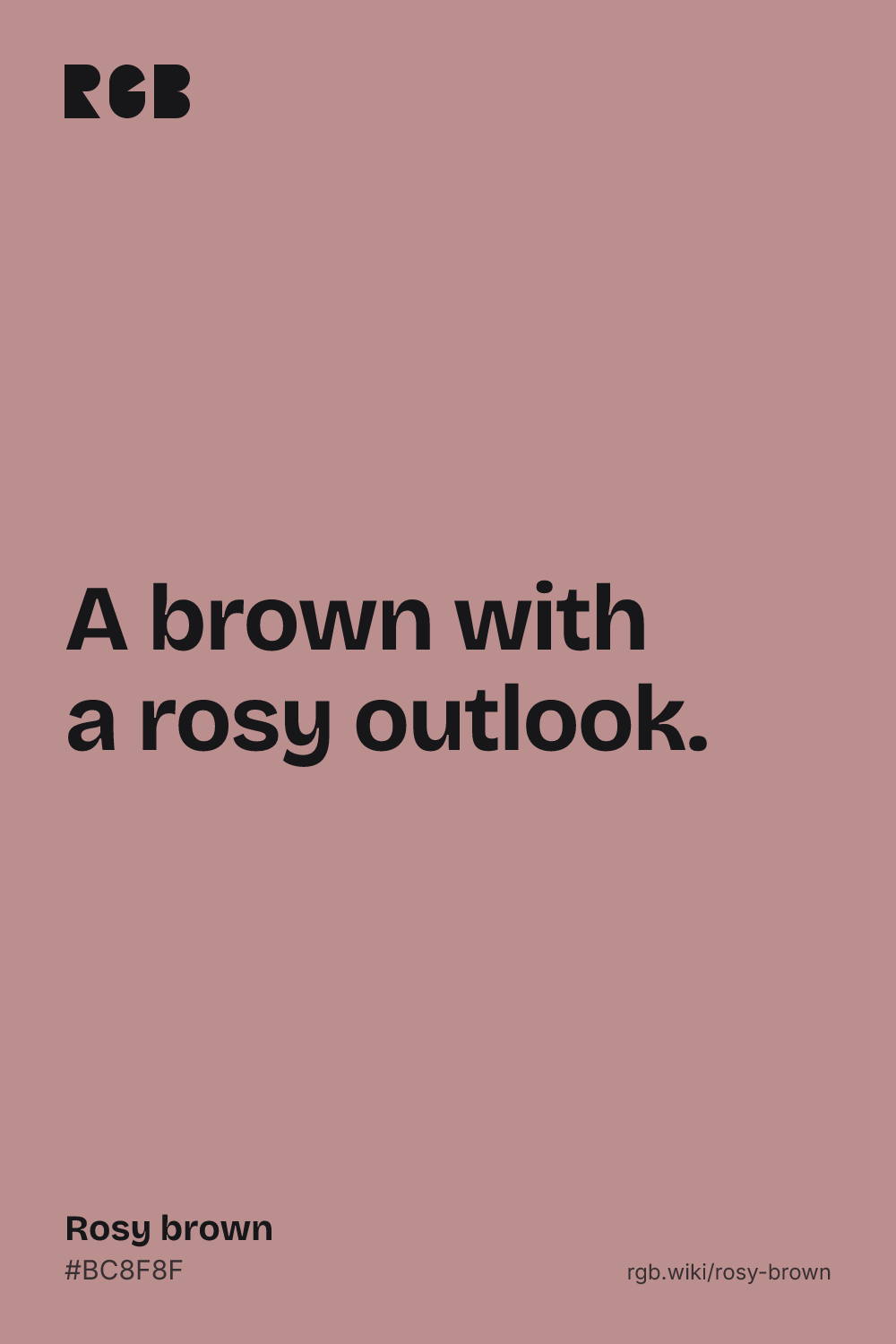
Rosy brown is a soft, grayish pink brown, like dried rose petals or an old suede glove. Its code is #BC8F8F: red at about 74%, green and blue equal at about 56%. Because green and blue are equal, its hue sits exactly on red, at 0°. What makes it look brown rather than pink is the gray: its saturation is only 25%, so the red is muted and dusty.
The name is the CSS keyword rosybrown. It isn’t in the X Window System’s first color list, from 1986, or in John Thomas’s 1989 list matched to crayons. Paul Raveling added it in his 1989 revision, as 188 143 143, placed in his spectrum between the goldenrods and indian red, with four numbered steps from a pale RosyBrown1, #FFC1C1, to a deep RosyBrown4, #8B6969. X11 Release 4 shipped it unchanged in December 1989, and the web adopted the list in 2001. No record says why he chose the name.
The name says brown, but other lists put this color with the roses and pinks. The closest center in the 1955 ISCC-NBS dictionary is “light grayish red”, #AD8884, the group for Maerz and Paul’s grecian rose and gloaming. In the xkcd color survey, the nearest names are grey pink and greyish pink. Its closest look-alike with a page here is dusty rose, #C08081. And swapping its numbers gives dark sea green, 143 188 143, an exact mirror on the green side.
On screens, rosy brown needs dark text: black on it has a contrast of about 7.5:1, white only about 2.8:1, too low even for large headings. It pairs well with navy, dark slate gray, cream and the other X11 browns, from tan to saddle brown.