Cobalt blue

A deep, vivid blue named after the metal that has colored glass and porcelain for thousands of years.

Overview

Cobalt blue is a deep, vivid blue. Its usual web code is #0047AB: no red, a little green and strong blue, a few steps brighter than navy.

The name comes from cobalt, a metal whose compounds have colored glass and ceramics blue for more than 3,000 years. The pure pigment, cobalt aluminate, was invented in France in 1803, and Monet was painting with it by the 1870s.

The real thing varies. Cobalt on old porcelain fires to a dark, inky blue, and dictionaries describe cobalt blue as a strong greenish blue. The web code has no official source; it is a cleaner, middle blue.

Cobalt blue works as a bold accent or a deep base color. It pairs well with orange, white, gold and sand.

HEX#0047AB
RGBrgb(0, 71, 171)
HSLhsl(215, 100%, 34%)
HSV215°, 100%, 67%
CMYK100, 58, 0, 33
OKLCHoklch(42.8% 0.172 259.7)
Every code converts from the HEX value #0047AB. #0047AB is the cobalt blue most color sites use, shown on Wikipedia since at least 2006 without a source. No color standard defines it. The 1955 ISCC-NBS dictionary files the cobalt blue of Maerz and Paul’s A Dictionary of Color (1930) as a strong greenish blue, and Merriam-Webster defines the color the same way. CMYK is a screen-based estimate; print results vary.
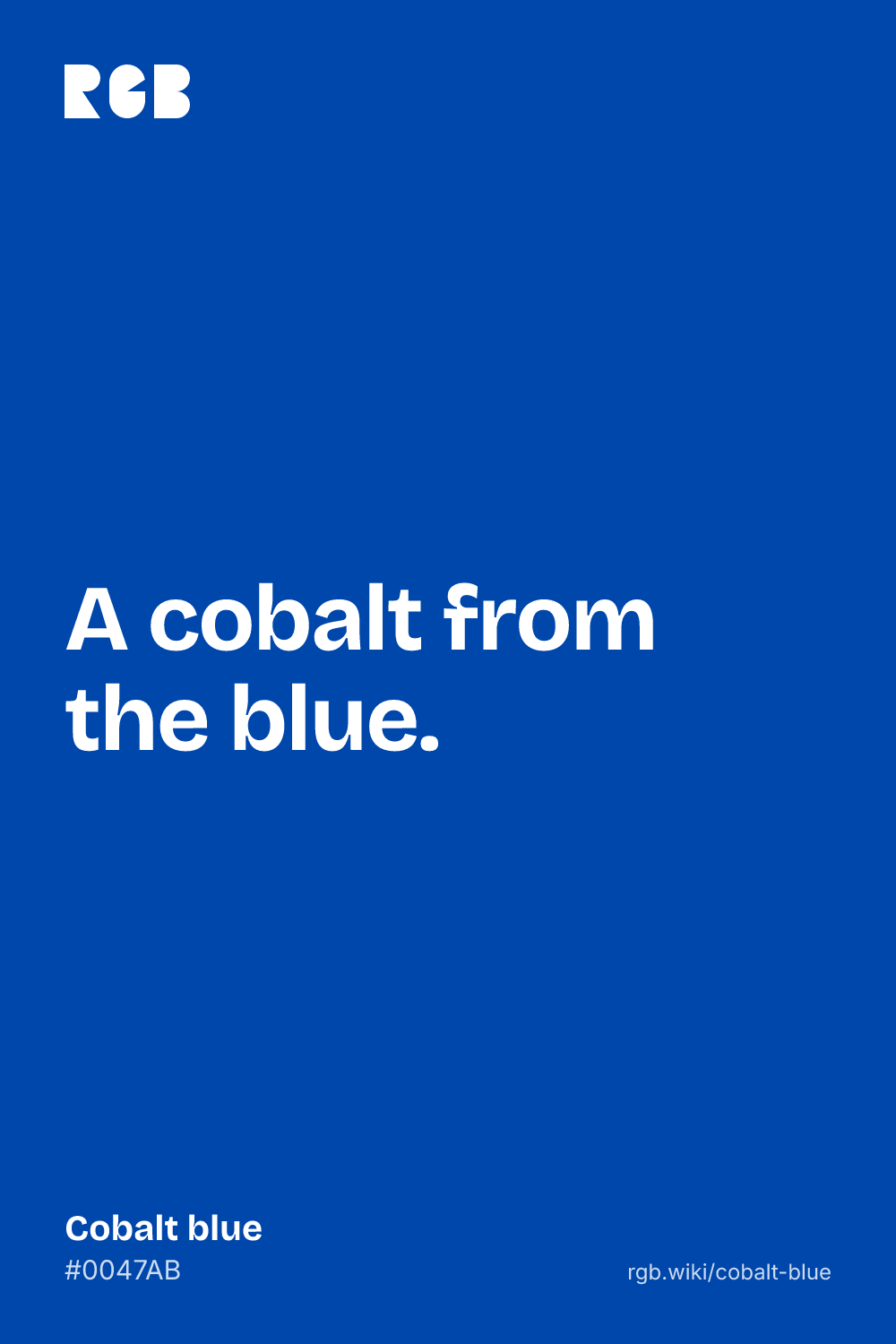
Cobalt blue color card, hex #0047AB: “A cobalt from the blue”

Cobalt blue on the color map

People’s average cobalt blue in the xkcd survey is darker and almost pure blue, at the bottom edge of the outline. The dictionary’s cobalt blue sits far to the left, near the edge of this view, among the greenish blues. The outline is an approximate range, not a measured one.

Shades and tints

Tints with white

Shades with black

Tones with gray

Cobalt blue sits in the middle. Tints add white, shades add black and tones add gray, in 10% steps out from it. Tap any swatch to copy its code.

Light and dark cobalt blue

#B2C8E6
Pale cobaltMixed 70% with white. A soft, cool blue for backgrounds.
#6691CD
Light cobaltMixed 40% with white. A clear mid blue.
#0047AB
Cobalt blueThe reference color.
#003399
SmaltGround cobalt glass, the cobalt pigment painters used before cobalt blue. See smalt
#002B67
Dark cobaltMixed 40% with black. Close to navy.

Colors that go with cobalt blue

Pairings that work in rooms, outfits and interfaces.

Cobalt and orange

Near-opposites. Bold, sporty and full of energy.

Cobalt and white

The blue-and-white of porcelain. Crisp and timeless.

Cobalt and gold

Rich and formal. Good for invitations and awards.

Cobalt and blush

Strong blue softened by pink. Modern and fresh.

Cobalt and lemon

Bright and loud. Works for sport and children’s brands.

Cobalt and sand

Warm meets cool. Relaxed, like a Mediterranean terrace.

Color-wheel palettes

Pick a palette to see where its colors sit on the color wheel. The caret marks cobalt blue. Tap a band to copy its code.

Similar colors

Cobalt blueSapphire81%YInMn blue70%Smalt71%International Klein Blue72%Egyptian blue78%Persian blue80%

Lined up by hue around cobalt blue. Hover a color to see how similar it is.The bar under each name shows how similar it is. Similarity comes from the distance between the two colors in OKLab, a model of how we see color.

Cobalt blue vs royal blue

Cobalt blue#0047AB · hue 215°
  • Darker and deeper
  • Named after a metal and its pigment
  • No official web code
Royal blue#4169E1 · hue 225°
  • Lighter and brighter
  • Leans a little toward violet
  • A CSS keyword, royalblue

Meaning

  • Glass
  • Porcelain
  • Painting
  • Chemistry
  • Flags

Cobalt blue feels clear, deep and confident: brighter than navy, darker than sky blue. Its meanings come from the material. Cobalt has colored glass since ancient Egypt and porcelain since medieval China, and painters took up the pure pigment in the 1800s as a cheaper, sturdier blue. It also flies on several flags. As with most named colors, mood research tests broad hues such as blue, not cobalt blue itself.

Invented to rival ultramarine

Historical record

In 1803 the French chemist Louis Jacques Thénard wrote that ultramarine had become so rare it cost more than its weight in gold, and that skies painted with Prussian blue soon turned green. Working from the cobalt blue on Sèvres porcelain, he fired a cobalt salt with alumina and got a blue he called as beautiful as ultramarine.1
Traded across Asia for its blue

Museum records

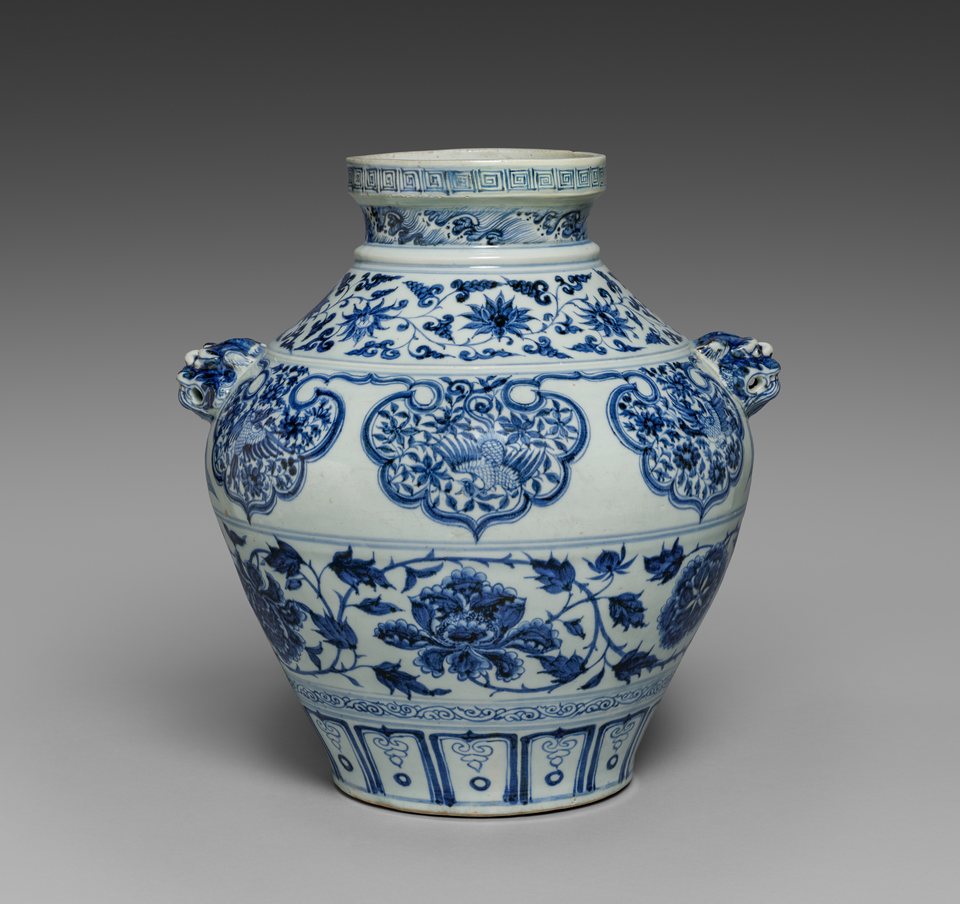
Potters in Basra, in today’s Iraq, were painting with cobalt blue on white glaze in the 800s. By the 1330s, porcelain makers at Jingdezhen in China were importing cobalt from Iran for blue-and-white ware made for the court, ordinary buyers and overseas trade.2, 3

Written into flag laws

Official documents

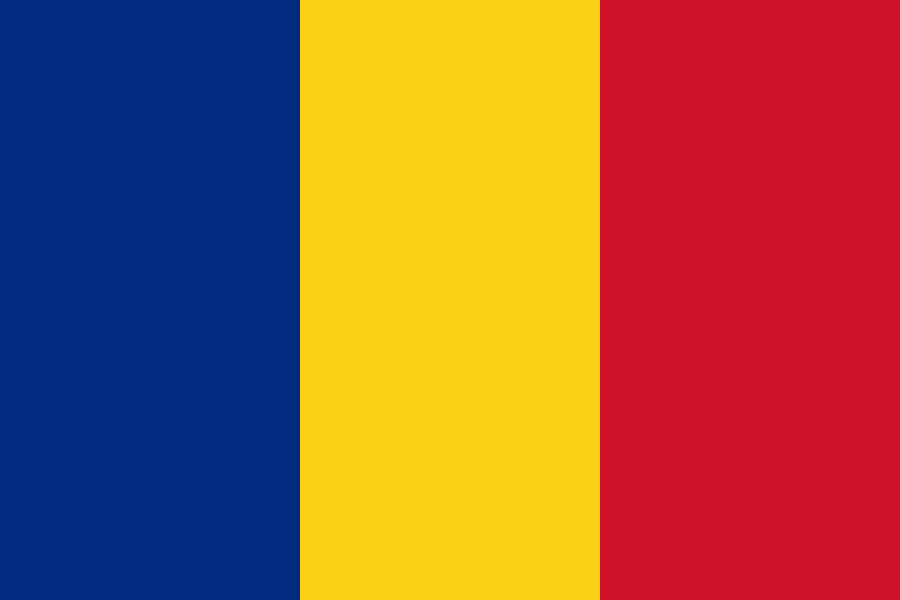
Nevada’s flag law asks for a field of “solid cobalt blue”, and the Dutch royal house describes the blue of the Netherlands flag as cobalt blue. Romania’s flag law named cobalt blue until 2023, when it switched to exact codes: its blue is now #002B7F, much darker than the web’s cobalt.4, 5, 6, 7

Sources (7)
  1. Thénard, L. J. (1803). Considérations générales sur les couleurs, suivies d’un procédé pour préparer une couleur bleue aussi belle que l’outremer. Journal des Mines, 15 (86), 128–136. PDF.
  2. Cleveland Museum of Art, “Dish with Splashes of Green”, Iraq, Basra, 830–900 (1915.304).
  3. Cleveland Museum of Art, “Jar with Lion-Head Handles”, China, Jingdezhen, Yuan dynasty, 1300s (1962.154).
  4. Nevada Revised Statutes, NRS 235.020, State flag (from a 1929 act).
  5. Royal House of the Netherlands, “Dutch flag”.
  6. Flags of the World, “Romania: flag law”, on Annex 1 of Law No. 75 of 1994.
  7. Romania, Law No. 176 of 19 June 2023, amending Law No. 75 of 1994, Annex 1.

History

Cobalt colored glass more than 3,000 years ago, long before anyone knew it was a metal. The pure pigment is a French invention of the early 1800s.

  1. About 1350 BCE

    Egyptian craftsmen inlay statues and objects with deep blue cobalt glass. The cobalt probably came from ores in Iran.1, 2

  2. 1300s

    By the 1330s, potters at Jingdezhen, China, paint porcelain with cobalt imported from Iran, making blue-and-white ware for home and for export.3

  3. 1739

    Swedish chemist Georg Brandt publishes his proof that the blue comes from a new metal. It is named cobalt, after the German word for a goblin that miners blamed for the troublesome ore.4

  4. 1777

    First recorded use of “cobalt blue” as a color name in English.5

  5. 1803

    Louis Jacques Thénard publishes his cobalt blue, made by firing a cobalt salt with alumina. Production starts in France in 1807.6, 7

  6. 1877

    Monet paints the Gare Saint-Lazare in Paris with cobalt blue, alongside the new cerulean blue.8

  7. 1929

    Nevada’s flag law calls for a field of “solid cobalt blue”.9

Sources (9)
  1. Cleveland Museum of Art, “Statuette of a Man”, Egypt, about 1391–1353 BCE, ebony inlaid with cobalt blue glass (1983.98).
  2. Wood, J. R. & Hsu, Y.-T. (2019). An archaeometallurgical explanation for the disappearance of Egyptian and Near Eastern cobalt-blue glass at the end of the Late Bronze Age. Internet Archaeology, 52. doi:10.11141/ia.52.3
  3. Cleveland Museum of Art, “Jar with Lion-Head Handles”, China, Jingdezhen, Yuan dynasty, 1300s (1962.154).
  4. Royal Society of Chemistry, “Cobalt”, Periodic Table, history section.
  5. Wikipedia, “Cobalt blue”, citing Maerz and Paul’s A Dictionary of Color (1930).
  6. Thénard, L. J. (1803). Considérations générales sur les couleurs, suivies d’un procédé pour préparer une couleur bleue aussi belle que l’outremer. Journal des Mines, 15 (86), 128–136. PDF.
  7. WebExhibits, “Cobalt blue: history”, Pigments through the Ages.
  8. Roy, A. (1985). The palettes of three Impressionist paintings. National Gallery Technical Bulletin, 9. National Gallery, London.
  9. Nevada Revised Statutes, NRS 235.020, State flag (from a 1929 act).

Cobalt blue in use

All brand colors
A round porcelain jar with two small lion-head handles, painted in deep blue on white with phoenix panels, peony scrolls and a band of petals at the base
#1A2C47#3A506B#637585#B4BEBB
CeramicsJar with lion-head handles (1300s)

A classic piece of Yuan dynasty blue-and-white porcelain from Jingdezhen, now at the Cleveland Museum of Art. Its cobalt came from Iran. Fired under the glaze, it turned a dark, grayish blue: the same hue as the web code, but much deeper.

#1A2C47#3A506B#637585#B4BEBB
Source: Cleveland Museum of Art
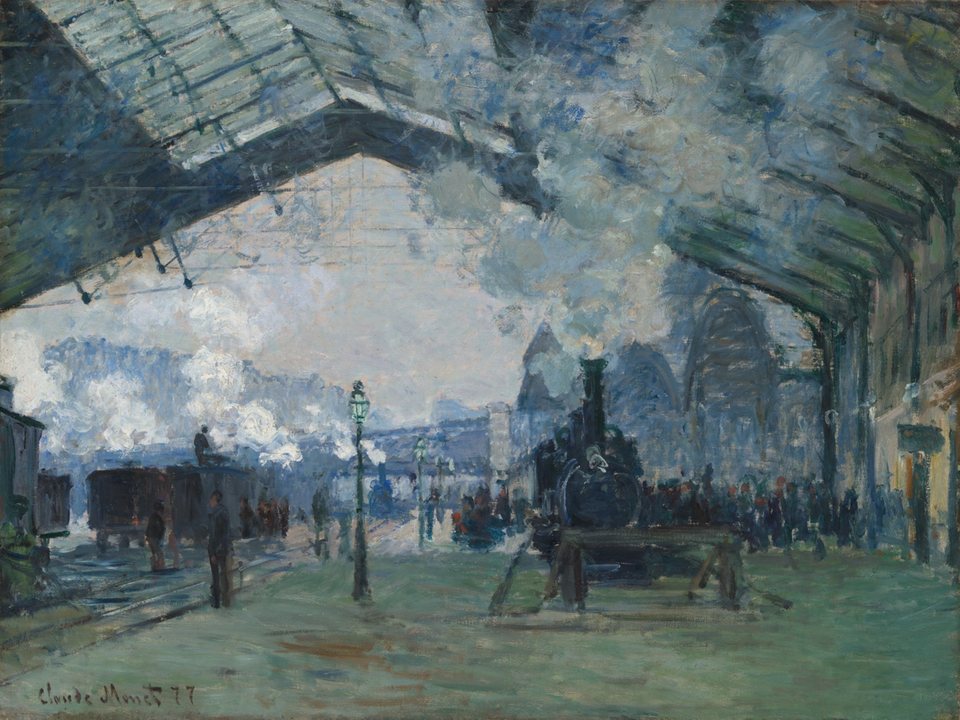
Monet’s painting of a steam train arriving under the glass and iron roof of a Paris station, filled with blue-gray steam and smoke
#303D41#495B5A#818F92#ADB3B5
PaintingArrival of the Normandy Train (1877)

One of Claude Monet’s paintings of the Gare Saint-Lazare in Paris, at the Art Institute of Chicago. The museum’s analysis found cobalt blue and ultramarine in it. Mixed with white and other colors, they become the soft blue-grays of steam and iron, far from the web’s bright cobalt.

#303D41#495B5A#818F92#ADB3B5
Source: Art Institute of Chicago
#00549A
BrandingBell

The Canadian carrier’s blue, #00549A, is a little lighter, softer and greener than this page’s code. It is the main color of Bell’s website.

#00549A
Source: Bell site CSS

Logos belong to their owners and are shown unaltered, only to show where each palette comes from. Palettes are sampled in-house.

Questions

What color is cobalt blue?

A deep, vivid blue. The usual web code is #0047AB (RGB 0, 71, 171).

Where does the code #0047AB come from?

No standard defines it. It became the usual code through Wikipedia and color sites. Real cobalt pigments vary, and dictionaries describe cobalt blue as a strong greenish blue.

Is cobalt blue the same as royal blue?

No. Royal blue (#4169E1) is lighter and brighter, with a slight violet lean. Cobalt blue is darker and deeper.

What colors go with cobalt blue?

Orange for strong contrast, white for the classic blue-and-white look, gold for something formal, and sand or blush to soften it.

Why is it called cobalt blue?

After cobalt, the metal in the pigment. The metal’s name comes from the German word for a goblin: miners blamed goblins for the troublesome ore.

Which flags are cobalt blue?

Nevada’s flag law asks for “solid cobalt blue”, and the Dutch royal house describes the Netherlands flag’s blue as cobalt blue. Romania’s flag law named cobalt blue until 2023, when it set exact codes instead.